Magnetism: Superposition of Magnetic Fields, Example No. 1
TL;DR
Magnetic fields from current carrying wires can be calculated using the superposition principle, where the fields from multiple wires are added up.
Transcript
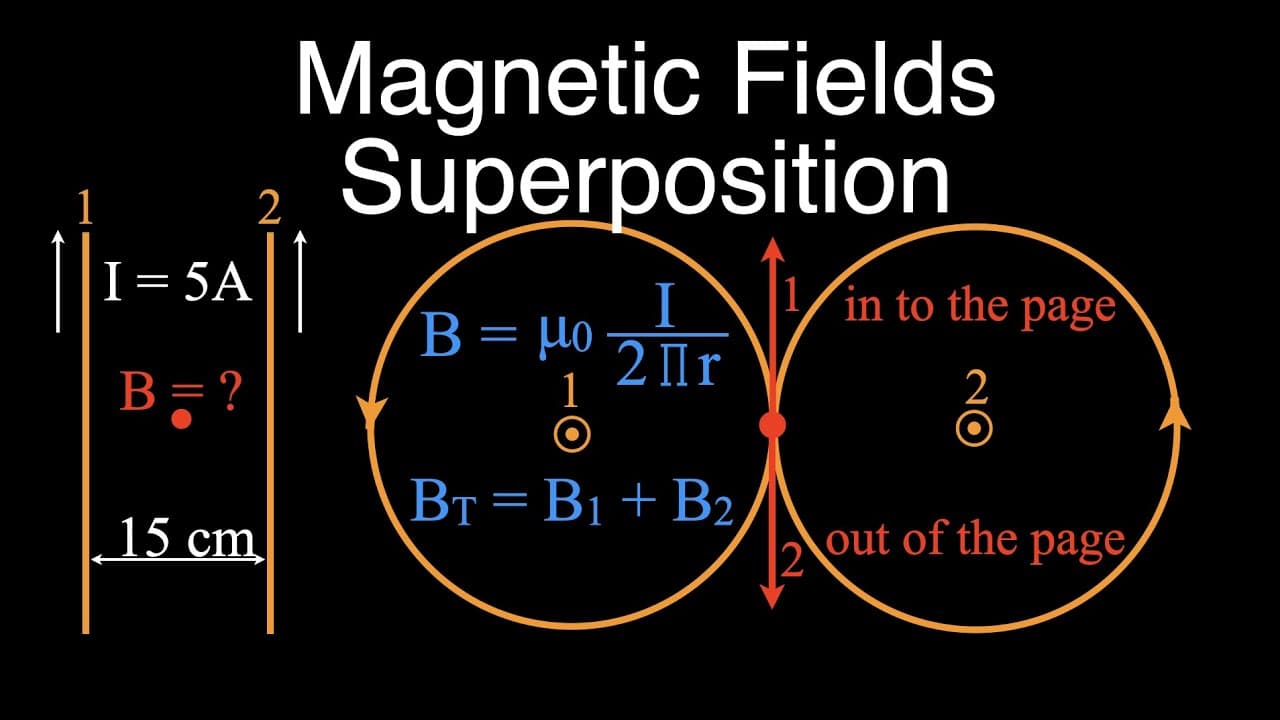
in today's video we are going to do an example problem for magnetic fields from current carrying wires and in this case we have more than one wire with the current through it so we're going to have more than one magnetic field so we're going to be talking about superposition so we have to add up at any given point both of those magnetic fields to d... Read More
Key Insights
- 🏑 The superposition principle is used to calculate magnetic fields from current carrying wires.
- 🏑 The direction of the current determines the direction of the magnetic field.
- 😃 The magnitude of the magnetic field can be found using the formula B = μ0 * I / (2πr).
- 💐 When currents flow in opposite directions, the magnetic fields can reinforce each other.
- 🏑 The magnetic field at a point can be zero if the fields from multiple wires cancel each other out.
- 🫱 The right hand rule is a useful tool for determining the direction of the magnetic field.
- 😥 The distance between the wires and the point of interest affects the magnitude of the magnetic field.
Install to Summarize YouTube Videos and Get Transcripts
Explore YouTube Video Summarizer or Get YouTube Transcript Extractor
Questions & Answers
Q: How are the magnetic fields from multiple wires calculated?
The magnetic fields from multiple wires are calculated using the superposition principle, which involves adding up the fields from each individual wire.
Q: What is the formula used to calculate the magnetic field from a current carrying wire?
The formula used is B = μ0 * I / (2πr), where B is the magnetic field strength, μ0 is the permeability of free space, I is the current, and r is the distance from the wire to the point of interest.
Q: How does the direction of the current affect the magnetic field?
The direction of the current determines the direction of the magnetic field. Using the right hand rule, the magnetic field is found to be counterclockwise when the current flows out of the page and clockwise when it flows into the page.
Q: What happens to the magnetic field when the currents flow in opposite directions?
When the currents flow in opposite directions, the magnetic fields from the wires add up. In this example, the fields point in the same direction, resulting in a larger overall field.
Summary & Key Takeaways
-
The video presents an example problem of calculating the magnetic field at a point between two wires carrying current.
-
Two cases are considered: one where the currents flow in the same direction and one where they flow in opposite directions.
-
The magnitude and direction of the magnetic field from each wire are determined using the right hand rule, and then the fields are added up.
Read in Other Languages (beta)
Share This Summary 📚
Summarize YouTube Videos and Get Video Transcripts with 1-Click
Try YouTube Summary with ChatGPT & Claude or YouTube Transcript Generator
Explore More Summaries from Step by Step Science 📚


Summarize YouTube Videos and Get Video Transcripts with 1-Click
Try YouTube Summary with ChatGPT & Claude or YouTube Transcript Generator