Where Are the Voyagers Now? Remembering the Amazing Voyager Missions
TL;DR
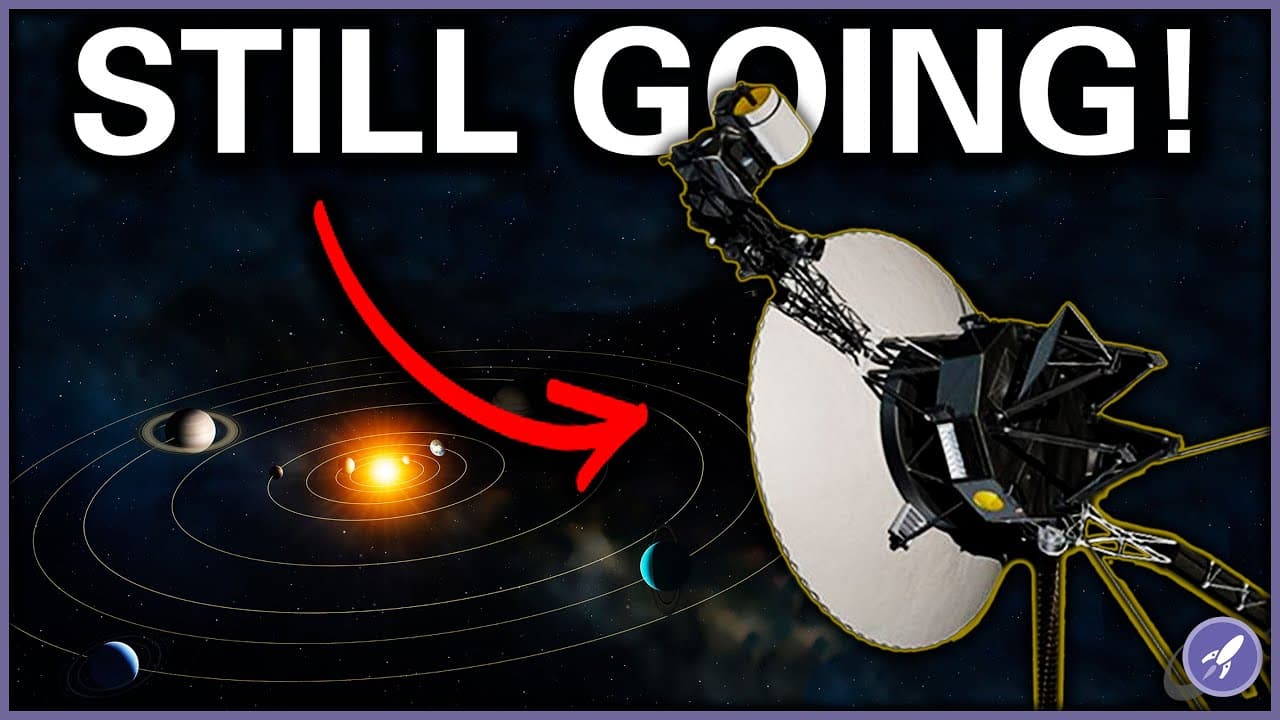
The Voyager missions, launched in the 1970s, explored Jupiter, Saturn, Uranus, and Neptune, discovering new moons, rings, and atmospheric features.
Transcript
Many people remember exactly where they were when humans first set foot on the Moon. But for those of us born after 1969, we’ve got to hang on to other epic moments in spaceflight history. I vividly remember watching the first launch of the space shuttle in 1981 when I was 9 years old, and I remember when NASA’s Voyager spacecraft swept past each o... Read More
Key Insights
- 🚠 The Voyager missions were able to take advantage of a rare alignment of the giant planets in the Solar System.
- ❓ The Voyagers provided valuable data on the composition, atmospheres, and structures of Jupiter, Saturn, Uranus, and Neptune.
- 🥮 The spacecraft made groundbreaking discoveries, including active volcanoes on a moon and subsurface oceans on multiple moons.
- 👾 The Voyagers are the farthest human-made objects in the Solar System and are still contributing to scientific knowledge even after almost 40 years in space.
Install to Summarize YouTube Videos and Get Transcripts
Explore YouTube Video Summarizer or Get YouTube Transcript Extractor
Questions & Answers
Q: What were the main objectives of the Voyager missions?
The main objectives were to study the giant planets in the Solar System, their moons, rings, and magnetospheres, and to gather scientific data on their compositions and atmospheric features.
Q: How long has it been since the Voyager missions were launched?
The Voyager missions were launched in the early 1970s, making it nearly 40 years since they began their journey.
Q: What were some of the major discoveries made by the Voyager spacecraft?
The Voyagers discovered active volcanoes on Jupiter's moon Io, subsurface oceans on Europa and Ganymede, the hexagonal vortex at Saturn's north pole, unique features of Uranus such as its corkscrew-shaped magnetosphere, and the fast winds and storms on Neptune.
Q: What is the current status of the Voyager spacecraft?
The Voyager spacecraft are still operational, although their power supply is dwindling. They have entered interstellar space and continue to emit weak signals back to Earth.
Summary & Key Takeaways
-
The Voyager missions, launched in the early 1970s, aimed to explore the giant planets in the Solar System: Jupiter, Saturn, Uranus, and Neptune.
-
Voyager 1 and Voyager 2 visited Jupiter and Saturn, with Voyager 2 also visiting Uranus and Neptune.
-
The spacecraft made numerous discoveries, including active volcanoes on Jupiter's moon Io, subsurface oceans on Europa and Ganymede, and storms and moons around Saturn, Uranus, and Neptune.
Read in Other Languages (beta)
Share This Summary 📚
Summarize YouTube Videos and Get Video Transcripts with 1-Click
Try YouTube Summary with ChatGPT & Claude or YouTube Transcript Generator
Explore More Summaries from Fraser Cain 📚




Summarize YouTube Videos and Get Video Transcripts with 1-Click
Try YouTube Summary with ChatGPT & Claude or YouTube Transcript Generator