What Are Policy Gradient Methods in Reinforcement Learning?
TL;DR
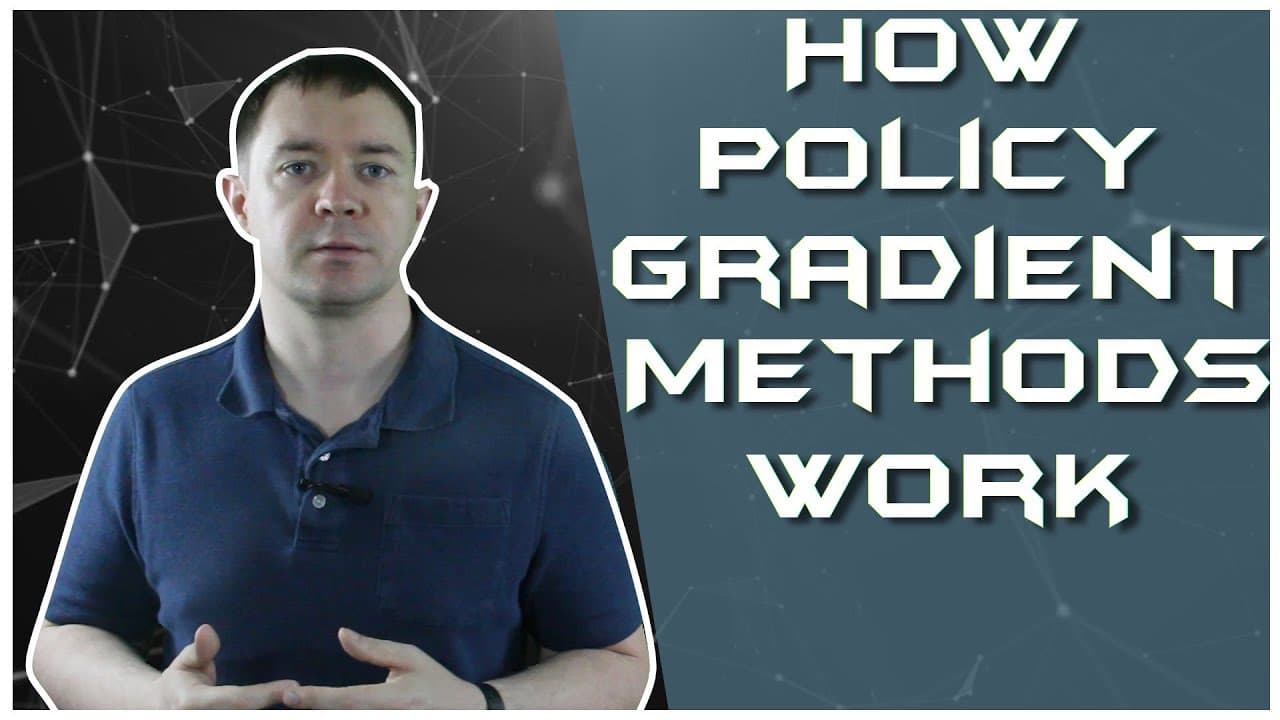
Policy gradient methods use deep neural networks to approximate an agent's policy and update it based on observed rewards, focusing on maximizing performance over time. While these methods face challenges like sample inefficiency and variability between episodes, they can achieve competitive results in reinforcement learning by employing techniques like reward scaling and batch updates.
Transcript
in this video I'm going to tell you everything you need to know to start solving reinforcement learning problems with policy gradient methods I'm gonna give you the algorithm and the lamentation details upfront and then we'll go into how it all works and why you would want to do it let's get to it so here's a basic idea behind policy creating metho... Read More
Key Insights
- 😒 Policy gradient methods use deep neural networks to approximate an agent's policy in reinforcement learning.
- 🏋️ The goal is to maximize the agent's performance over time by updating the weights of the neural network using gradient ascent.
- ♻️ Policy gradient methods can be more efficient in certain environments than other reinforcement learning algorithms, such as deep Q learning.
- ❓ Sample inefficiency and variations between episodes are challenges in policy gradient methods, but can be addressed with reward scaling and batch updates.
- 💨 Policy gradient methods provide a way to approach a deterministic policy over time, even though they are stochastic.
- 🐎 The trade-off between sample efficiency and convergence speed can be controlled by adjusting the batch size for updates in policy gradient methods.
Install to Summarize YouTube Videos and Get Transcripts
Explore YouTube Video Summarizer or Get YouTube Transcript Extractor
Questions & Answers
Q: What is the main idea behind policy gradient methods?
Policy gradient methods use deep neural networks to approximate an agent's policy, which is a probability distribution for selecting actions based on observed rewards.
Q: How are the weights of the neural network updated in policy gradient methods?
The weights of the neural network are updated using gradient ascent, where the new weights equal the old weights plus a learning rate multiplied by the gradient of the performance metric. This allows the agent to learn actions with high expected future returns.
Q: What are the shortcomings of policy gradient methods?
Policy gradient methods suffer from sample inefficiency, as the agent resets its memory at the start of each episode, discarding previous experience. Additionally, there can be large variations between episodes, leading to different actions and future returns.
Q: How can the issues of sample inefficiency and variations between episodes be addressed?
Sample inefficiency can be tackled by scaling rewards with a baseline, such as the average reward from an episode, and further normalizing the gradient factor. Variations between episodes can be controlled by allowing the agent to play a batch of games before updating the neural network weights.
Summary & Key Takeaways
-
Policy gradient methods use deep neural networks to approximate an agent's policy and update it based on observed rewards.
-
The agent's policy is a probability distribution used to select actions, and the goal is to maximize performance over time.
-
Policy gradient methods suffer from sample inefficiency and variations between episodes, but these issues can be mitigated using techniques like reward scaling and batch updates.
Read in Other Languages (beta)
Share This Summary 📚
Summarize YouTube Videos and Get Video Transcripts with 1-Click
Try YouTube Summary with ChatGPT & Claude or YouTube Transcript Generator
Explore More Summaries from Machine Learning with Phil 📚




Summarize YouTube Videos and Get Video Transcripts with 1-Click
Try YouTube Summary with ChatGPT & Claude or YouTube Transcript Generator