Titrations of polyprotic acids | Acids and bases | AP Chemistry | Khan Academy
TL;DR
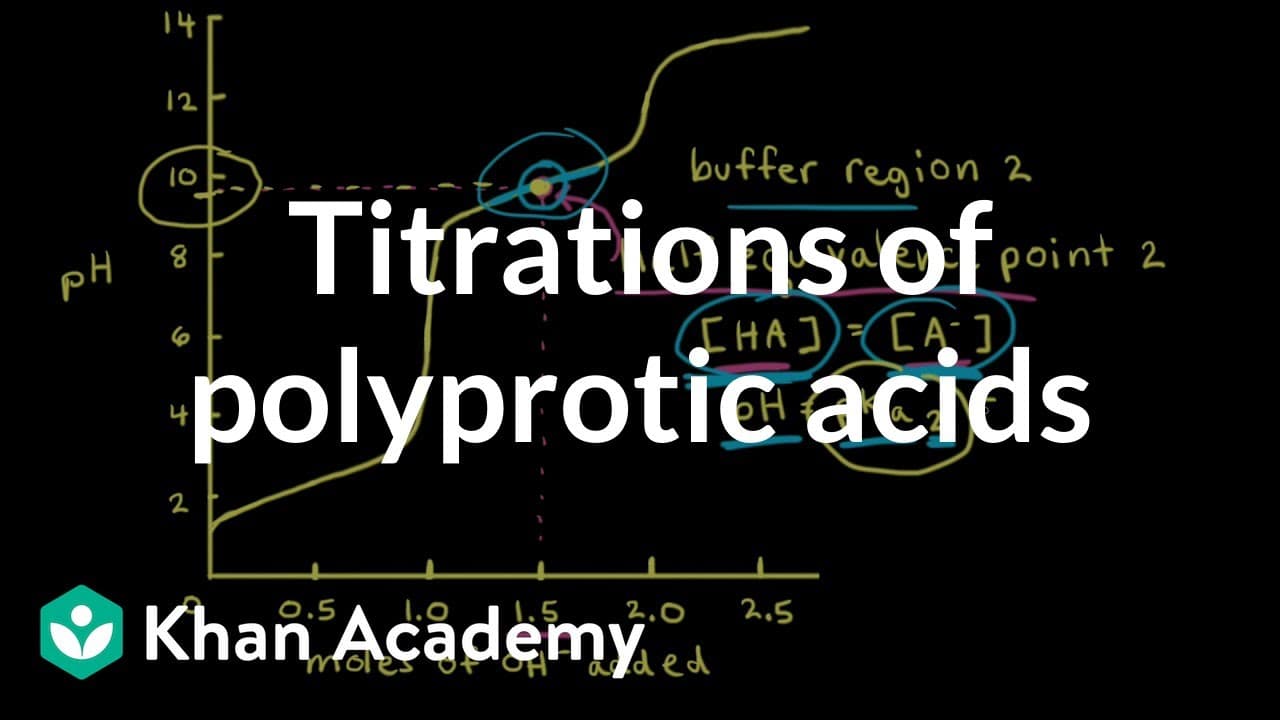
This video explains the concept of polyprotic acids and demonstrates how to interpret titration curves for a diprotic acid.
Transcript
- [Instructor] A polyprotic acid is an acid with more than one proton that it can donate in solution. An example of a polyprotic acid is the protonated form of the amino acid alanine. Here's a dot structure showing the protonated form of the amino acid alanine, and we can represent this as H2A plus. Let's say we're doing a titration with the proton... Read More
Key Insights
- ❓ Polyprotic acids can donate multiple protons in solution, like the diprotic acid alanine.
- 😥 Titration curves help visualize the change in pH during the addition of a base to a diprotic acid.
- 😥 Equivalence points on the titration curve indicate the complete neutralization of the acid.
- 😥 Buffers are formed at the half-equivalence points, where the concentrations of the weak acid and its conjugate base are equal.
- 😥 The Henderson-Hasselbalch equation is used to calculate the pH at the half-equivalence points, which corresponds to the pKa values of the acidic protons.
Install to Summarize YouTube Videos and Get Transcripts
Explore YouTube Video Summarizer or Get YouTube Transcript Extractor
Questions & Answers
Q: What is a polyprotic acid?
A polyprotic acid is an acid that can donate more than one proton in solution. Examples include amino acids and sulfuric acid.
Q: How does the protonated form of alanine behave in a titration?
The protonated form of alanine has two acidic protons. When sodium hydroxide is added, the hydroxide ions neutralize one proton to form water, converting the protonated form of alanine into the neutral form.
Q: What is an equivalence point in a titration curve?
An equivalence point is the point in a titration where the moles of the acid or base being titrated are stoichiometrically equivalent to the moles of the added titrant.
Q: How can the pKa values be determined from the titration curve?
The pKa values for the acidic protons can be determined by finding the half-equivalence points on the titration curve and correlating them with the pH values.
Summary & Key Takeaways
-
A polyprotic acid is an acid that can donate more than one proton in solution.
-
The protonated form of the amino acid alanine is an example of a diprotic acid.
-
Titration curves illustrate the change in pH during the addition of sodium hydroxide to the diprotic acid solution.
Read in Other Languages (beta)
Share This Summary 📚
Summarize YouTube Videos and Get Video Transcripts with 1-Click
Try YouTube Summary with ChatGPT & Claude or YouTube Transcript Generator
Explore More Summaries from Khan Academy 📚





Summarize YouTube Videos and Get Video Transcripts with 1-Click
Try YouTube Summary with ChatGPT & Claude or YouTube Transcript Generator