Products
Features
YouTube Video Summarizer
Summarize YouTube videos
Web & PDF Highlighter
Highlight web pages & PDFs
Chat with PDF
Ask any PDF questions with AI
Ask AI Clone
Chat with your highlights & memories
Audio Transcriber
Transcribe audio files to text
Glasp Reader
Read and highlight articles
Kindle Highlight Export
Export your Kindle highlights
Idea Hatch
Hatch ideas from your highlights
Integrations
Obsidian Plugin
Notion Integration
Pocket Integration
Instapaper Integration
Medium Integration
Readwise Integration
Snipd Integration
Hypothesis Integration
Apps & Extensions
Chrome Extension
Safari Extension
Edge Add-ons
Firefox Add-ons
iOS App
Android App
Discover
Discover
Ideas
Discover new ideas and insights
Articles
Curated articles and insights
Books
Book recommendations by great minds
Posts
Essays and notes from readers
Quotes
Inspiring quotes collection
Videos
Curated videos and summaries
Explore Glasp
Glasp Newsletter
Weekly insights and updates
Glasp Talk
Interview series with great minds
Glasp Blog
Latest news and articles
Glasp Use Cases
Learn how others use Glasp
Build & Support
Glasp API
Access Glasp's API for developers
MCP Connector
Connect Glasp to Claude & ChatGPT
Community
Glasp Reddit Community
Students
Student discount and benefits
FAQs
Frequently Asked Questions
AboutPricing
DashboardLog inSign up

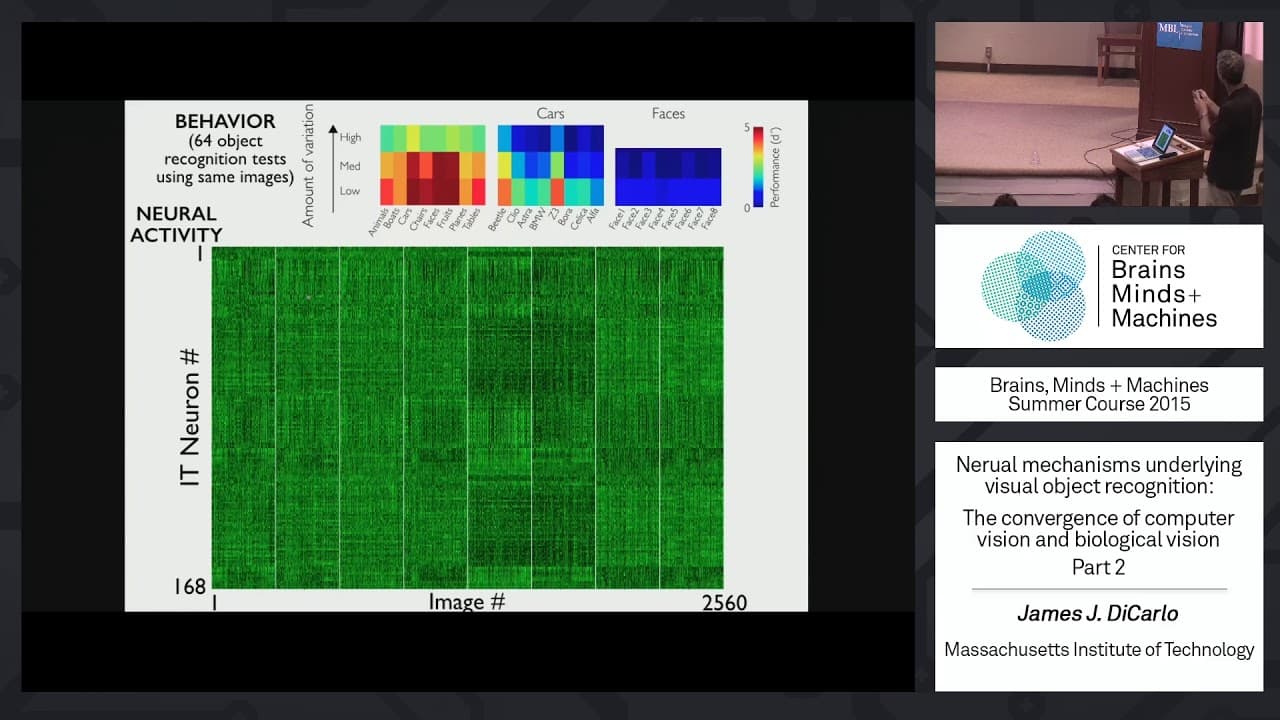
Lecture 1.4: Neural Mechanisms of Recognition, Part 2
April 3, 2018
by
MIT OpenCourseWare
YouTube video player
Lecture 1.4: Neural Mechanisms of Recognition, Part 2

TL;DR

A deep convolutional network model, optimized for invariant object recognition tasks, can predict neural responses in the ventral stream and explain a significant portion of the neural response variance.

Transcript

The following content is provided under a Creative Commons license. Your support will help MIT OpenCourseWare continue to offer high quality educational resources for free. To make a donation, or view additional materials from hundreds of MIT courses, visit MIT OpenCourseWare at OCW.MIT.edu. JAMES DICARLO: I'm going to shift more towards this decod... Read More

Key Insights

  • 🎏 A deep convolutional network model optimized for invariant object recognition tasks can predict neural responses in the ventral stream.
  • 🎏 The model outperforms previous models in predicting neural responses, suggesting that it is a better fit for the ventral stream.
  • 🌥️ The models are optimized for specific tasks and have a large number of parameters that can be adjusted to improve performance.

Install to Summarize YouTube Videos and Get Transcripts

Explore YouTube Video Summarizer or Get YouTube Transcript Extractor

Questions & Answers

Q: How well can the deep convolutional network model predict neural responses in the ventral stream?

The model can predict a significant portion of the neural response variance, with an average R squared value of 0.5.

Q: How does the model compare to previous models in predicting neural responses?

The model outperforms previous models in predicting neural responses, suggesting that it is a better fit for the ventral stream.

Q: What tasks were the models optimized for?

The models were optimized for invariant object recognition tasks, which involve discriminating objects based on their identity across various transformations.

Q: Can the models be used to predict neural responses in other brain regions?

The models can be applied to other brain regions, but their performance may vary depending on the specific area and task being considered.

Summary & Key Takeaways

  • Optimal models of the ventral stream can predict neural responses in IT and V4 with significant accuracy.

  • The models are optimized for tasks of invariant object recognition.

  • The models outperform previous models in predicting neural responses.

  • These findings suggest that the encoding mechanisms in the models are similar to those in the ventral stream.


Read in Other Languages (beta)

English

Share This Summary 📚

Summarize YouTube Videos and Get Video Transcripts with 1-Click

Download browser extensions on:

Try YouTube Summary with ChatGPT & Claude or YouTube Transcript Generator

Explore More Summaries from MIT OpenCourseWare 📚
Seeing the Big Picture from Space with Astronaut Jeff Hoffman (S2:E4) thumbnail
Seeing the Big Picture from Space with Astronaut Jeff Hoffman (S2:E4)
MIT OpenCourseWare
L21.6 Example: The Distribution of a Busy Period thumbnail
L21.6 Example: The Distribution of a Busy Period
MIT OpenCourseWare
Introduction to Week 6 thumbnail
Introduction to Week 6
MIT OpenCourseWare
19. Roth's theorem II: Fourier analytic proof in the integers thumbnail
19. Roth's theorem II: Fourier analytic proof in the integers
MIT OpenCourseWare
L1.4 Fermions, Bosons, and Fields: Decays thumbnail
L1.4 Fermions, Bosons, and Fields: Decays
MIT OpenCourseWare
Lecture 9: Phonology, Part 2 thumbnail
Lecture 9: Phonology, Part 2
MIT OpenCourseWare

Summarize YouTube Videos and Get Video Transcripts with 1-Click

Download browser extensions on:

Try YouTube Summary with ChatGPT & Claude or YouTube Transcript Generator

Apps & Extensions

  • Chrome Extension
  • Safari Extension
  • Edge Add-ons
  • Firefox Add-ons
  • iOS App
  • Android App

Key Features

  • YouTube Video Summarizer
  • Web & PDF Summarizer
  • Web & PDF Highlighter
  • Chat with PDF
  • Ask AI Clone
  • Audio Transcriber
  • Glasp Reader
  • Kindle Highlight Export
  • Idea Hatch

Integrations

  • Obsidian Plugin
  • Notion Integration
  • Pocket Integration
  • Instapaper Integration
  • Medium Integration
  • Readwise Integration
  • Snipd Integration
  • Hypothesis Integration

More Features

  • APIs
  • MCP Connector
  • Blog & Post
  • Embed Links
  • Image Highlight
  • Personality Test
  • Quote Shots

Company

  • About us
  • Blog
  • Community
  • FAQs
  • Job Board
  • Newsletter
  • Pricing
Terms

•

Privacy

•

Guidelines

© 2026 Glasp Inc. All rights reserved.