L21.6 Example: The Distribution of a Busy Period
TL;DR
The first busy period in a Bernoulli process, which determines the length of time until an idle slot appears, follows a geometric distribution with parameter 1 minus p.
Transcript
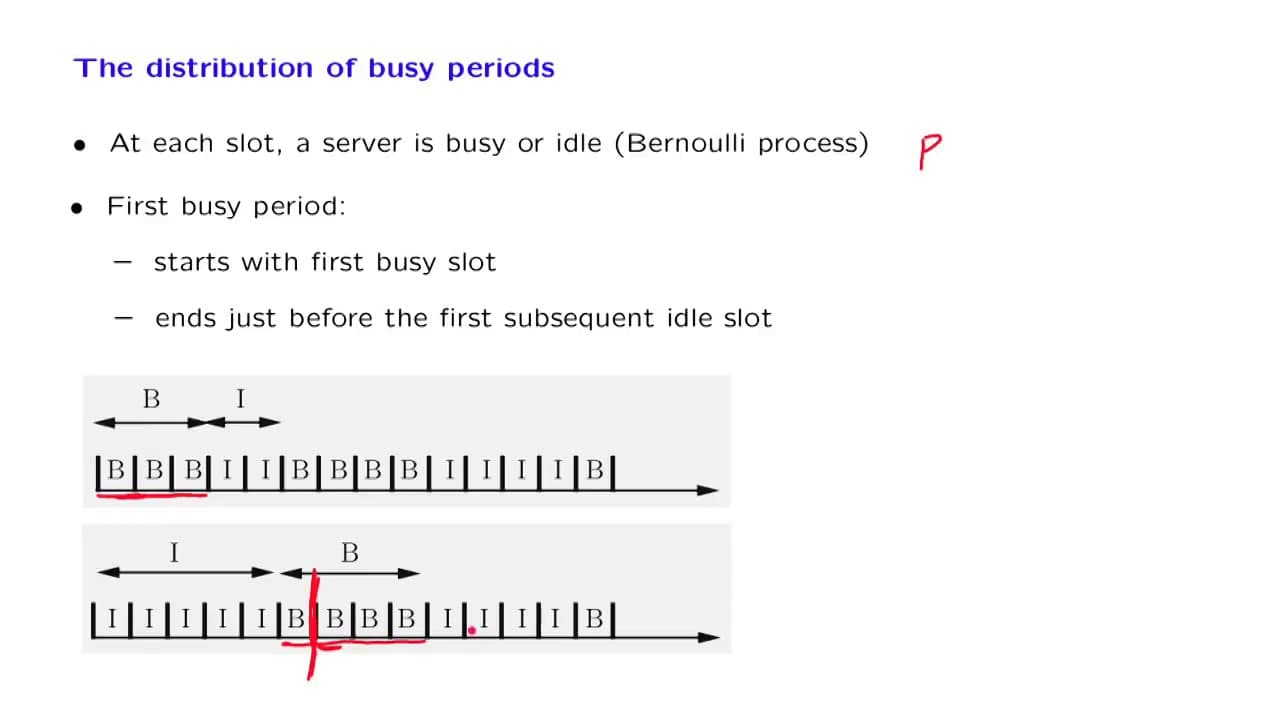
Here is an example of a problem related to the Bernoulli process, which can be tricky, but is actually easy to answer if one makes good use of the fresh-start property. Here is the setting. Time is discrete, divided into slots. We have a server that receives tasks to process. Tasks received gets processed in the same time slot. So slots are divided... Read More
Key Insights
- 🦥 Time in a Bernoulli process is divided into slots, with a probability p for job arrivals and independent slots.
- ❤️🩹 The first busy period starts with the first job arrival and ends before the next idle slot.
- ➖ The length of the first busy period follows a geometric distribution with parameter 1 minus p.
Install to Summarize YouTube Videos and Get Transcripts
Explore YouTube Video Summarizer or Get YouTube Transcript Extractor
Questions & Answers
Q: What is a Bernoulli process?
A Bernoulli process involves dividing time into slots, where there is a probability p for a job arrival and different slots are independent of each other.
Q: What is the first busy period?
The first busy period starts at the first slot with a job and ends just before the next idle slot, representing the length of time until the server becomes idle again.
Q: How is the first busy period related to a geometric distribution?
The length of the first busy period follows a geometric distribution with parameter 1 minus p, where each idle slot is considered a success and the parameter represents the probability of success.
Q: Why is the length of the first busy period the same as the shifted blue interval?
The red and blue intervals represent the length of time until the first idle slot, and their lengths are equal. Since the red interval represents the length of the first busy period, they have the same distribution.
Summary & Key Takeaways
-
The content explains the concept of a Bernoulli process, where time is divided into slots and a server processes tasks.
-
The first busy period is defined as the time between the first job arrival and the next idle slot.
-
The length of the first busy period follows a geometric distribution with parameter 1 minus p.
Read in Other Languages (beta)
Share This Summary 📚
Summarize YouTube Videos and Get Video Transcripts with 1-Click
Try YouTube Summary with ChatGPT & Claude or YouTube Transcript Generator
Explore More Summaries from MIT OpenCourseWare 📚


Summarize YouTube Videos and Get Video Transcripts with 1-Click
Try YouTube Summary with ChatGPT & Claude or YouTube Transcript Generator