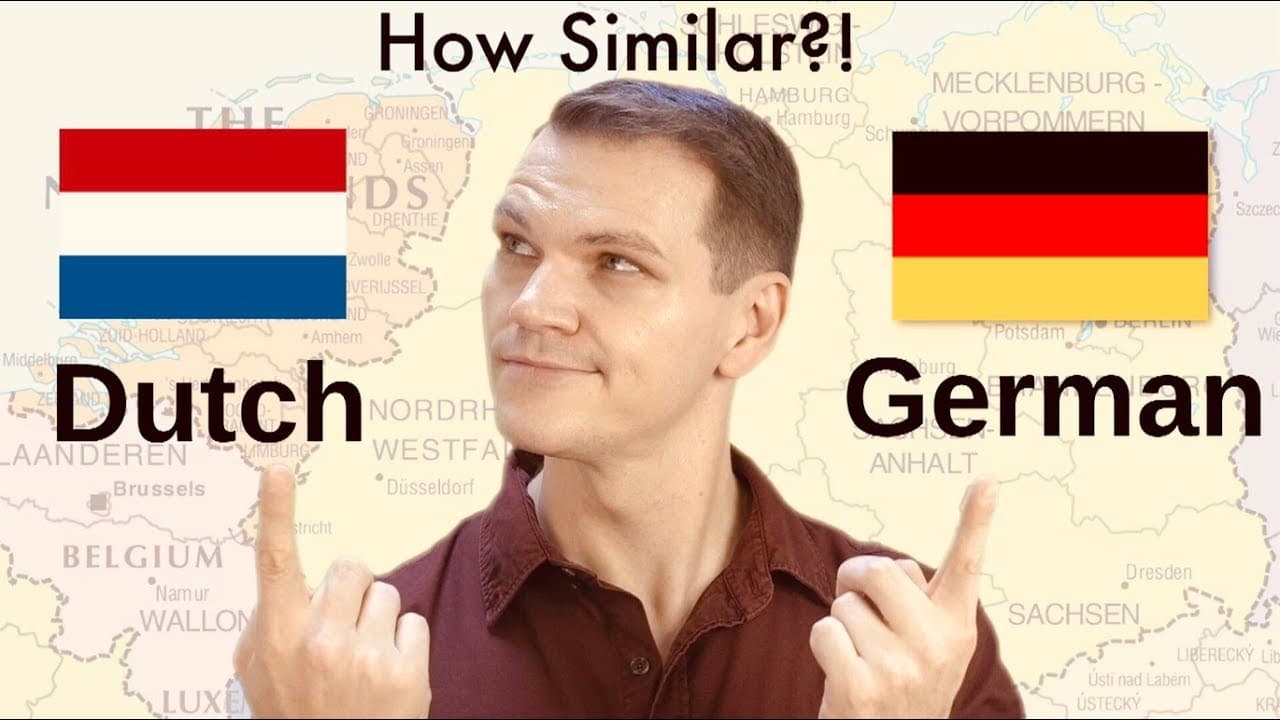
How Similar are German and Dutch?
TL;DR
German and Dutch share similarities but have distinct differences in vocabulary and pronunciation.
Transcript
hello everyone welcome to the Laing focused Channel and my name is Paul today we'll be answering the question how similar are German and Dutch wait what were those two languages again german dutch dutch nederlands flumps Dutch isn't it strange that English speakers call the language of the Netherlands and Flanders Dutch while German speakers call t... Read More
Key Insights
- German and Dutch are both part of the West Germanic branch, sharing a common ancestor, Proto-Germanic, but have evolved differently over time.
- The lexical similarity between Dutch and German is around 84%, meaning many words are cognates but may differ in form and pronunciation.
- Pronunciation differences arise from historical sound shifts, such as the High German consonant shift affecting German but not Dutch.
- German has three grammatical genders, while modern Dutch simplifies this to two, merging masculine and feminine into a common gender.
- German nouns have four cases affecting articles and adjectives, while Dutch has largely abandoned noun cases, simplifying its grammar.
- Word order in both languages often follows a V2 structure, but Dutch and German diverge in complex sentence constructions and auxiliary verb placement.
- False cognates exist between the languages, where words look similar but have different meanings, leading to potential confusion.
- German and Dutch speakers might understand each other's written language more easily than spoken due to dialectal variations and pronunciation differences.
Install to Summarize YouTube Videos and Get Transcripts
Explore YouTube Video Summarizer or Get YouTube Transcript Extractor
Questions & Answers
Q: What historical development caused pronunciation differences between German and Dutch?
The High German consonant shift, occurring between the 4th and 9th centuries, significantly altered German pronunciation. This shift did not affect Dutch, leading to distinct pronunciation differences between the two languages, particularly in consonants like 'p', 't', and 'k' becoming fricatives or affricates in German.
Q: How do German and Dutch differ in grammatical gender?
German maintains three grammatical genders: masculine, feminine, and neuter, which affect nouns, articles, and adjectives. In contrast, modern Dutch has simplified its gender system to two: common gender (merging masculine and feminine) and neuter, reducing complexity in grammatical agreement.
Q: What is the role of noun cases in German compared to Dutch?
German utilizes four noun cases: nominative, accusative, dative, and genitive, which influence the form of nouns, articles, and adjectives. Dutch historically had noun cases but has largely eliminated them from standard usage, simplifying sentence structure and reducing the need for case-based inflections.
Q: How do Dutch and German handle auxiliary verbs in complex sentences?
In complex sentences, Dutch typically moves auxiliary verbs to the end, maintaining the main verb's position. German, however, places auxiliary verbs after the main verb in subordinate clauses, reflecting differences in sentence construction and verb placement rules between the two languages.
Q: What are false cognates, and how do they affect German-Dutch comprehension?
False cognates are words that look similar in two languages but have different meanings. In German and Dutch, false cognates can lead to misunderstandings, as speakers might assume identical meanings. For example, 'zee' in Dutch means 'sea', while 'See' in German means 'lake'.
Q: Why might written German and Dutch be more mutually intelligible than spoken?
Written German and Dutch are often more mutually intelligible due to the visual similarity of cognates and the ability to process text at one's own pace. Dialectal variations and pronunciation differences in spoken language can obscure comprehension, making written forms easier to understand.
Q: How does the V2 word order manifest in German and Dutch?
Both German and Dutch typically follow a V2 word order, where the conjugated verb appears second in main clauses. However, in complex sentences with subordinate clauses, German often shifts the verb to the end, whereas Dutch maintains a more consistent verb placement, highlighting subtle syntactic differences.
Q: What impact does the simplification of Dutch grammar have on language learners?
The simplification of Dutch grammar, such as the reduction of noun cases and gender distinctions, makes it generally easier for language learners compared to German. Learners can focus on vocabulary and pronunciation without the added complexity of memorizing numerous grammatical rules and inflections.
Summary & Key Takeaways
-
German and Dutch are closely related languages, both stemming from the West Germanic branch, yet they have notable differences due to historical developments.
-
The High German consonant shift significantly altered German pronunciation, creating distinct sound patterns compared to Dutch, which retained older forms.
-
Despite sharing 84% lexical similarity, German and Dutch differ in grammatical structures, such as gender, noun cases, and word order, impacting mutual intelligibility.
Read in Other Languages (beta)
Share This Summary 📚
Summarize YouTube Videos and Get Video Transcripts with 1-Click
Try YouTube Summary with ChatGPT & Claude or YouTube Transcript Generator
Explore More Summaries from Langfocus 📚

Summarize YouTube Videos and Get Video Transcripts with 1-Click
Try YouTube Summary with ChatGPT & Claude or YouTube Transcript Generator