Analyzing unbounded limits: mixed function | Limits and continuity | AP Calculus AB | Khan Academy
TL;DR
The video explains how to find the one-sided limits of a function and demonstrates two methods to approach the problem.
Transcript
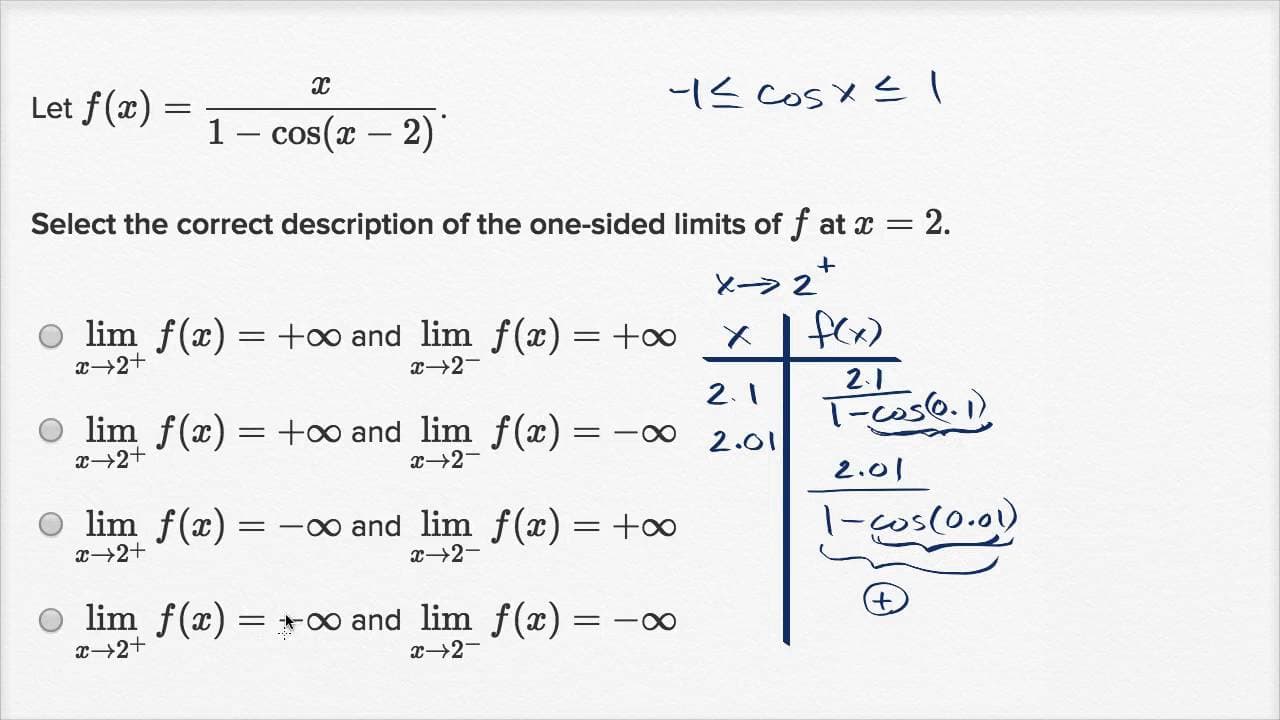
- [Voiceover] So we're told that f of x is equal to x over one minus cosine of x minus two, and they ask us to select the correct description of the one-sided limits of f at x equals two. And we see that right at x equals two, if we try to evaluate f of two, we get two over one minus cosine of two minus two, which is the same thing as cosine of zer... Read More
Key Insights
- 0️⃣ f(2) is undefined because the denominator becomes zero.
- ☺️ The one-sided limits of f at x=2 can be determined by evaluating f(x) as x approaches 2 from the positive and negative directions.
- ☺️ Analyzing the properties of the cosine function helps determine the behavior of f as x approaches 2.
- 🚰 Creating a table and evaluating f(x) values near 2 can provide insights into the function's behavior.
Install to Summarize YouTube Videos and Get Transcripts
Explore YouTube Video Summarizer or Get YouTube Transcript Extractor
Questions & Answers
Q: Why is it important to find the one-sided limits of f at x=2?
It is important to find the one-sided limits because f(2) is undefined, and understanding the behavior of the function near x=2 helps analyze its properties.
Q: How can the one-sided limits be calculated without a calculator?
Without a calculator, analyzing the behavior of the cosine function and the fact that cosine is bounded between -1 and 1 can provide insights into the function's behavior. As x approaches 2 from either direction, the numerator is positive, and the denominator is positive but less than 1, indicating that f approaches positive infinity.
Q: What is the purpose of using a table to analyze f(x) values approaching 2?
Creating a table helps evaluate the function at values very close to 2 without a calculator. By observing the pattern of approaching values, it becomes clear that f approaches positive infinity as x approaches 2.
Q: Why is the first choice the correct one for the one-sided limits?
The first choice is correct because as x approaches 2, the numerator is positive, and the denominator is positive but less than 1. This combination results in positive values, and since the choices mention unboundedness towards positive infinity, the first choice is the only one that satisfies all conditions.
Summary & Key Takeaways
-
The function f(x) is given as x/(1-cos(x)-2), and the goal is to determine the one-sided limits of f at x=2.
-
f(2) is undefined because the denominator becomes zero. Therefore, finding the limit as x approaches 2 is necessary.
-
Using a table to analyze f(x) for values approaching 2 from positive and negative directions, it can be observed that the function approaches positive infinity.
Read in Other Languages (beta)
Share This Summary 📚
Summarize YouTube Videos and Get Video Transcripts with 1-Click
Try YouTube Summary with ChatGPT & Claude or YouTube Transcript Generator
Explore More Summaries from Khan Academy 📚






Summarize YouTube Videos and Get Video Transcripts with 1-Click
Try YouTube Summary with ChatGPT & Claude or YouTube Transcript Generator