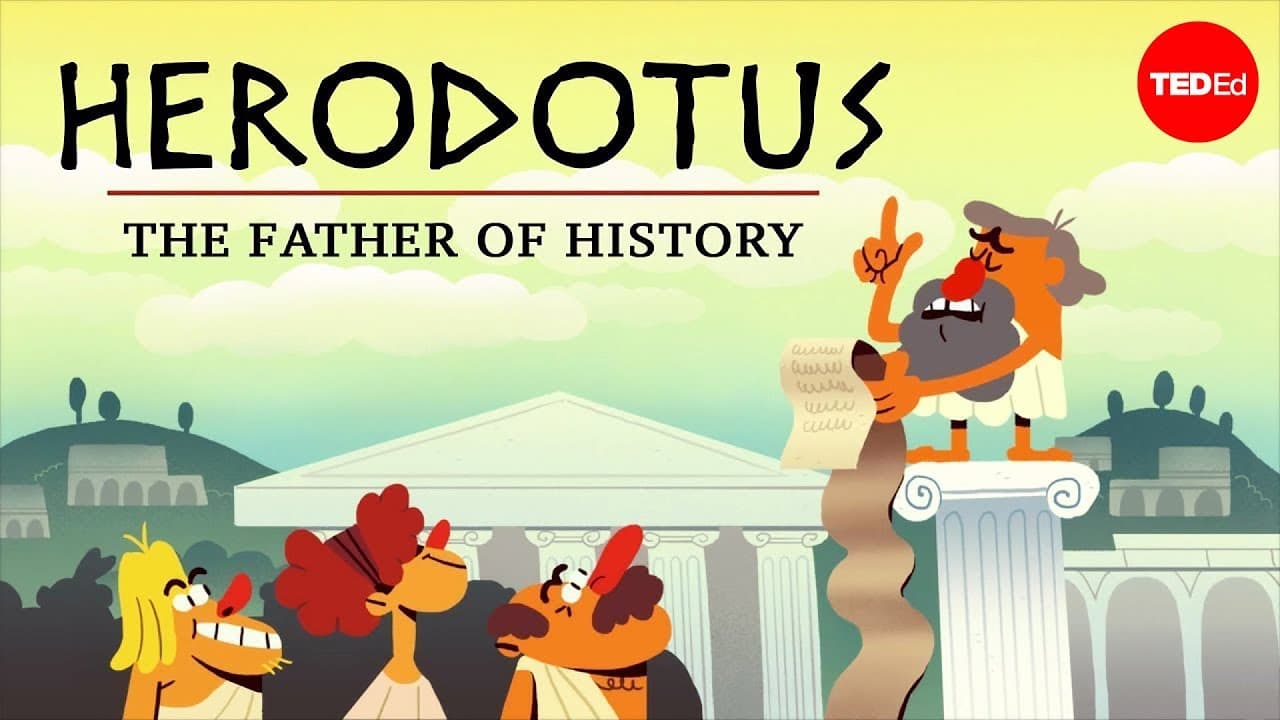
Why is Herodotus called “The Father of History”? - Mark Robinson
TL;DR
The Histories by Herodotus, an Ancient Greek writer, revolutionized historical writing by providing a rational and comprehensive understanding of events through eyewitness accounts and analysis.
Transcript
Giant gold-digging ants, a furious king who orders the sea to be whipped 300 times, and a dolphin that saves a famous poet from drowning. These are just some of the stories from The Histories by Herodotus, an Ancient Greek writer from the 5th century BCE. Not all the events in the text may have happened exactly as Herodotus reported them, but this... Read More
Key Insights
- ✍️ Herodotus revolutionized historical writing by providing a rational understanding of events, rather than attributing them solely to divine intervention.
- 🛟 The Histories focused on the Persian Wars and recorded the achievements of both Greeks and non-Greeks, preserving their history for future generations.
- 🅰️ Herodotus collected stories from various sources and used different types of evidence, such as eyewitness accounts and hearsay, to reach conclusions about historical events.
- 👨🔬 The Greek word "autopsy" describes Herodotus's method of research, combining different types of evidence to understand what actually happened.
Install to Summarize YouTube Videos and Get Transcripts
Explore YouTube Video Summarizer or Get YouTube Transcript Extractor
Questions & Answers
Q: How did Herodotus revolutionize historical writing?
Herodotus revolutionized historical writing by looking at events from both sides and providing a rational understanding of their causes, rather than attributing them solely to the will of the gods. He used various types of evidence, such as eyewitness accounts and hearsay, to reach conclusions about what actually happened.
Q: What were the Persian Wars and how did Herodotus explain them?
The Persian Wars were a series of conflicts between the Persians and the Greeks. Herodotus explained that the wars began when the Athenians assisted a rebellion by Greeks living under Persian rule. He recorded the battles, including the Battle of Marathon where the Athenians won unexpectedly, and the Battle of Thermopylae where the Spartans made a heroic stand against the Persians.
Q: How did Herodotus collect information for The Histories?
Herodotus collected stories from all around the Mediterranean in order to explain how the Persian Wars broke out and why the Greeks were victorious. He recorded achievements of both Greeks and non-Greeks before they were lost to time, using various types of evidence such as eyewitness accounts, hearsay, and tradition.
Q: What made Herodotus the first proper historian?
Herodotus was considered the first proper historian because of his method of research, known as "autopsy," meaning "seeing for oneself." He combined different kinds of evidence to reach conclusions about historical events, using eyewitness accounts, hearsay, and tradition.
Summary & Key Takeaways
-
Herodotus, an Ancient Greek writer, changed the way the past was documented by providing a rational understanding of events, rather than accepting them as the will of the gods.
-
He collected stories to explain the Persian Wars between the Persians and the Greeks, recording the achievements of both Greeks and non-Greeks in order to preserve their history.
-
Herodotus wrote The Histories as an "inquiry," combining various types of evidence, such as eyewitness accounts and hearsay, to reach conclusions about historical events.
Read in Other Languages (beta)
Share This Summary 📚
Summarize YouTube Videos and Get Video Transcripts with 1-Click
Try YouTube Summary with ChatGPT & Claude or YouTube Transcript Generator
Explore More Summaries from TED-Ed 📚





Summarize YouTube Videos and Get Video Transcripts with 1-Click
Try YouTube Summary with ChatGPT & Claude or YouTube Transcript Generator