Simple Harmonic Motion (10 of 16): An Explanation
TL;DR
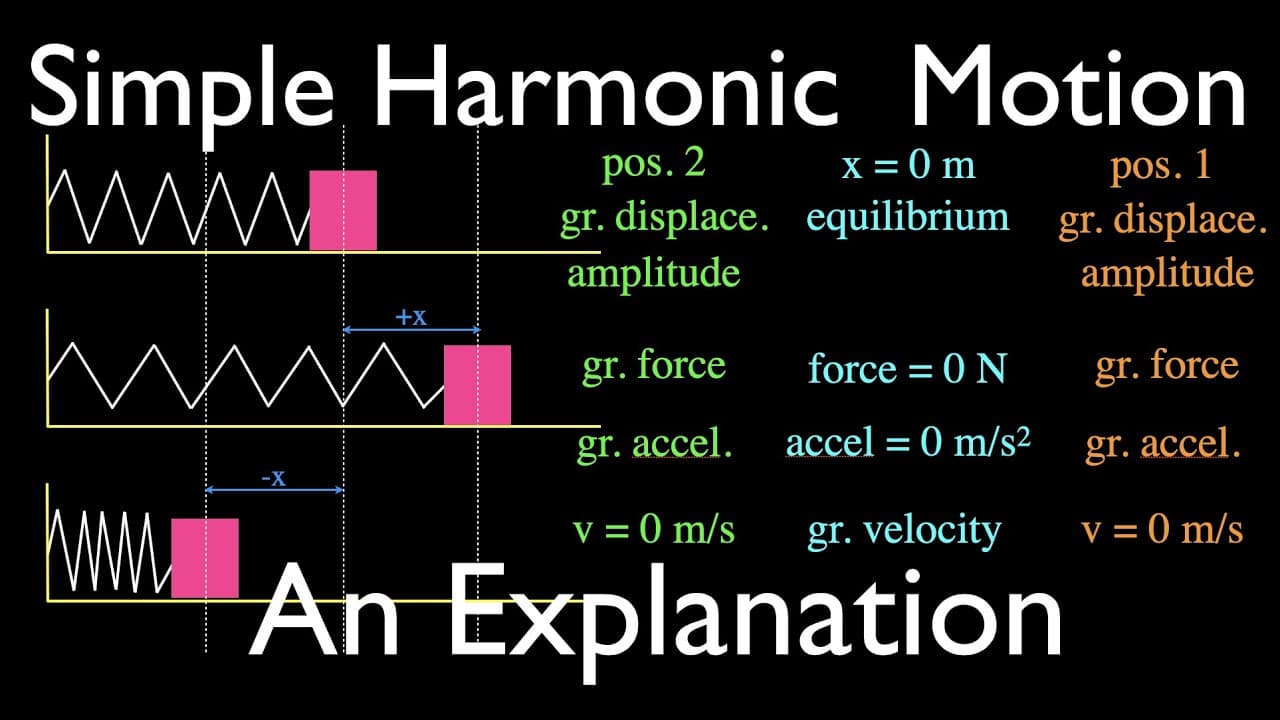
This video provides a step-by-step explanation of simple harmonic motion, covering its definition, characteristics, key terms, and key locations.
Transcript
today's video is entitled simple harmonic motion and explanation and that's right we're going to go over an explanation of simple harmonic motion before we get started please don't forget to subscribe to my channel step by step science get all my excellent physics chemistry and math fields when i look at my youtube analytics i see that more than 90... Read More
Key Insights
- ❓ Simple harmonic motion involves the periodic motion of an object with a restoring force directly proportional to displacement.
- 🧘 The equilibrium position is where the net force on the object is zero, and displacement is the distance from this position.
- 🌸 Hooke's Law equation, force = spring constant * displacement, is used in simple harmonic motion.
- 👻 The absence of friction and energy loss in an ideal scenario allows for perpetual oscillating motion in a simple harmonic system.
- 🧘 Important terms in simple harmonic motion include natural length, equilibrium position, displacement, amplitude, cycle, period, and frequency.
- 🥺 The greatest displacement leads to the greatest force and acceleration, while the equilibrium position has zero force, acceleration, and maximum velocity.
Install to Summarize YouTube Videos and Get Transcripts
Explore YouTube Video Summarizer or Get YouTube Transcript Extractor
Questions & Answers
Q: What is the definition of simple harmonic motion?
Simple harmonic motion refers to the periodic motion of an object where the restoring force is directly proportional to the displacement.
Q: What is Hooke's Law and how is it used in simple harmonic motion?
Hooke's Law states that the force on a spring is equal to the spring constant multiplied by the displacement. It is used to calculate the force, spring constant, or displacement in simple harmonic motion.
Q: What are some important terms in simple harmonic motion?
Important terms include the natural length of the spring (when no force is applied), equilibrium position (where the net force is zero), displacement (distance from equilibrium position), and amplitude (magnitude of the maximum displacement).
Q: What is the relationship between period and frequency in simple harmonic motion?
The period is the time taken to complete one cycle of motion, while the frequency is the number of cycles per second. They are inversely proportional, meaning the period is equal to one over the frequency, and vice versa.
Summary & Key Takeaways
-
The video begins with an introduction to simple harmonic motion, defining it as the periodic motion of an object where the restoring force is directly proportional to the displacement.
-
It explains that a common example of simple harmonic motion is a horizontal spring with a mass attached, where the spring is displaced to the right or left from its equilibrium position.
-
The video highlights key characteristics of simple harmonic motion, including the restoring force always acting towards the equilibrium position, the use of Hooke's Law equation to calculate force, spring constant, or displacement, and the absence of friction and energy loss in an ideal scenario.
Read in Other Languages (beta)
Share This Summary 📚
Summarize YouTube Videos and Get Video Transcripts with 1-Click
Try YouTube Summary with ChatGPT & Claude or YouTube Transcript Generator
Explore More Summaries from Step by Step Science 📚
Summarize YouTube Videos and Get Video Transcripts with 1-Click
Try YouTube Summary with ChatGPT & Claude or YouTube Transcript Generator