Products
Features
YouTube Video Summarizer
Summarize YouTube videos
Web & PDF Highlighter
Highlight web pages & PDFs
Chat with PDF
Ask any PDF questions with AI
Ask AI Clone
Chat with your highlights & memories
Audio Transcriber
Transcribe audio files to text
Glasp Reader
Read and highlight articles
Kindle Highlight Export
Export your Kindle highlights
Idea Hatch
Hatch ideas from your highlights
Integrations
Obsidian Plugin
Notion Integration
Pocket Integration
Instapaper Integration
Medium Integration
Readwise Integration
Snipd Integration
Hypothesis Integration
Apps & Extensions
Chrome Extension
Safari Extension
Edge Add-ons
Firefox Add-ons
iOS App
Android App
Discover
Discover
Ideas
Discover new ideas and insights
Articles
Curated articles and insights
Books
Book recommendations by great minds
Posts
Essays and notes from readers
Quotes
Inspiring quotes collection
Videos
Curated videos and summaries
Explore Glasp
Glasp Newsletter
Weekly insights and updates
Glasp Talk
Interview series with great minds
Glasp Blog
Latest news and articles
Glasp Use Cases
Learn how others use Glasp
Build & Support
Glasp API
Access Glasp's API for developers
MCP Connector
Connect Glasp to Claude & ChatGPT
Community
Glasp Reddit Community
Students
Student discount and benefits
FAQs
Frequently Asked Questions
AboutPricing
DashboardLog inSign up

Model Laws - Dimensional Analysis - Applied Hydraulics
610 views
•
April 7, 2022
by
Ekeeda
YouTube video player
Model Laws - Dimensional Analysis - Applied Hydraulics

TL;DR

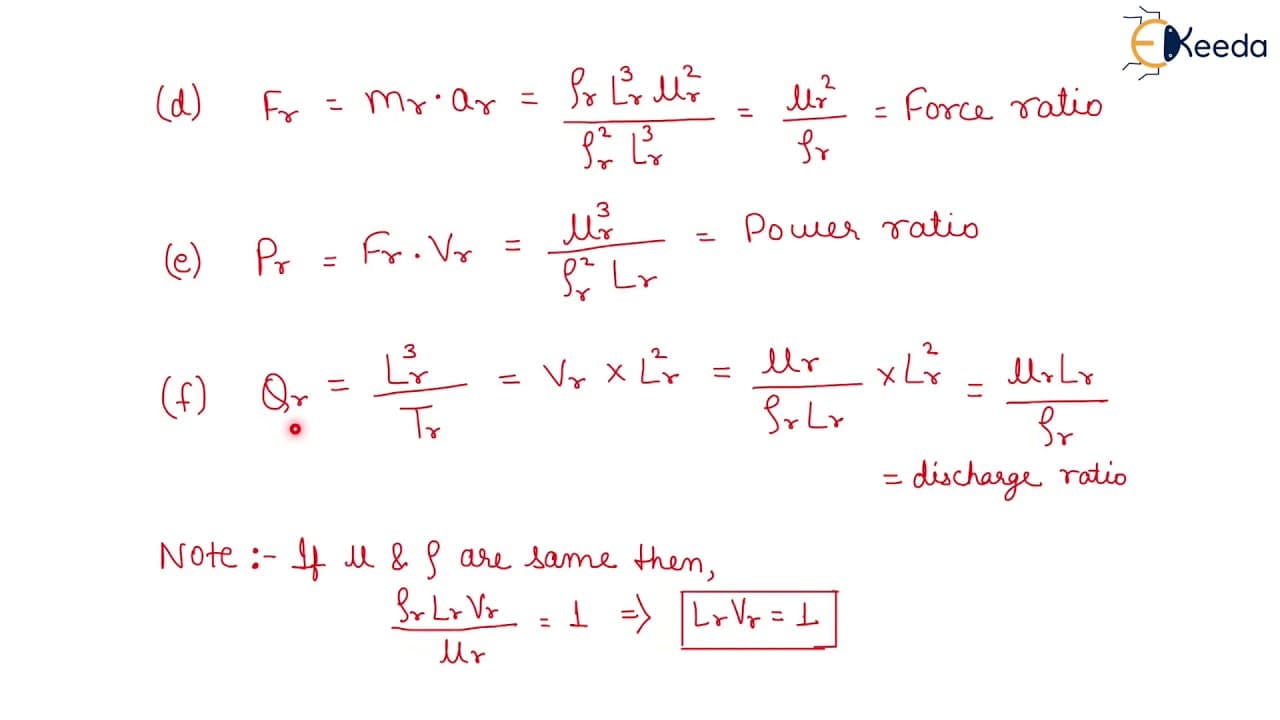
Model laws for dynamic similarity are based on dominant forces and are used to ensure similarity between model and prototype.

Transcript

hello students today we are going to study model laws for dynamic similarity between model and prototype ratio of dimensionless number that is the reynold number fraud number ios number weber's number mesh number should be same for model and prototype but it is difficult to satisfy all the forces ratios hence models are designed on the basis of rat... Read More

Key Insights

  • 👮 Model laws for dynamic similarity are based on dominant forces in a flow phenomena.
  • 👮 Reynolds model law is used when viscous forces are dominant.
  • 👮 Fröhlich model law is applicable when gravity forces are important in addition to inertia forces.
  • 👮 Euler's model law is used when pressure forces are dominant.
  • 👮 Weber's model law is applied when surface tension forces are dominant.
  • 👮 Mesh model law is used when compressibility forces are dominant.
  • 👮 Each model law has specific applications and equations for achieving dynamic similarity.

Install to Summarize YouTube Videos and Get Transcripts

Explore YouTube Video Summarizer or Get YouTube Transcript Extractor

Questions & Answers

Q: What are model laws for dynamic similarity based on?

Model laws for dynamic similarity are based on the forces that are dominant in a flow phenomena. Different laws are used depending on the dominating forces.

Q: When is Reynolds model law used?

Reynolds model law is used when only viscous forces are dominant, such as in laminar flow or flow around completely submerged objects.

Q: In which situations is Fröhlich model law applicable?

Fröhlich model law is applicable when gravity forces are important in addition to the inertia force. It is used in free surface flow scenarios like flow over spillways and hydraulic jumps.

Q: When is Euler's model law used?

Euler's model law is applied when apart from inertia forces, only pressure forces are dominant. It is used in cases like pipe flow at high pressure or for pressure due to the sudden closure of valves.

Q: What is Weber's model law used for?

Weber's model law is applied when apart from inertia forces, surface tension forces are dominant. It is used in situations like capillary rise, flow over weirs, and flow of blood in veins and arteries.

Q: When is mesh model law used?

Mesh model law is used when apart from inertia forces, compressibility forces are dominant. It is applied in aerodynamic testing and the flow of gases through pipes at high velocity.

Summary & Key Takeaways

  • Model laws for dynamic similarity are based on forces dominating in a flow phenomena.

  • Reynolds model law is used when only viscous forces are dominant.

  • Fröhlich model law is applied when gravity forces are important in addition to inertia force.

  • Euler's model law is used when pressure forces are dominant.

  • Weber's model law is applied when surface tension forces are dominant.

  • Mesh model law is used when compressibility forces are dominant.


Read in Other Languages (beta)

English

Share This Summary 📚

Summarize YouTube Videos and Get Video Transcripts with 1-Click

Download browser extensions on:

Try YouTube Summary with ChatGPT & Claude or YouTube Transcript Generator

Explore More Summaries from Ekeeda 📚

Introduction to Thermal Boundary Layer in Circular - Convection Heat Transfer - Heat Transfer thumbnail
Introduction to Thermal Boundary Layer in Circular - Convection Heat Transfer - Heat Transfer
Ekeeda
Various Lines on Psychrometric Chart - Psychrometry - Refrigeration and Air Conditioning thumbnail
Various Lines on Psychrometric Chart - Psychrometry - Refrigeration and Air Conditioning
Ekeeda
Graphical Method to Calculate Velocity & Acceleration of Four Bar Chain Numerical 2 thumbnail
Graphical Method to Calculate Velocity & Acceleration of Four Bar Chain Numerical 2
Ekeeda
Block Diagram Reduction Technique  - Transfer Function - Control Systems thumbnail
Block Diagram Reduction Technique - Transfer Function - Control Systems
Ekeeda
Introduction to DEMUX | Number System and Code | Digital Circuit Design in EXTC Engineering thumbnail
Introduction to DEMUX | Number System and Code | Digital Circuit Design in EXTC Engineering
Ekeeda
Buffer Management - Transaction Management - Database Management System thumbnail
Buffer Management - Transaction Management - Database Management System
Ekeeda

Summarize YouTube Videos and Get Video Transcripts with 1-Click

Download browser extensions on:

Try YouTube Summary with ChatGPT & Claude or YouTube Transcript Generator

Apps & Extensions

  • Chrome Extension
  • Safari Extension
  • Edge Add-ons
  • Firefox Add-ons
  • iOS App
  • Android App

Key Features

  • YouTube Video Summarizer
  • Web & PDF Summarizer
  • Web & PDF Highlighter
  • Chat with PDF
  • Ask AI Clone
  • Audio Transcriber
  • Glasp Reader
  • Kindle Highlight Export
  • Idea Hatch

Integrations

  • Obsidian Plugin
  • Notion Integration
  • Pocket Integration
  • Instapaper Integration
  • Medium Integration
  • Readwise Integration
  • Snipd Integration
  • Hypothesis Integration

More Features

  • APIs
  • MCP Connector
  • Blog & Post
  • Embed Links
  • Image Highlight
  • Personality Test
  • Quote Shots

Company

  • About us
  • Blog
  • Community
  • FAQs
  • Job Board
  • Newsletter
  • Pricing
Terms

•

Privacy

•

Guidelines

© 2026 Glasp Inc. All rights reserved.