Products
Features
YouTube Video Summarizer
Summarize YouTube videos
Web & PDF Highlighter
Highlight web pages & PDFs
Chat with PDF
Ask any PDF questions with AI
Ask AI Clone
Chat with your highlights & memories
Audio Transcriber
Transcribe audio files to text
Glasp Reader
Read and highlight articles
Kindle Highlight Export
Export your Kindle highlights
Idea Hatch
Hatch ideas from your highlights
Integrations
Obsidian Plugin
Notion Integration
Pocket Integration
Instapaper Integration
Medium Integration
Readwise Integration
Snipd Integration
Hypothesis Integration
Apps & Extensions
Chrome Extension
Safari Extension
Edge Add-ons
Firefox Add-ons
iOS App
Android App
Discover
Discover
Ideas
Discover new ideas and insights
Articles
Curated articles and insights
Books
Book recommendations by great minds
Posts
Essays and notes from readers
Quotes
Inspiring quotes collection
Videos
Curated videos and summaries
Explore Glasp
Glasp Newsletter
Weekly insights and updates
Glasp Talk
Interview series with great minds
Glasp Blog
Latest news and articles
Glasp Use Cases
Learn how others use Glasp
Build & Support
Glasp API
Access Glasp's API for developers
MCP Connector
Connect Glasp to Claude & ChatGPT
Community
Glasp Reddit Community
Students
Student discount and benefits
FAQs
Frequently Asked Questions
AboutPricing
DashboardLog inSign up

Simple Circuits

July 11, 2023
by
The Organic Chemistry Tutor
YouTube video player
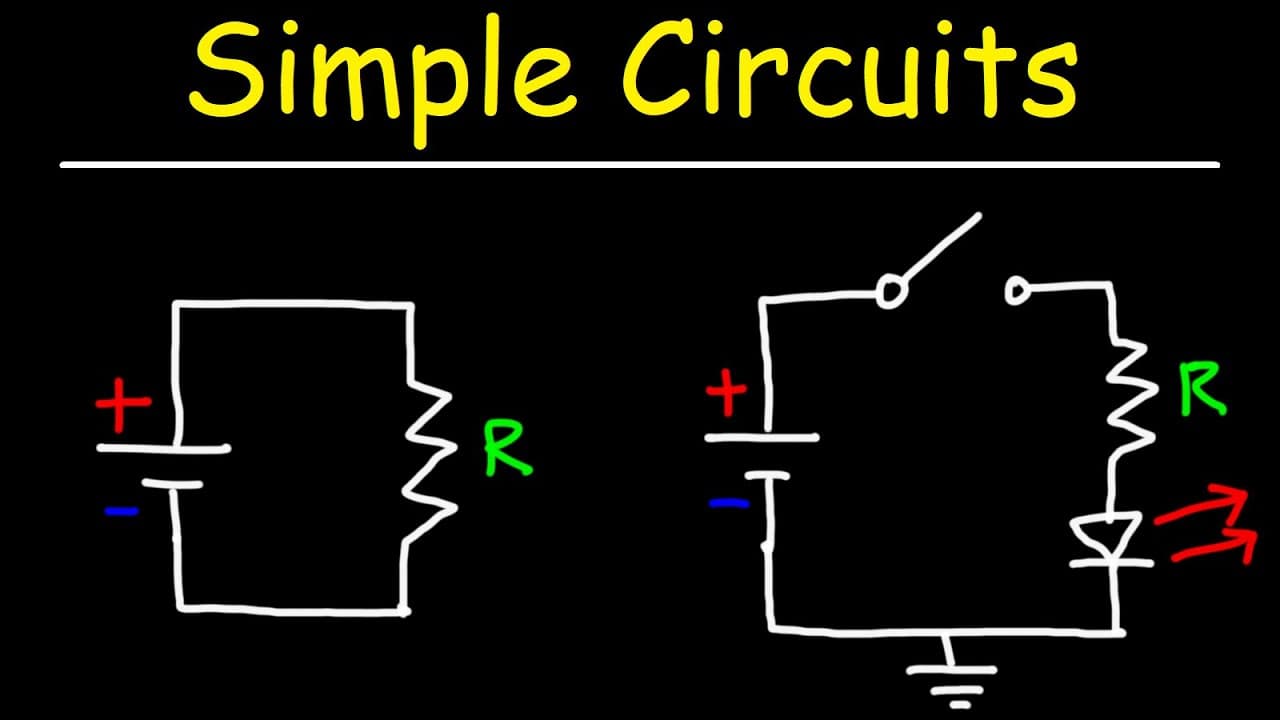
Simple Circuits

TL;DR

This video provides an introduction to simple circuits, explaining the role of batteries, resistors, and LEDs in circuit design.

Transcript

in this video we're going to focus on simple circuits one of the most simple circuits that we can create is one that has a battery and a resistor that's a very simple circuit now right now the circuit is on this is the positive terminal of the battery and this is the negative terminal of the battery let's say we have a 12 volt battery connected acr... Read More

Key Insights

  • 🔋 Simple circuits consist of a battery as a power source and a resistor to control current flow.
  • 🪜 Adding a resistor prevents excessive current and potential hazards.
  • 🈂️ Electrons, not conventional current, are the charge carriers in an electrical conductor.
  • 👮 Current can be calculated using Ohm's law.
  • ☠️ Power is the rate at which energy is transferred between objects.
  • 👫 Circuit elements such as switches and LEDs can be added to create more complex circuit configurations.
  • 😥 Voltage is the electric potential difference between two points.

Install to Summarize YouTube Videos and Get Transcripts

Explore YouTube Video Summarizer or Get YouTube Transcript Extractor

Questions & Answers

Q: Why is it important to add a resistor in a circuit?

Adding a resistor restricts the flow of current, preventing excessive current from flowing through the circuit and potentially causing damage or hazards.

Q: How is the amount of current flowing through a resistor calculated?

The current can be calculated using Ohm's law, dividing the voltage across the resistor by its resistance value.

Q: How is power dissipated by a resistor calculated?

Power dissipated by a resistor can be calculated using various formulas, such as voltage times current, current squared times resistance, or voltage squared divided by resistance.

Q: What happens when a circuit is closed by a switch?

When a switch is closed, the circuit becomes a closed circuit, allowing current to flow through the components.

Summary & Key Takeaways

  • A simple circuit consists of a battery and a resistor to control the flow of electricity.

  • Adding a resistor in the circuit prevents excessive current flow, which could lead to dangerous situations.

  • Electrons, not conventional current, actually flow through a circuit.


Read in Other Languages (beta)

English

Share This Summary 📚

Summarize YouTube Videos and Get Video Transcripts with 1-Click

Download browser extensions on:

Try YouTube Summary with ChatGPT & Claude or YouTube Transcript Generator

Explore More Summaries from The Organic Chemistry Tutor 📚
Triple Integrals - Calculus 3 thumbnail
Triple Integrals - Calculus 3
The Organic Chemistry Tutor
What Is Inductive Reactance and How Does It Affect AC Circuits? thumbnail
What Is Inductive Reactance and How Does It Affect AC Circuits?
The Organic Chemistry Tutor
Kirchhoff's Voltage Law - KVL Circuits, Loop Rule & Ohm's Law - Series Circuits, Physics thumbnail
Kirchhoff's Voltage Law - KVL Circuits, Loop Rule & Ohm's Law - Series Circuits, Physics
The Organic Chemistry Tutor
Midpoint Rule & Riemann Sums thumbnail
Midpoint Rule & Riemann Sums
The Organic Chemistry Tutor
How To Calculate Your Monthly Mortgage Payment Given The Principal, Interest Rate, & Loan Period thumbnail
How To Calculate Your Monthly Mortgage Payment Given The Principal, Interest Rate, & Loan Period
The Organic Chemistry Tutor
Total Internal Reflection of Light and Critical Angle of Refraction Physics thumbnail
Total Internal Reflection of Light and Critical Angle of Refraction Physics
The Organic Chemistry Tutor

Summarize YouTube Videos and Get Video Transcripts with 1-Click

Download browser extensions on:

Try YouTube Summary with ChatGPT & Claude or YouTube Transcript Generator

Apps & Extensions

  • Chrome Extension
  • Safari Extension
  • Edge Add-ons
  • Firefox Add-ons
  • iOS App
  • Android App

Key Features

  • YouTube Video Summarizer
  • Web & PDF Summarizer
  • Web & PDF Highlighter
  • Chat with PDF
  • Ask AI Clone
  • Audio Transcriber
  • Glasp Reader
  • Kindle Highlight Export
  • Idea Hatch

Integrations

  • Obsidian Plugin
  • Notion Integration
  • Pocket Integration
  • Instapaper Integration
  • Medium Integration
  • Readwise Integration
  • Snipd Integration
  • Hypothesis Integration

More Features

  • APIs
  • MCP Connector
  • Blog & Post
  • Embed Links
  • Image Highlight
  • Personality Test
  • Quote Shots

Company

  • About us
  • Blog
  • Community
  • FAQs
  • Job Board
  • Newsletter
  • Pricing
Terms

•

Privacy

•

Guidelines

© 2026 Glasp Inc. All rights reserved.