What Is Bayes' Theorem and How Is It Derived?
TL;DR
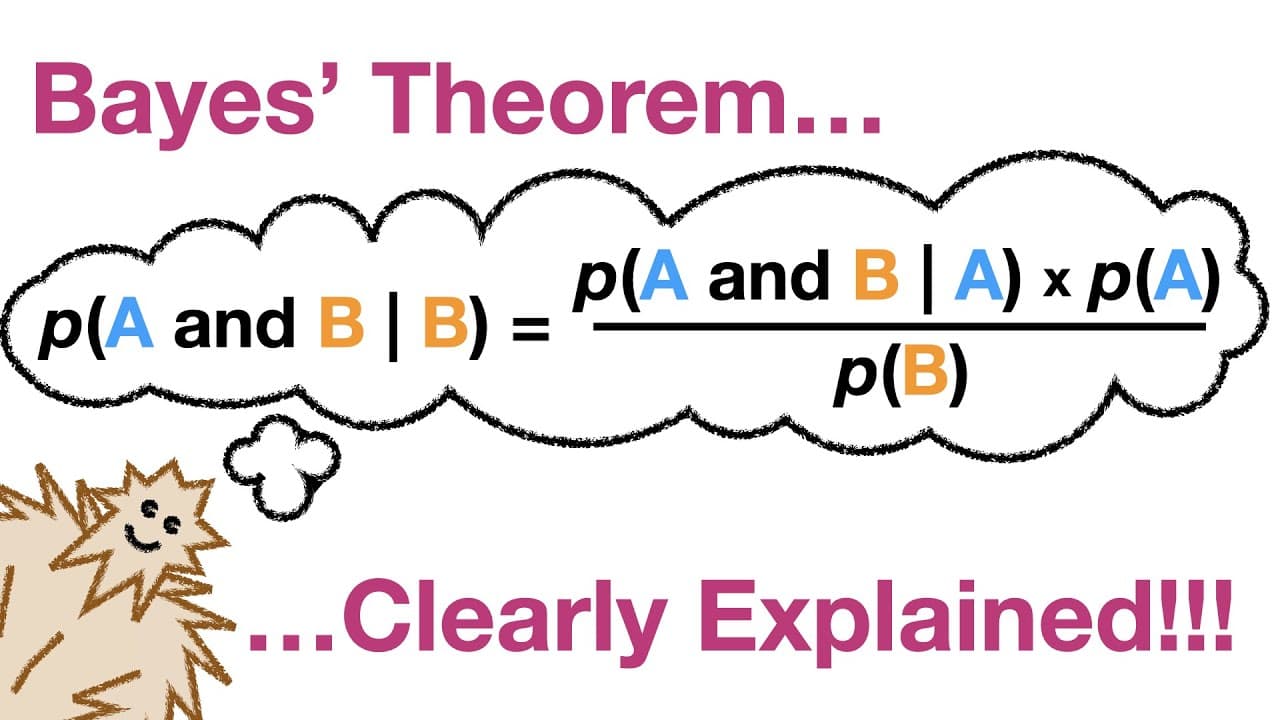
Bayes' Theorem calculates conditional probabilities based on prior knowledge and allows for the updating of beliefs with new evidence. It can be derived through algebra, demonstrating how different pieces of information about an event can inform our understanding of its probabilities. This theorem is essential in Bayesian statistics, particularly when complete data is unavailable.
Transcript
base theorem versus statsquatch base theorem wins statquest hello i'm josh starmer and welcome to statquest today we're going to talk about bayes theorem and it's going to be clearly explained note this stat quest assumes that you are already familiar with conditional probability if not check out the quest that said let's do a quick review in the s... Read More
Key Insights
- ❓ Bayes Theorem can be derived from conditional probability by algebraic manipulation.
- ❓ Conditional probability is the probability of an event happening given that another event has already occurred.
- 👻 Bayes Theorem allows for updating prior beliefs with new evidence.
- ⚾ Bayesian statistics is based on the principles of Bayes Theorem and provides a framework for incorporating prior knowledge into statistical analysis.
- 😒 Conditional probabilities can be calculated even when all data is not available through the use of Bayes Theorem.
- 💄 Bayes Theorem is particularly useful in situations where making guesses or estimates is necessary due to limited data.
- 🙂 The longer, slightly redundant notation for conditional probabilities can help in understanding the relationship between events and calculating probabilities.
Install to Summarize YouTube Videos and Get Transcripts
Explore YouTube Video Summarizer or Get YouTube Transcript Extractor
Questions & Answers
Q: What is conditional probability and how does it relate to Bayes Theorem?
Conditional probability is the probability of an event occurring, given that another event has already occurred. Bayes Theorem provides a way to calculate conditional probabilities based on prior knowledge.
Q: In what situations is Bayes Theorem useful?
Bayes Theorem is useful in situations where all data is not available, and probabilities need to be estimated based on prior knowledge and conditional probabilities.
Q: How does Bayes Theorem help in making predictions or estimates?
Bayes Theorem allows us to update our prior beliefs or knowledge about an event based on new evidence, enabling us to make more accurate predictions or estimates.
Q: Why is Bayesian statistics important?
Bayesian statistics provides a framework for incorporating prior knowledge into statistical analysis, allowing for more nuanced and realistic modeling of uncertainty.
Summary & Key Takeaways
-
The content provides a clear explanation of conditional probability and how it was used to calculate probabilities in a given scenario.
-
It introduces the concept of conditional probability and discusses how it can be applied to calculate probabilities based on prior knowledge.
-
The content derives Bayes Theorem through algebraic manipulation and explains how it can be used to calculate conditional probabilities in situations where all data is not available.
Read in Other Languages (beta)
Share This Summary 📚
Summarize YouTube Videos and Get Video Transcripts with 1-Click
Try YouTube Summary with ChatGPT & Claude or YouTube Transcript Generator
Explore More Summaries from StatQuest with Josh Starmer 📚

Summarize YouTube Videos and Get Video Transcripts with 1-Click
Try YouTube Summary with ChatGPT & Claude or YouTube Transcript Generator