JWST's Science // Surgeon Robot for ISS // Booster 7 Test Fire
TL;DR
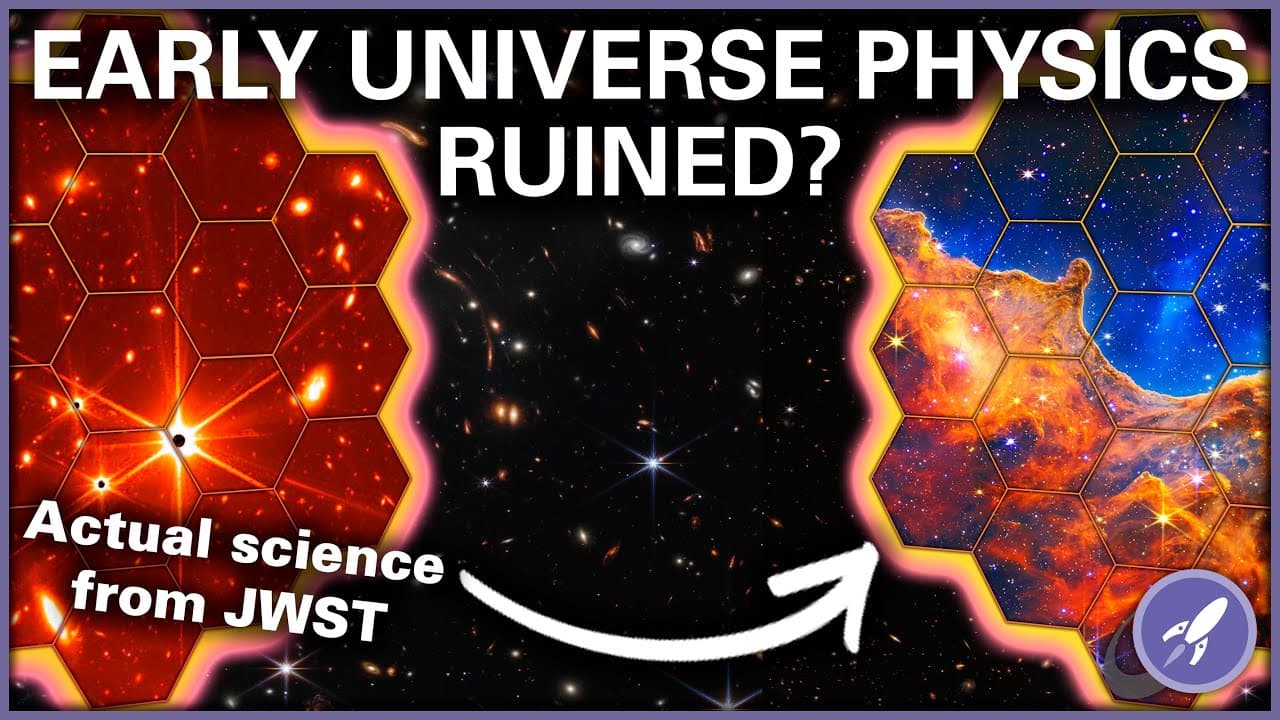
This week's Space Bites covers James Webb's scientific background, progress with the Space Launch System and starship, plans for remote surgery on the ISS, unusual discoveries by the Perseverance rover on Mars, and the continued success of the Hubble Space Telescope.
Transcript
The science behind James Webb images, Space Launch System and starship getting closer to their first flights, remote surgery on the International Space Station, perseverance finds more weird stuff on Mars, And Hubble is still going strong. All this and more in this week's episode of Space bites. Hi, everyone. I'm Fraser Cain. I'm the publisher of U... Read More
Key Insights
- 💁 The James Webb Space Telescope's scientific document provides detailed information about image capture, filters, exposure times, and scientific purposes.
- ❤️🩹 The Space Launch System is preparing for the end-of-August launch, with plans for multiple Artemis missions to return humans to the Moon.
- 🇲🇭 Perseverance rover continues to make interesting discoveries on Mars, while Curiosity celebrates its 10th anniversary.
- 🇰🇷 South Korea's Dindori mission aims to scan the Moon's surface and find potential landing spots.
- 😘 NASA plans to send a surgical robot to the ISS by 2024 for remote surgeries and medical assistance.
- 😇 Dwarf galaxies' lack of dark matter halo protection raises questions about our understanding of gravity.
- ☢️ The Hubble Space Telescope remains active, providing valuable data and capturing stunning images.
Install to Summarize YouTube Videos and Get Transcripts
Explore YouTube Video Summarizer or Get YouTube Transcript Extractor
Questions & Answers
Q: How is the James Webb Space Telescope capturing images and what scientific basis do they have?
The telescope uses a variety of filters and exposure times to capture images. The recent release of a 15-page document provides detailed scientific information about the basis for each image, the search for farthest galaxies, and surprising observations of fully evolved early universe galaxies.
Q: What progress has been made with the Space Launch System and when will it launch?
NASA is gearing up for the Space Launch System (SLS) launch, scheduled for the end of August. Detailed plans have been shared about the mission, including opening opportunities for current NASA astronauts to participate. The launch date can be anytime between one month and 12 months, according to Elon Musk.
Q: What interesting discoveries has Perseverance made on Mars?
Perseverance has found strange debris, including a piece of string or hair inside its drill chuck. It is believed to be leftover from its parachute or other equipment. Despite this, the rover continues to function well, and its next goal is to explore the ancient flood channel, Gediz Vallis.
Q: What is the significance of South Korea's lunar mission, Dindori?
Dindori aims to scan the Moon's surface, test scientific instruments, and identify potential landing spots for future missions. If successful, it will make South Korea the seventh country to send a spacecraft to the Moon.
Q: How does remote surgery on the ISS work, and when will it be implemented?
NASA plans to send a surgical robot to the ISS by 2024. The robot will be remotely operated by doctors on Earth, performing small incisions and surgeries inside the astronauts' bodies. This technology will be crucial for medical emergencies and long-duration missions.
Q: What recent insights have been gained about dark matter through the study of dwarf galaxies?
Recent observations of dwarf galaxies within a galaxy cluster suggest that some lack the expected dark matter halo protection. This supports the theory that our understanding of gravity at large scales is incomplete, adding to the ongoing mystery of dark matter.
Q: How is the Hubble Space Telescope still contributing despite the focus on the James Webb Telescope?
The Hubble Space Telescope recently captured an image of a globular star cluster, demonstrating its continued functionality. It remains oversubscribed and continues to provide valuable data and stunning images.
Q: What is the upcoming special interview mentioned by Fraser Cain?
Fraser Cain has a special interview planned for August 22, although the guest is not revealed. The video provides hints, suggesting it will be related to astronomy and astrophotography.
Summary & Key Takeaways
-
James Webb Space Telescope: Scientists have released a detailed document explaining the scientific basis, filters used, exposure times, and integration of data for the images captured by the telescope. They are discovering the farthest galaxies and that galaxies in the early universe are more mature than expected.
-
Space Launch System (SLS): NASA is preparing for the SLS launch at the end of August, with detailed information about mission plans, stages, and orbits. The Artemis missions also aim to return humans to the Moon, with opportunities open to veteran and new astronauts.
-
Perseverance on Mars: Perseverance continues to make interesting discoveries, including strange debris found in its drill chuck. Despite some wheel damage, the rover remains operational and will explore the ancient flood channel, Gediz Vallis.
-
Curiosity's 10th Anniversary: NASA's Curiosity rover has successfully found evidence of water on Mars over the past 10 years. It will now focus on exploring the ancient flood channel, Gediz Vallis.
-
South Korea's Lunar Mission: South Korea has launched its first Moon mission, called Dindori, to scan the Moon's surface, test scientific instruments, and identify potential landing spots for future missions.
-
Remote Surgery on the ISS: NASA plans to send a surgical robot to the International Space Station by 2024 to perform remote surgeries and assist astronauts with medical emergencies.
-
Dwarf Galaxies and Dark Matter: A study reveals that dwarf galaxies in a galaxy cluster have been distorted by gravity, indicating a lack of dark matter halo protection. This adds to the ongoing mystery surrounding dark matter and its interaction with gravity.
-
Hubble Telescope: While attention is on the James Webb Telescope, the Hubble Space Telescope continues to provide stunning images, including a recent picture of a globular star cluster in the Milky Way's Sagittarius region.
Read in Other Languages (beta)
Share This Summary 📚
Summarize YouTube Videos and Get Video Transcripts with 1-Click
Try YouTube Summary with ChatGPT & Claude or YouTube Transcript Generator
Explore More Summaries from Fraser Cain 📚



Summarize YouTube Videos and Get Video Transcripts with 1-Click
Try YouTube Summary with ChatGPT & Claude or YouTube Transcript Generator