1st Numerical of Ship Model - Dimensional Analysis - Applied Hydraulics
TL;DR
Calculation of the total drag force on a naval ship prototype based on model analysis and given parameters.
Transcript
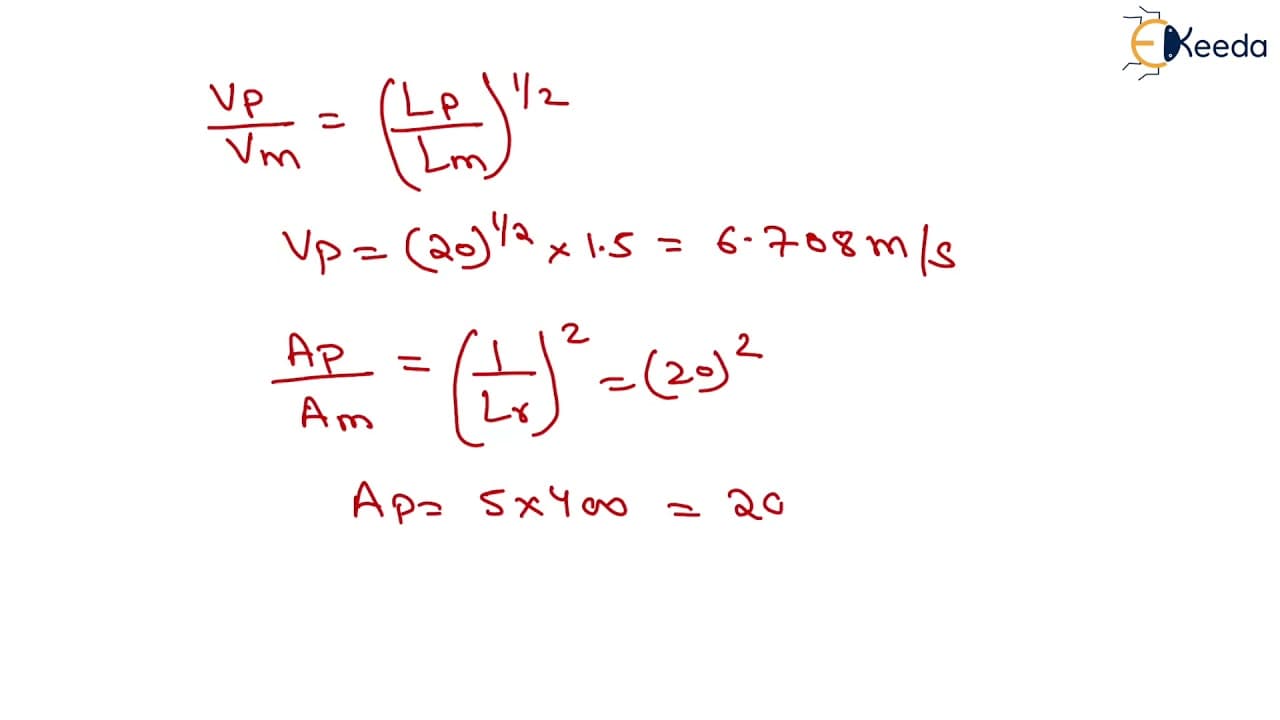
hello students today we are going to solve numerical of shift model question is given as a 1 2 20 model of a naval ship having a submit area of 5 meter square and length 8 meter has a total drag of 20 newton when torqued through water at a velocity of 1.5 meter per second calculate the total drag on the prototype when moving at corresponding speed ... Read More
Key Insights
- ☺️ The kinematic viscosity of water is an important parameter in the analysis and is given as 0.01 stokes or 0.01 x 10^-4 m^2/s.
- 💐 The Reynolds number is used to determine the flow regime and is calculated by dividing the velocity by the kinematic viscosity.
- #️⃣ The skin friction coefficient (cf) is determined using the Reynolds number and is used to calculate the skin resistance.
- 👋 Wave making resistance is the difference between the total drag force and the skin resistance for the model.
- #️⃣ The Reynolds number, velocity, length, and area are important parameters in determining various resistances.
- ⚖️ The analysis involves scaling up the values from the model to the prototype using appropriate relationships.
- 👋 The total drag force on the prototype is the sum of the frictional resistance and wave making resistance.
Install to Summarize YouTube Videos and Get Transcripts
Explore YouTube Video Summarizer or Get YouTube Transcript Extractor
Questions & Answers
Q: What is the equation used to calculate skin resistance in the model analysis?
The equation used is fr = (1/2)cf * row * A * v^2, where fr is the skin resistance, cf is the skin friction coefficient, row is the density of the fluid, A is the area, and v is the velocity.
Q: How is the wave making resistance calculated for the model?
The wave making resistance is calculated by subtracting the skin resistance from the given total drag force value of the model.
Q: How is the wave making resistance for the prototype determined?
The wave making resistance for the prototype is calculated by multiplying the wave making resistance of the model by the ratio of Reynolds numbers raised to the power of three.
Q: What parameters are needed to calculate the frictional resistance on the prototype?
The frictional resistance on the prototype requires the coefficient of friction, the density of the fluid, the velocity of the prototype, and the area of the prototype.
Summary & Key Takeaways
-
The content provides a step-by-step analysis of drag forces on a naval ship model and prototype.
-
It includes calculations for skin resistance, wave-making resistance, Reynolds numbers, and frictional resistance.
-
The analysis concludes with the determination of the total drag force on the prototype.
Read in Other Languages (beta)
Share This Summary 📚
Summarize YouTube Videos and Get Video Transcripts with 1-Click
Try YouTube Summary with ChatGPT & Claude or YouTube Transcript Generator
Explore More Summaries from Ekeeda 📚






Summarize YouTube Videos and Get Video Transcripts with 1-Click
Try YouTube Summary with ChatGPT & Claude or YouTube Transcript Generator