'Accidental' CrossCompiler - Computerphile
TL;DR
Discover the complexities and solutions involved in cross-compiling and porting compilers for different architectures.
Transcript
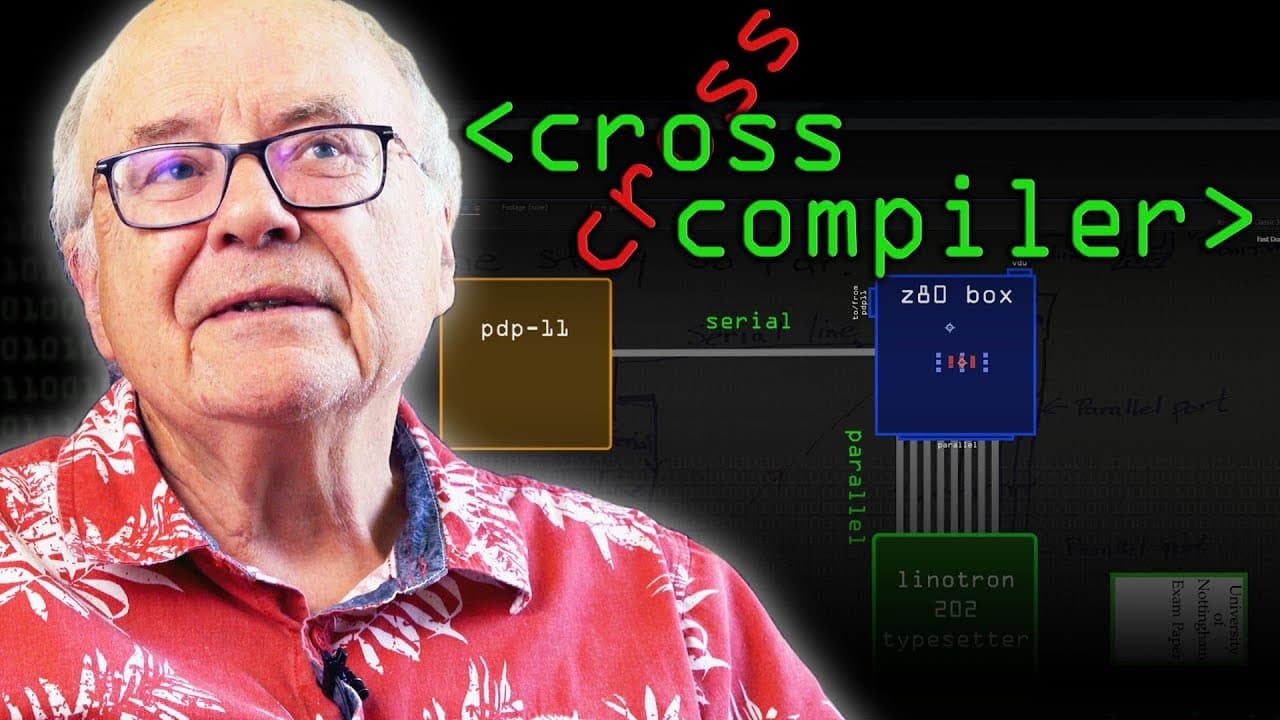
what we're going to look at today is to pick up the story that we've been involved in for quite a while now of accidentally discovering that one's written across compiler the first ever one i wrote and i almost didn't realize was getting into it for those of you who've been following the story so far i've been trying to motivate t diagrams as a way... Read More
Key Insights
- 😵 Cross-compiling and porting compilers involve bridging hardware components through boards and converting incompatible parallel ports to compatible serial interfaces.
- 👾 Limited memory and RAM constraints can present challenges during compiler development and require creative solutions to manage space.
- 💽 The "Great Jailbreak" demonstrated the option to either invade and take control of a mini-computer or interface with it from a distance, depending on resource availability and expertise.
- ❤️🩹 Developing an intermediate language like Zed code can simplify the porting process by allowing the front end (syntax analysis) to remain the same while adapting the back end (code generation) to each architecture.
- 😀 The search for a universal intermediate language faced difficulties due to architectural differences, making it challenging to create a one-size-fits-all solution.
Install to Summarize YouTube Videos and Get Transcripts
Explore YouTube Video Summarizer or Get YouTube Transcript Extractor
Questions & Answers
Q: What was the purpose of the bridging board between the Linotron 202 typesetter and the Z80 chip?
The bridging board was necessary to convert the non-standard parallel port of the typesetter to a serial input/output compatible with the Z80 chip. It allowed data to flow between the two components and enabled communication.
Q: How did the limited RAM pose challenges during the project?
The project had a generous 2K of RAM, which had to be divided between buffering characters and storing error messages. Despite being 40 bytes short of the required amount, the team managed to work around it by utilizing the upper bit of the additional 2K RAM.
Q: What was the significance of Zed code in compiler development?
Zed code, an intermediate language developed by Steve Bourne, aimed to simplify the process of porting compilers to different architectures. By emitting Zed code instead of specific binary code, new architectures only required a Zed code compilable interpreter, reducing the need for complete compiler transportation.
Q: Why did the search for a universal intermediate language face challenges?
Despite the idea of a universal intermediate language (uncle) being desirable, the differences in architectures and their requirements hindered the development of a one-size-fits-all solution. Each architecture presented unique challenges that couldn't be addressed by a single intermediate language easily.
Summary & Key Takeaways
-
The content explores the challenges faced in cross-compiling and porting compilers and the specific case of bridging a Linotron 202 typesetter with a Z80 chip.
-
The author discusses the limitations of memory and the need for more space to host the compiler on the Z80 board.
-
The story also highlights the different approaches taken by Ken Thompson in the "Great Jailbreak" and Steve Bourne in generating code for the Z80, and the concept of an intermediate language known as Zed code.
Read in Other Languages (beta)
Share This Summary 📚
Summarize YouTube Videos and Get Video Transcripts with 1-Click
Try YouTube Summary with ChatGPT & Claude or YouTube Transcript Generator
Explore More Summaries from Computerphile 📚





Summarize YouTube Videos and Get Video Transcripts with 1-Click
Try YouTube Summary with ChatGPT & Claude or YouTube Transcript Generator