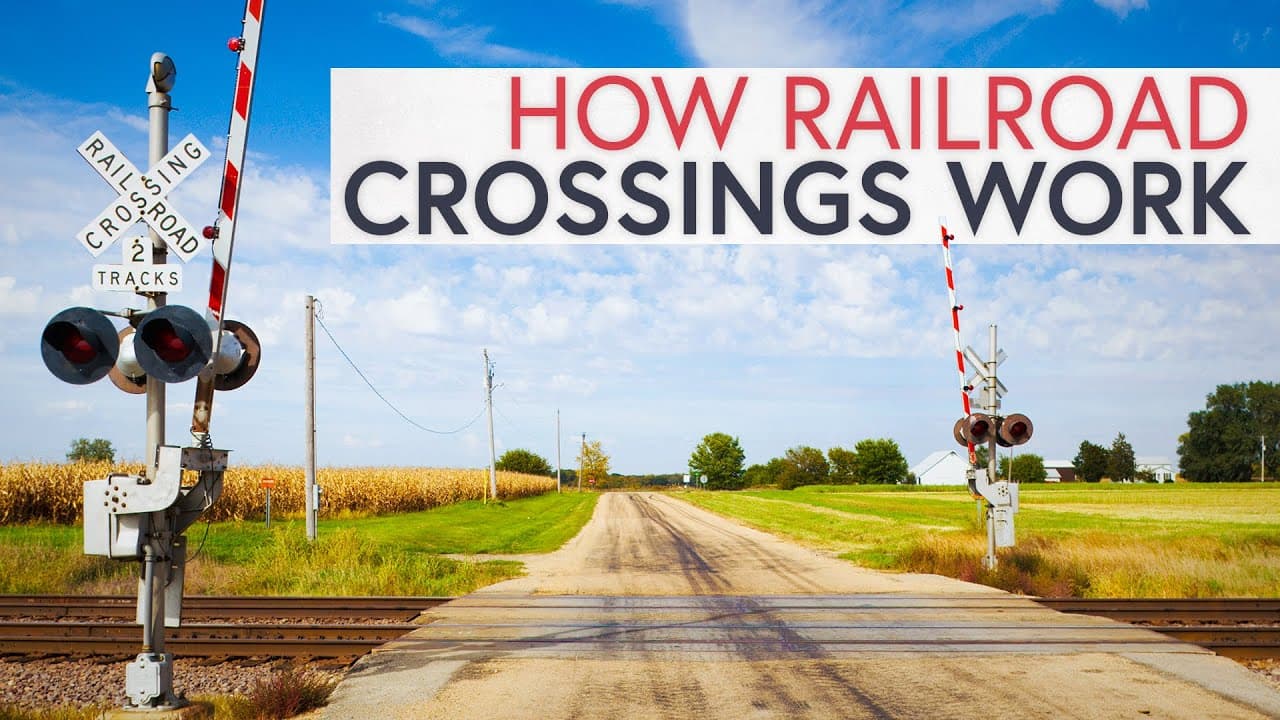
How Railroad Crossings Work
TL;DR
Railroad crossings employ safety measures to prevent train-vehicle collisions.
Transcript
If you’ve ever ridden a bike, driven a car, or operated pretty much any other vehicle on earth, there’s a fact you’ve probably taken for granted: you can see farther than it takes to stop. Within the span between seeing a stationary hazard and colliding with it, you have enough time to recognize it, apply the brakes, and come to a stop to avoid... Read More
Key Insights
- Trains have a much longer stopping distance compared to other vehicles, making safety infrastructure at crossings crucial.
- Grade crossings use both passive and active warning devices to alert motorists of approaching trains.
- The track circuit system is vital for detecting train presence using the electrical conductivity of rails and wheels.
- Fail-safe operations ensure that any failure in the track circuit defaults to assuming a train is present.
- Three-circuit systems at crossings help manage warning times by using approach and island circuits for accurate train detection.
- Speed prediction technology is used to maintain consistent warning times, preventing unnecessary delays for motorists.
- Coordination between traffic signals and crossing devices in urban areas prevents vehicles from blocking tracks.
- Reliability and trust in warning devices are essential to prevent motorists from ignoring them, ensuring safety at crossings.
Install to Summarize YouTube Videos and Get Transcripts
Explore YouTube Video Summarizer or Get YouTube Transcript Extractor
Questions & Answers
Q: Why do trains have the right-of-way at crossings?
Trains have significantly longer stopping distances than other vehicles, often requiring upwards of a mile to come to a halt. This makes it impractical for trains to yield to road traffic at crossings. Therefore, trains are given the right-of-way to prevent collisions, and safety infrastructure is implemented to alert and stop road vehicles.
Q: What are passive warning devices at railroad crossings?
Passive warning devices are fixed signs and symbols that do not change with the approach of a train. These include stop or yield signs, the crossbuck (the international symbol for a railroad crossing), and sometimes a plate indicating the number of tracks. Drivers must rely on these signs to assess the safety of crossing the tracks.
Q: How do track circuits detect the presence of a train?
Track circuits detect trains by using the electrical conductivity of the steel rails and wheels. A current runs through one rail, passes through a relay, and returns via the other rail. When a train's wheels and axles create a short circuit, it de-energizes the relay, triggering the warning devices. This system ensures that when a train is present, the warning devices activate.
Q: What is fail-safe operation in the context of railroad crossings?
Fail-safe operation ensures that if there is a failure in the track circuit, such as loss of power or a broken rail, the system defaults to the safest condition by assuming a train is present. This means the warning devices will activate, preventing motorists from crossing the tracks, thereby reducing the risk of accidents.
Q: How do three-circuit systems improve warning times at crossings?
Three-circuit systems use separate circuits for each approach and the crossing island itself. This setup allows for early detection of an approaching train, activating warning devices well before the train reaches the intersection. The island circuit maintains control until the train has cleared the crossing, ensuring safety without unnecessary delays.
Q: How is train speed accounted for in warning time calculations?
Train speed is factored into warning time calculations using prediction technology. Systems can estimate the train's speed and calculate the time it will take to reach the crossing. This ensures that warning devices activate with sufficient time, regardless of the train's speed, preventing excessive waiting times for motorists.
Q: What measures are taken to prevent false activations of warning devices?
To prevent false activations, railroads maintain clean tracks and ensure proper drainage to avoid water, plant growth, or debris from causing current leaks between the tracks. Regular maintenance and careful monitoring help maintain the reliability of the warning systems, ensuring they only activate when necessary.
Q: How are traffic signals coordinated with railroad crossings in urban areas?
In urban areas, traffic signals near railroad crossings are coordinated with the crossing's warning devices. When a train is approaching, the traffic signal turns green to clear any queue of vehicles that might block the tracks. This coordination helps prevent vehicles from being stuck on the tracks, enhancing safety at crossings.
Summary & Key Takeaways
-
Railroad crossings require complex engineering solutions to manage the longer stopping distances of trains compared to other vehicles. This video explores the safety infrastructure in place to prevent collisions at these intersections.
-
A combination of passive and active warning devices, such as lights, bells, and gates, are used at grade crossings to alert motorists of an approaching train. The track circuit plays a crucial role in train detection using electrical conductivity.
-
Fail-safe operations and three-circuit systems are implemented to ensure accurate warning times for motorists. Speed prediction technology helps maintain consistent warning times, preventing unnecessary delays and ensuring safety at crossings.
Read in Other Languages (beta)
Share This Summary 📚
Summarize YouTube Videos and Get Video Transcripts with 1-Click
Try YouTube Summary with ChatGPT & Claude or YouTube Transcript Generator
Explore More Summaries from Practical Engineering 📚






Summarize YouTube Videos and Get Video Transcripts with 1-Click
Try YouTube Summary with ChatGPT & Claude or YouTube Transcript Generator