Magnetism (8 of 13) Lorentz Force, Calculate Magnetic Force on Charged Particle
TL;DR
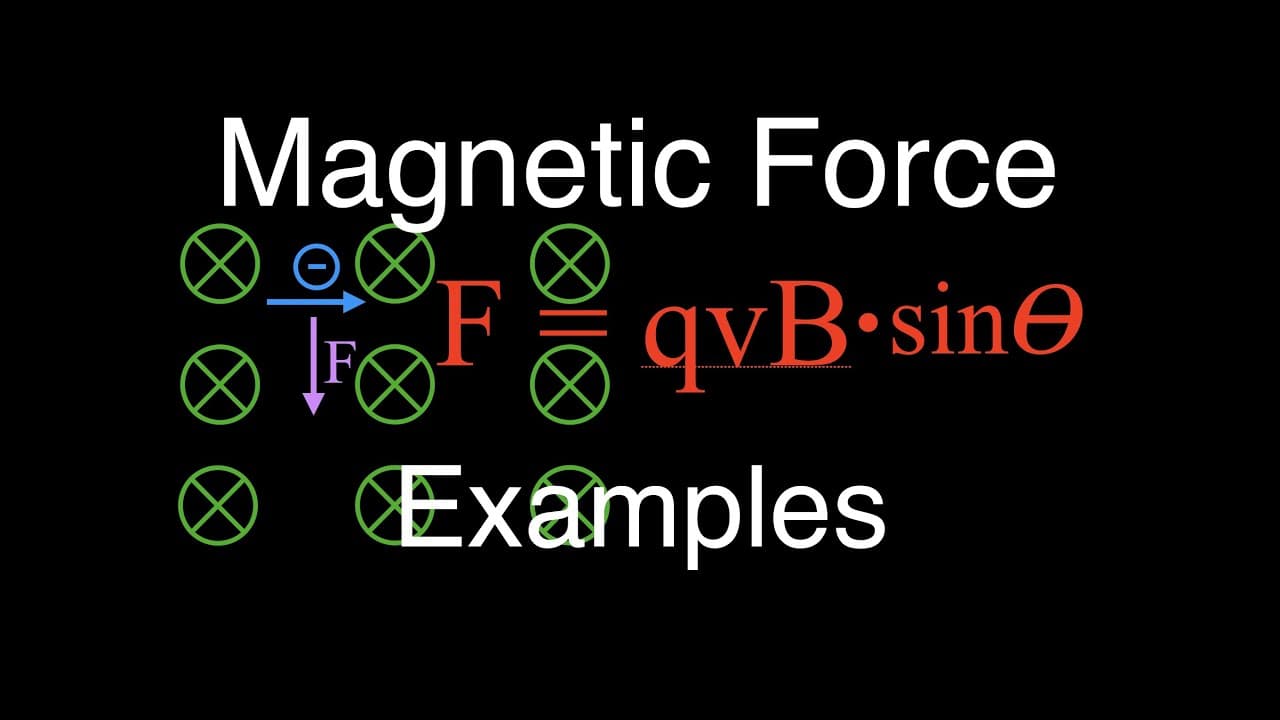
This video explains how to calculate the magnitude of the force on a charged particle moving through a magnetic field using the equation F = qvBsin(theta).
Transcript
okay in today's video I'm going over how to calculate the magnitude of the force on a charged particle that's moving through a magnetic field in the previous video the the previous video which you've linked in the upper right-hand corner this video I made a video of how to determine the direction of the force using the right and the left hand rule ... Read More
Key Insights
- 🏑 The magnitude of the force on a charged particle in a magnetic field can be calculated using the equation F = qvBsin(theta).
- 0️⃣ If the velocity of the particle is zero, there will be no force on the particle.
- 🔺 The angle theta represents the direction and magnitude of the force.
- 🏑 When the angle theta is 0 or 180 degrees, the particle is moving parallel to the magnetic field and experiences no force.
- 🏑 When the angle theta is 90 degrees, the particle is moving perpendicular to the magnetic field and experiences maximum force.
- 🔺 The force is reduced when the angle theta is between 0 and 90 degrees.
- 🏑 The magnitude of the force depends on the charge of the particle, the velocity, and the magnetic field strength.
Install to Summarize YouTube Videos and Get Transcripts
Explore YouTube Video Summarizer or Get YouTube Transcript Extractor
Questions & Answers
Q: What equation is used to calculate the magnitude of the force on a charged particle in a magnetic field?
The equation used is F = qvBsin(theta), where F is the force, q is the charge, v is the velocity, B is the magnetic field strength, and theta is the angle between the velocity and the magnetic field.
Q: What happens if the velocity of the charged particle is zero?
If the velocity is zero, then there will be no force on the particle because multiplying all the other terms by zero will result in zero force.
Q: What does the angle theta represent in the equation?
Theta represents the angle between the velocity of the particle and the magnetic field. It determines the direction and magnitude of the force experienced by the particle.
Q: When will a charged particle not experience any force in a magnetic field?
A charged particle will not experience any force if it is either stationary or moving parallel to the magnetic field. In both cases, the sine of the angle theta is zero, resulting in zero force.
Summary & Key Takeaways
-
The video explains the equation to calculate the magnitude of the force on a charged particle in a magnetic field, which is F = qvBsin(theta).
-
The force depends on the charge of the particle (q), its velocity (v), the magnetic field strength (B), and the angle between the velocity and the magnetic field (theta).
-
There are special cases where the particle won't experience any force, such as when it is stationary or moving parallel to the magnetic field.
Read in Other Languages (beta)
Share This Summary 📚
Summarize YouTube Videos and Get Video Transcripts with 1-Click
Try YouTube Summary with ChatGPT & Claude or YouTube Transcript Generator
Explore More Summaries from Step by Step Science 📚
Summarize YouTube Videos and Get Video Transcripts with 1-Click
Try YouTube Summary with ChatGPT & Claude or YouTube Transcript Generator