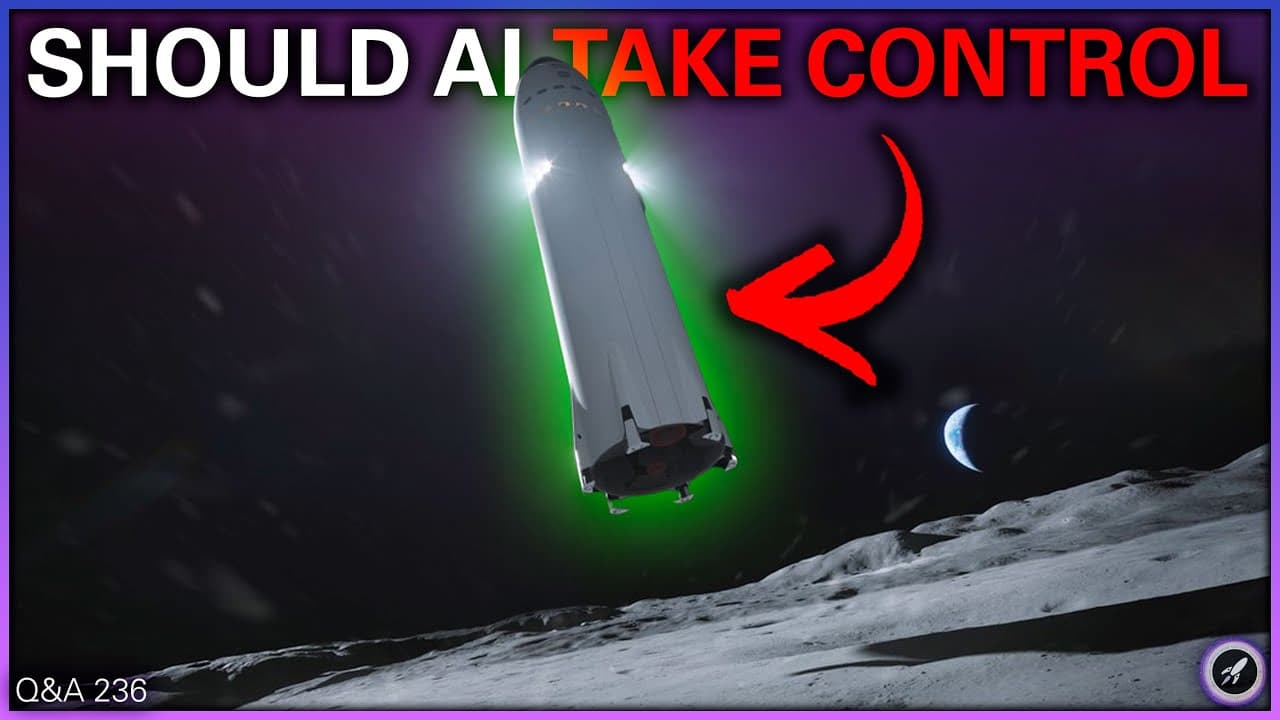
AI Pilots for Space Missions, A New Big Bang, Falsifiable Dark Matter | Q&A 236
TL;DR
This week's Question Show covers topics such as finding near-Earth objects, dark matter, the possibility of another Big Bang, the future of space exploration with artificial intelligence, and the debate about the presence of phosphine on Venus.
Transcript
could another big bang happen within the universe is dark matter falsifiable and is there room in the lrange points all this and more in this week's question show it's time for the question show your questions my answers as always wherever you are across my channel if a question pops into your brain just write it down we'll gather them up and I'll ... Read More
Key Insights
- 🛰️ Super synchronous orbit satellites can improve the detection of near-Earth objects due to better infrared visibility and a different perspective on the solar system.
- 🕶️ Dark matter is supported by various observations, such as galactic rotation, star orbits, and gravitational lensing, but the exact nature of dark matter is still unknown.
- ⌛ The possibility of another Big Bang occurring within our infinite universe depends on highly improbable events happening over an infinitely long time.
- 🛰️ Artificial intelligence has significant potential in space exploration, particularly for autonomous decision-making and overcoming communication limitations in long-distance missions.
Install to Summarize YouTube Videos and Get Transcripts
Explore YouTube Video Summarizer or Get YouTube Transcript Extractor
Questions & Answers
Q: Could a constellation of satellites at Super synchronous orbit be more effective than Earthbound telescopes for finding near-Earth objects?
Yes, Super synchronous orbit satellites can be more effective in finding near-Earth objects due to better visibility in infrared and avoiding the limitations of Earth-based observations.
Q: Is there a falsifiable prediction for dark matter?
While there is no definitive theory for dark matter, its presence is supported by observations of galactic rotation, star orbits, and gravitational lensing. Scientists are actively searching for a particle-based explanation.
Q: Could another Big Bang occur within our universe, and what would it look like?
The conditions that caused the Big Bang are not fully understood. However, if the universe continues to expand infinitely, rare events may occur, leading to the formation of another Big Bang.
Q: What is the potential of using artificial intelligence in space exploration, such as for landing spacecraft?
Artificial intelligence can be highly valuable in space exploration, especially for missions where real-time communication is not practical. AI can make autonomous decisions and improve efficiency in long-distance missions.
Q: Is the presence of phosphine on Venus confirmed, and how do we gather conclusive evidence on neighboring Venus?
The presence of phosphine on Venus is still debated due to inconclusive evidence. Spectrometry data can be challenging to obtain from Venus, making it difficult to confirm the findings. Further research is needed to reach conclusive results.
Summary & Key Takeaways
-
Satellites at Super synchronous orbit could be better than Earthbound telescopes for finding near-Earth objects due to better visibility in infrared.
-
The presence of dark matter is supported by observations of galactic rotation, star orbits, and gravitational lensing.
-
The possibility of another Big Bang happening in our universe depends on infinite time and the occurrence of highly improbable events.
-
Artificial intelligence can play a significant role in space exploration, especially for autonomous decision-making in long-distance missions.
-
The presence of phosphine on Venus is still debatable due to inconclusive evidence and a need for further research.
Read in Other Languages (beta)
Share This Summary 📚
Summarize YouTube Videos and Get Video Transcripts with 1-Click
Try YouTube Summary with ChatGPT & Claude or YouTube Transcript Generator
Explore More Summaries from Fraser Cain / Universe Today Podcast 📚
Summarize YouTube Videos and Get Video Transcripts with 1-Click
Try YouTube Summary with ChatGPT & Claude or YouTube Transcript Generator