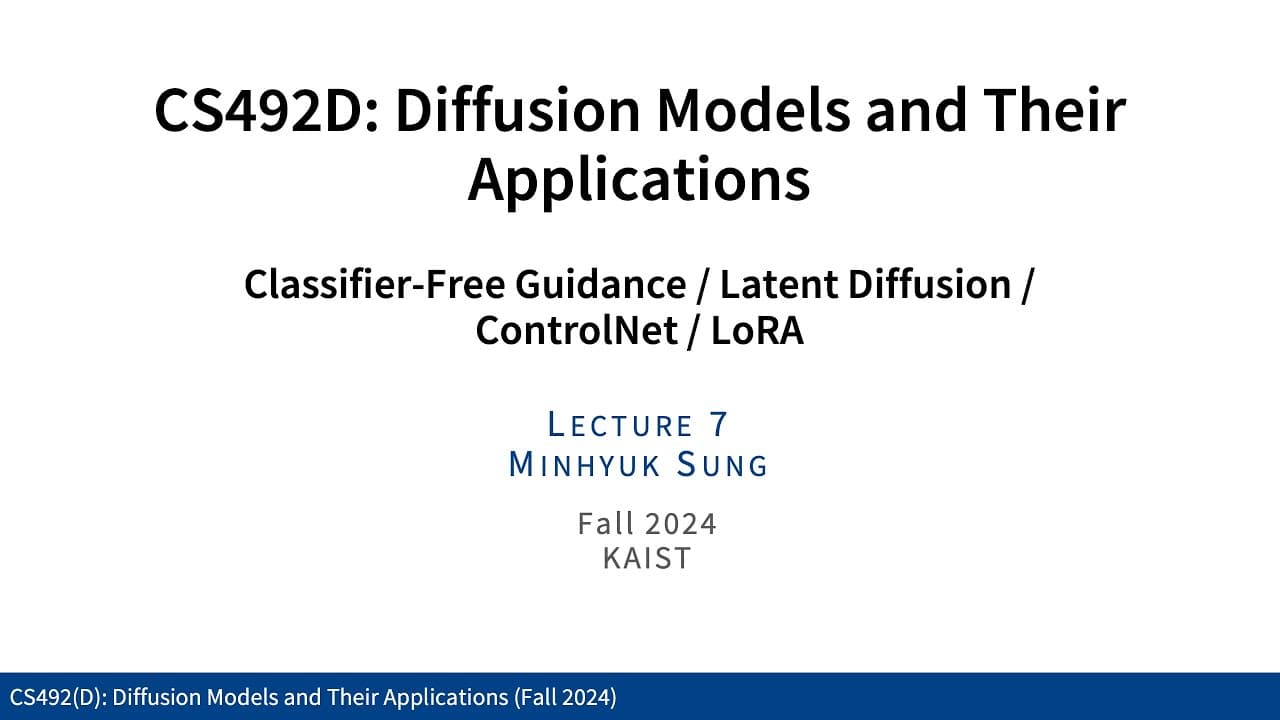
Lecture 07: CFG / Latent Diffusion /ControlNet / LoRA (KAIST CS492D, Fall 2024)
TL;DR
Lecture discusses practical implementation of diffusion models for large datasets.
Transcript
okay so welcome back so this course like we have uh so far discussed the basic idea about division models including some the ddpm and the ddim and also we had the assignments in terms of how to implement these things with some kind of the simple D to setup with some kind of 2D points and very small set of images and from today uh we are going to sw... Read More
Key Insights
- Diffusion models are being adapted for large-scale datasets, focusing on practical applications beyond theoretical foundations.
- Conditional generation and personalization are key areas where diffusion models can be applied effectively.
- Classifier-free guidance allows for conditional generation without needing a separate classification network, enhancing flexibility.
- Latent diffusion models compress images for efficient processing, crucial for handling high-resolution data.
- ControlNet enables fine-tuning of pre-trained diffusion models for specific tasks using minimal additional data.
- Fine-tuning techniques like LoRA reduce parameter requirements, allowing for efficient personalization of diffusion models.
- FID (Fréchet Inception Distance) is commonly used to evaluate image generation quality, though it has limitations.
- Practical applications of diffusion models include text-to-image generation, image-to-image translation, and audio-to-image conversion.
Install to Summarize YouTube Videos and Get Transcripts
Explore YouTube Video Summarizer or Get YouTube Transcript Extractor
Questions & Answers
Q: What is the primary focus of the lecture?
The primary focus of the lecture is on the practical implementation of diffusion models for large-scale datasets. It discusses how these models can be adapted for various applications, including conditional generation and personalization, by leveraging techniques like classifier-free guidance and latent diffusion.
Q: How does classifier-free guidance enhance diffusion models?
Classifier-free guidance enhances diffusion models by allowing for conditional generation without requiring a separate classification network. This approach increases the flexibility of diffusion models, enabling them to incorporate various types of conditions, such as text or images, directly into the noise prediction process.
Q: What role does latent diffusion play in handling high-resolution data?
Latent diffusion plays a crucial role in handling high-resolution data by compressing images into a lower-dimensional latent space. This compression allows for more efficient processing and reduces the computational resources required for training and generating high-resolution images, making it feasible to work with large-scale datasets.
Q: What is ControlNet, and how does it benefit diffusion models?
ControlNet is a technique that enables the fine-tuning of pre-trained diffusion models for specific tasks using a minimal amount of additional data. It benefits diffusion models by allowing them to adapt to new conditions or tasks without retraining from scratch, thus saving time and computational resources while maintaining high-quality outputs.
Q: How does LoRA contribute to diffusion model personalization?
LoRA contributes to diffusion model personalization by reducing the number of parameters required for fine-tuning. It approximates large matrices with smaller ones, enabling efficient adaptation of pre-trained models to specific styles or objects with minimal computational overhead, thus facilitating personalized image generation.
Q: What are the limitations of using FID for evaluating image generation quality?
FID has limitations in evaluating image generation quality as it assumes normal distribution of image features, which may not accurately represent complex distributions. Additionally, FID relies on a specific neural network's latent space, which may not align with human perceptual similarity, potentially leading to misleading evaluations.
Q: What practical applications of diffusion models are discussed in the lecture?
The lecture discusses several practical applications of diffusion models, including text-to-image generation, image-to-image translation, and audio-to-image conversion. These applications demonstrate the versatility of diffusion models in generating high-quality images from various types of input data, highlighting their potential in creative and industrial domains.
Q: How can pre-trained diffusion models be adapted for specific tasks?
Pre-trained diffusion models can be adapted for specific tasks through fine-tuning techniques like ControlNet and LoRA. These methods involve introducing additional parameters or layers to the existing model architecture, allowing it to incorporate new conditions or styles without needing extensive retraining, thus enabling efficient task-specific adaptation.
Summary & Key Takeaways
-
The lecture covers practical aspects of implementing diffusion models on large datasets, emphasizing conditional generation and personalization. It introduces classifier-free guidance, which enhances model flexibility by eliminating the need for a separate classification network.
-
Latent diffusion models are discussed as a means to compress images for efficient processing, which is crucial for high-resolution data. ControlNet is introduced as a technique for fine-tuning pre-trained diffusion models for specific tasks with minimal additional data.
-
Fine-tuning techniques like LoRA are highlighted for reducing parameter requirements, facilitating efficient personalization of diffusion models. The lecture also touches on the limitations of FID in evaluating image generation quality and explores various practical applications of diffusion models.
Read in Other Languages (beta)
Share This Summary 📚
Summarize YouTube Videos and Get Video Transcripts with 1-Click
Try YouTube Summary with ChatGPT & Claude or YouTube Transcript Generator
Explore More Summaries from Minhyuk Sung 📚
Summarize YouTube Videos and Get Video Transcripts with 1-Click
Try YouTube Summary with ChatGPT & Claude or YouTube Transcript Generator