W Boson Breaking the Standard Model with Dr. Paul Sutter
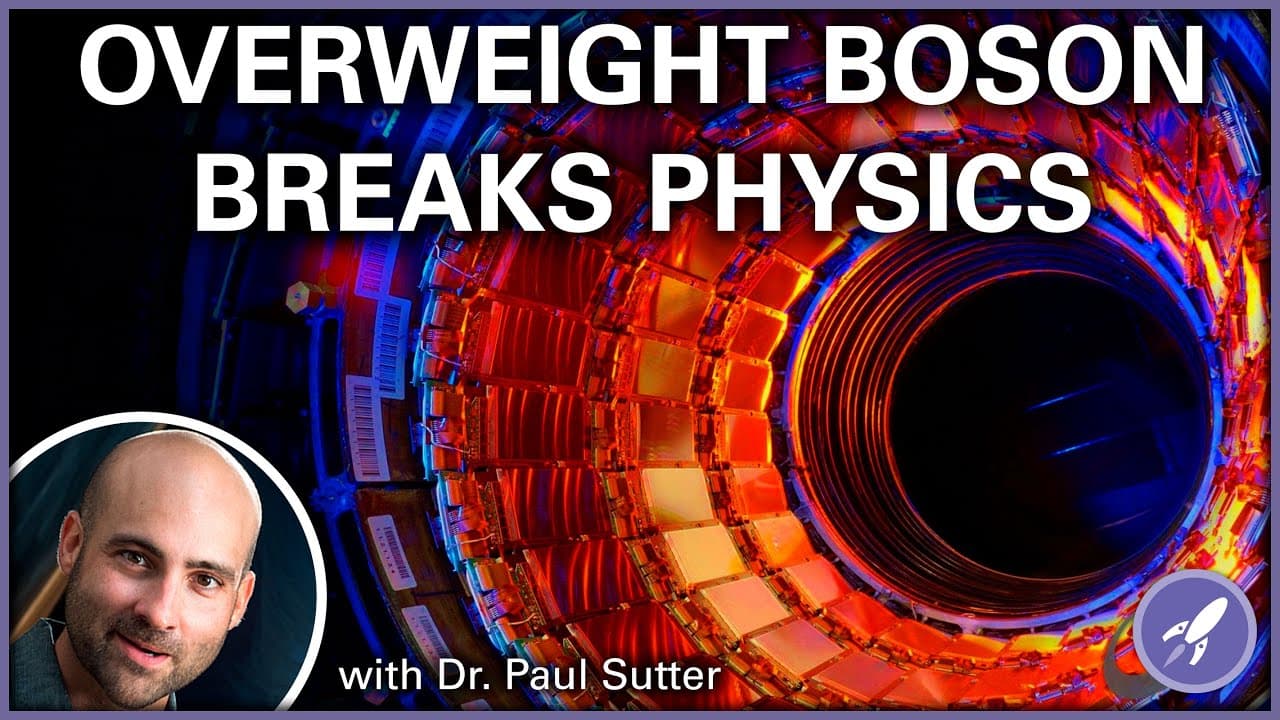
TL;DR
Recent measurements at the Tevatron particle collider suggest that the mass of the W boson is slightly heavier than predicted by the Standard Model, potentially indicating the presence of unknown particles or interactions.
Transcript
Fraser Cain: Hi, everyone. I'm Fraser Cain, publisher of Universe Today, I have been a space and astronomy journalist for over 20 years. And sometimes I get a little over my head with the news. And I honestly have no idea what has been discovered. And it's times like that when I bring a bigger brain, in this case, a doctor of particle physics, I be... Read More
Key Insights
- 🙂 The Tevatron particle collider at Fermilab has measured the mass of the W boson to be slightly heavier than predicted by the Standard Model.
- 🆕 The W boson is a particle that carries the weak nuclear force, one of the fundamental forces in nature.
- 🤨 This discrepancy raises questions about the accuracy of the Standard Model and suggests the possibility of new particles or interactions that could explain the observed deviation.
- 🪡 Further analysis and experiments will be needed to confirm the results and investigate the potential implications for particle physics.
- 👶 If the discrepancy is confirmed, it could provide new insights into the nature of particles and forces in the universe.
- 🪈 The precision of the Tevatron measurement and its consistency with other experiments will be examined in order to determine the validity of the result.
- 💆 The mass of the W boson is connected to other particles and their masses, and any discrepancy could indicate a flaw in the interconnections described by the Standard Model.
Install to Summarize YouTube Videos and Get Transcripts
Explore YouTube Video Summarizer or Get YouTube Transcript Extractor
Questions & Answers
Q: What is the W boson and why is its mass important in particle physics?
The W boson is a particle that carries the weak nuclear force, one of the four fundamental forces in nature. Its mass is important in the Standard Model because it affects the behavior of other particles and their interactions.
Q: How was the mass of the W boson measured?
The measurement is indirect and involves studying the decay products of particles created during collisions at the Tevatron collider. By analyzing the energy of particles like electrons produced in these decays, scientists can infer the mass of the W boson.
Q: How does the measured mass of the W boson differ from theoretical predictions?
The measured mass of the W boson is slightly higher than predicted by the Standard Model, with a significant difference of seven standard deviations. This indicates a potential discrepancy between theory and experiment.
Q: What could explain the observed discrepancy in the W boson mass?
There are several possibilities to consider. One is that the Tevatron measurement is incorrect or affected by unknown systematic errors. Another possibility is that the Standard Model is incomplete and there are unknown particles or interactions that contribute to the mass of the W boson.
Summary & Key Takeaways
-
The Tevatron particle collider at Fermilab has measured the mass of the W boson, a particle that carries the weak nuclear force. The result shows that the W boson is slightly heavier than theoretical predictions and other experimental measurements.
-
The mass of the W boson is important in the Standard Model of particle physics, which describes the fundamental particles and forces in the universe.
-
This discrepancy raises questions about the accuracy of the Standard Model and suggests the possibility of new particles or interactions that could explain the observed discrepancy.
Read in Other Languages (beta)
Share This Summary 📚
Summarize YouTube Videos and Get Video Transcripts with 1-Click
Try YouTube Summary with ChatGPT & Claude or YouTube Transcript Generator
Explore More Summaries from Fraser Cain 📚





Summarize YouTube Videos and Get Video Transcripts with 1-Click
Try YouTube Summary with ChatGPT & Claude or YouTube Transcript Generator