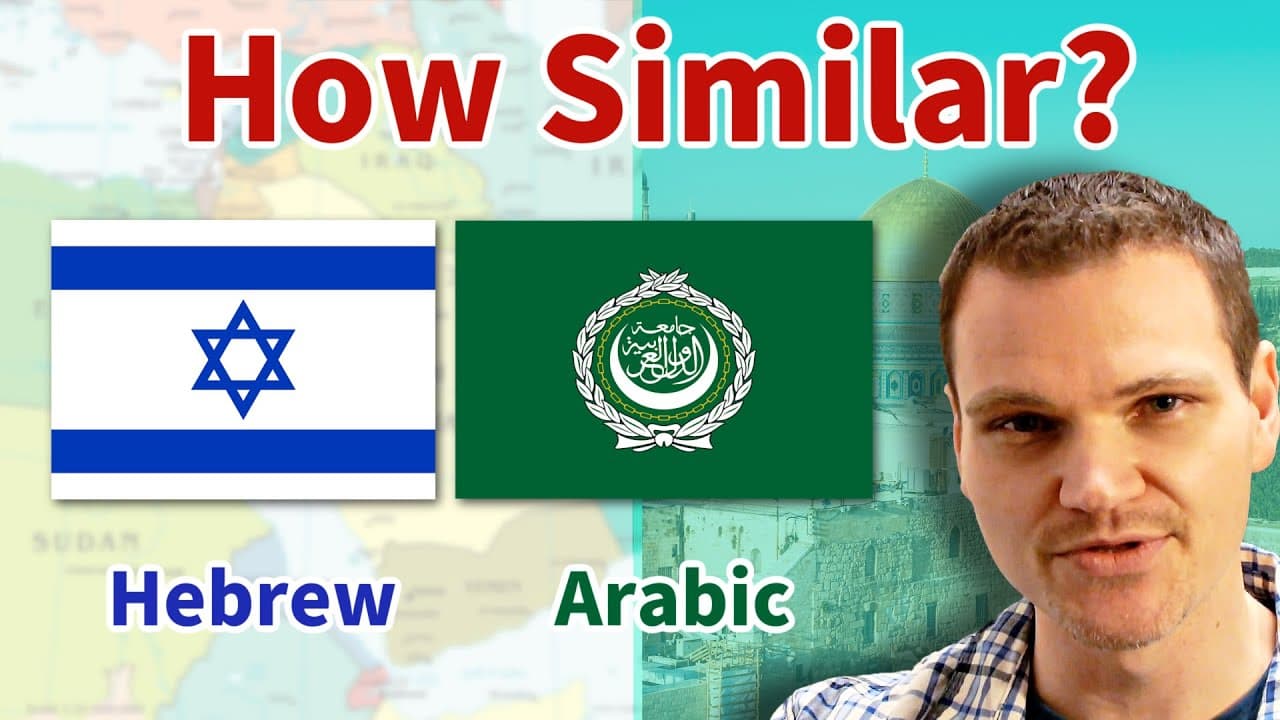
Hebrew vs Arabic - How Similar Are They? (2 SEMITIC LANGUAGES)
TL;DR
Hebrew and Arabic are similar but not mutually intelligible.
Transcript
Can a Hebrew speaker understand an Arabic speaker? Well, the short answer is "No". The long answer is "kinda, sorta, maybe, but not really, no." The question of the day is: "How similar are Hebrew and Arabic?" As someone who has studied both languages, I get asked this question by quite a few people. And it's a good question, it makes me think, be... Read More
Key Insights
- Hebrew and Arabic are closely related languages from the Semitic family, sharing many similarities in grammar and vocabulary.
- Despite their similarities, Hebrew and Arabic are not mutually intelligible, meaning speakers cannot understand each other without studying the other language.
- Both languages use a root and template system for word formation, involving three consonant roots placed into patterns to create words.
- Many words in Hebrew and Arabic are cognates, having developed from the same root in an earlier Semitic language, though pronunciation and spelling may differ.
- Some words are identical in both languages, such as 'yad' for 'hand' and 'dam' for 'blood', while others have similar roots but different meanings.
- The phonology of Hebrew and Arabic has diverged over time, leading to differences in sound and pronunciation despite shared vocabulary.
- Learning one of these languages can significantly aid in learning the other due to shared linguistic structures and vocabulary.
- Cultural and dialectal variations in Arabic can affect comprehension, with different regions having unique pronunciations and vocabulary.
Install to Summarize YouTube Videos and Get Transcripts
Explore YouTube Video Summarizer or Get YouTube Transcript Extractor
Questions & Answers
Q: Can a Hebrew speaker understand an Arabic speaker?
A Hebrew speaker cannot understand an Arabic speaker without studying Arabic. Although the languages share similarities due to their Semitic roots, they are not mutually intelligible. This means that speakers of one language cannot automatically understand the other without prior learning.
Q: What are some similarities between Hebrew and Arabic?
Hebrew and Arabic share a root and template system for word formation, where three consonant roots are combined with patterns to create words. They also have many cognate words, such as 'yad' for 'hand' and 'dam' for 'blood', which have similar meanings across both languages.
Q: In what way do Hebrew and Arabic differ?
Despite their similarities, Hebrew and Arabic differ in phonology and pronunciation. Over time, the sounds and spellings of words have diverged, resulting in differences that can lead to confusion. Additionally, some words have different meanings in each language, further complicating comprehension.
Q: How does learning one language help with learning the other?
Learning one of these languages aids in learning the other due to shared linguistic structures and vocabulary. The root and template system is common to both, so understanding it in one language provides a foundation for grasping it in the other, making the learning process more efficient.
Q: What role do cultural and regional variations play in language comprehension?
Cultural and regional variations, especially in Arabic, can impact comprehension. Different Arabic-speaking regions have unique dialects with variations in pronunciation and vocabulary, which can affect mutual understanding even among Arabic speakers. This highlights the complexity of achieving fluency across different dialects.
Q: Are there any identical words in Hebrew and Arabic?
Yes, there are identical words in Hebrew and Arabic, such as 'yad' meaning 'hand' and 'dam' meaning 'blood'. These words have retained their meanings across both languages due to their shared Semitic roots, although such exact matches are relatively rare compared to other vocabulary.
Q: What is the significance of the root and template system in these languages?
The root and template system is crucial in both Hebrew and Arabic for word formation. It involves inserting three consonant roots into patterns to generate words. This system allows for the creation of various word types, including verbs, nouns, and adjectives, and is a key feature of both languages.
Q: Why are Hebrew and Arabic considered separate languages and not dialects?
Hebrew and Arabic are considered separate languages due to their lack of mutual intelligibility and distinct phonological and grammatical differences. While they share a common linguistic ancestry, the divergence in sounds, vocabulary, and usage over time has resulted in them being distinct languages rather than dialects of the same language.
Summary & Key Takeaways
-
Hebrew and Arabic are related languages from the Semitic family, sharing similar grammatical structures and vocabulary due to a common linguistic ancestry. However, they are not mutually intelligible, requiring speakers to learn the other language to communicate effectively.
-
Both languages utilize a root and template system for word formation, where three consonant roots are inserted into patterns to create various words. This system, along with shared vocabulary, makes learning one language beneficial for understanding the other.
-
Despite similarities, differences in phonology and meaning can lead to confusion. Cultural and regional variations in Arabic further complicate mutual understanding, highlighting the need for dedicated study to achieve proficiency in both languages.
Read in Other Languages (beta)
Share This Summary 📚
Summarize YouTube Videos and Get Video Transcripts with 1-Click
Try YouTube Summary with ChatGPT & Claude or YouTube Transcript Generator
Explore More Summaries from Langfocus 📚






Summarize YouTube Videos and Get Video Transcripts with 1-Click
Try YouTube Summary with ChatGPT & Claude or YouTube Transcript Generator