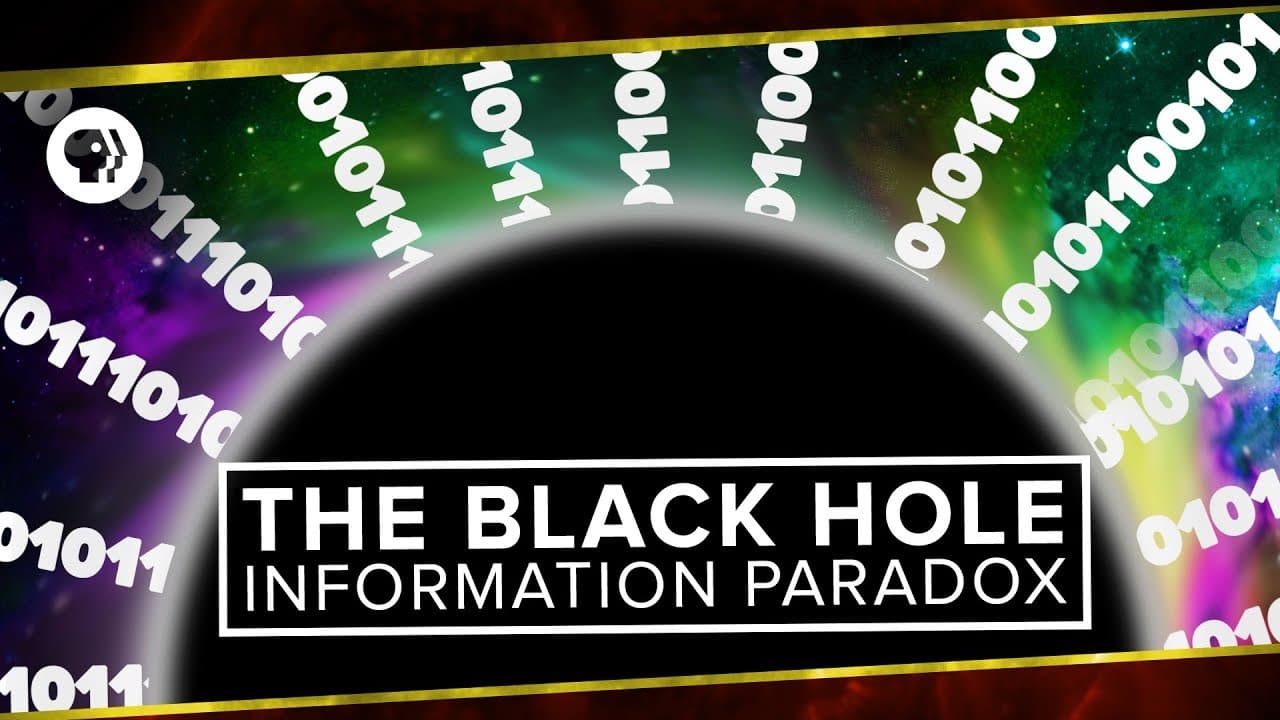
The Black Hole Information Paradox
TL;DR
Hawking radiation challenges quantum mechanics by potentially destroying information.
Transcript
MATT O'DOWD: Thank you to Brilliant.org for supporting PBS Digital Studios. Stephen Hawking found a way to vanquish the black hole with his eponymous radiation. But that same radiation threatens the very foundations of quantum mechanics. It may very well be the loose thread that leads to a theory of everything. [MUSIC PLAYING] Black holes are engin... Read More
Key Insights
- Stephen Hawking's discovery of Hawking radiation suggests black holes can evaporate, releasing mass over time, but raises questions about information preservation.
- The black-hole information paradox challenges the law of conservation of quantum information, a fundamental principle of quantum mechanics.
- The no-hair theorem states black holes are defined by mass, charge, and angular momentum, but doesn't account for the information swallowed by black holes.
- Hawking radiation, resembling thermal radiation, is theorized to erase information, conflicting with quantum mechanics' demand for information preservation.
- Physicists debate whether information escapes black holes via Hawking radiation or is lost to a new universe, leading to groundbreaking theories.
- The holographic principle suggests our 3D universe could be a projection of a 2D surface, inspired by black hole information storage theories.
- Black-hole complementarity posits that information might exist in two forms—inside and outside the black hole—without violating quantum mechanics.
- The paradox has led to radical new ideas in physics, including the possibility of the universe being a hologram and the exploration of string theory.
Install to Summarize YouTube Videos and Get Transcripts
Explore YouTube Video Summarizer or Get YouTube Transcript Extractor
Questions & Answers
Q: What is the black-hole information paradox?
The black-hole information paradox arises from Stephen Hawking's discovery of Hawking radiation, which suggests that black holes can evaporate over time. This process challenges the law of conservation of quantum information, a fundamental principle of quantum mechanics, by potentially erasing information that falls into black holes.
Q: How does Hawking radiation challenge quantum mechanics?
Hawking radiation challenges quantum mechanics by proposing that black holes can evaporate, releasing mass as thermal radiation without preserving the information about the matter that fell into them. This contradicts the law of conservation of quantum information, which states that information must be preserved, leading to the black-hole information paradox.
Q: What is the no-hair theorem?
The no-hair theorem posits that black holes can be completely described by only three properties: mass, electric charge, and angular momentum. However, it doesn't account for the information about the matter that forms the black hole, contributing to the black-hole information paradox when considering Hawking radiation's potential to erase information.
Q: What is the holographic principle?
The holographic principle is a theoretical concept suggesting that our 3D universe could be a projection of a 2D surface. This idea emerged from attempts to resolve the black-hole information paradox, where information about matter falling into a black hole might be stored on its surface, influencing outgoing Hawking radiation.
Q: How does black-hole complementarity relate to the information paradox?
Black-hole complementarity is a theoretical approach to resolving the information paradox by suggesting that information might exist in two forms: inside the black hole and on its event horizon. This concept proposes that these two forms of information are complementary, avoiding violations of quantum mechanics like the no-cloning theorem.
Q: What are the implications of the black-hole information paradox?
The black-hole information paradox has led to groundbreaking theories in physics, including the holographic principle and black-hole complementarity. It challenges our understanding of quantum mechanics and general relativity, suggesting that a deeper theory, potentially involving quantum gravity, is needed to reconcile these fundamental concepts.
Q: What was the bet between John Preskill and Stephen Hawking?
John Preskill and Stephen Hawking made a bet regarding the fate of information in black holes. Preskill bet that information somehow escapes black holes, while Hawking believed it was lost forever. Hawking later conceded the bet, acknowledging that information might escape, and gave Preskill an encyclopedia as a prize.
Q: How did Gerard 't Hooft contribute to resolving the information paradox?
Gerard 't Hooft contributed to resolving the information paradox by proposing that infalling material distorts the event horizon of a black hole, creating a 'lump' that contains information. This distortion could influence outgoing Hawking radiation, allowing it to carry information, leading to the idea that the universe might be a hologram.
Summary & Key Takeaways
-
Hawking radiation proposes that black holes can gradually evaporate, challenging the fundamental principles of quantum mechanics by potentially erasing information.
-
The black-hole information paradox arises from the conflict between Hawking radiation and the law of conservation of quantum information, a core tenet of quantum mechanics.
-
Physicists explore various theories, including the holographic principle and black-hole complementarity, to reconcile the paradox and understand the universe's fundamental nature.
Read in Other Languages (beta)
Share This Summary 📚
Summarize YouTube Videos and Get Video Transcripts with 1-Click
Try YouTube Summary with ChatGPT & Claude or YouTube Transcript Generator
Explore More Summaries from PBS Space Time 📚
Summarize YouTube Videos and Get Video Transcripts with 1-Click
Try YouTube Summary with ChatGPT & Claude or YouTube Transcript Generator