Products
Features
YouTube Video Summarizer
Summarize YouTube videos
Web & PDF Highlighter
Highlight web pages & PDFs
Chat with PDF
Ask any PDF questions with AI
Ask AI Clone
Chat with your highlights & memories
Audio Transcriber
Transcribe audio files to text
Glasp Reader
Read and highlight articles
Kindle Highlight Export
Export your Kindle highlights
Idea Hatch
Hatch ideas from your highlights
Integrations
Obsidian Plugin
Notion Integration
Pocket Integration
Instapaper Integration
Medium Integration
Readwise Integration
Snipd Integration
Hypothesis Integration
Apps & Extensions
Chrome Extension
Safari Extension
Edge Add-ons
Firefox Add-ons
iOS App
Android App
Discover
Discover
Ideas
Discover new ideas and insights
Articles
Curated articles and insights
Books
Book recommendations by great minds
Posts
Essays and notes from readers
Quotes
Inspiring quotes collection
Videos
Curated videos and summaries
Explore Glasp
Glasp Story
How we grew from 0 to 3 million users
Glasp Newsletter
Weekly insights and updates
Glasp Talk
Interview series with great minds
Glasp Blog
Latest news and articles
Glasp Use Cases
Learn how others use Glasp
Build & Support
Glasp API
Access Glasp's API for developers
MCP Connector
Connect Glasp to Claude & ChatGPT
Community
Glasp Reddit Community
Students
Student discount and benefits
FAQs
Frequently Asked Questions
AboutPricing
DashboardLog inSign up

States of Matter - Solids, Liquids, Gases & Plasma - Chemistry
September 6, 2018
by
The Organic Chemistry Tutor
YouTube video player
States of Matter - Solids, Liquids, Gases & Plasma - Chemistry

TL;DR

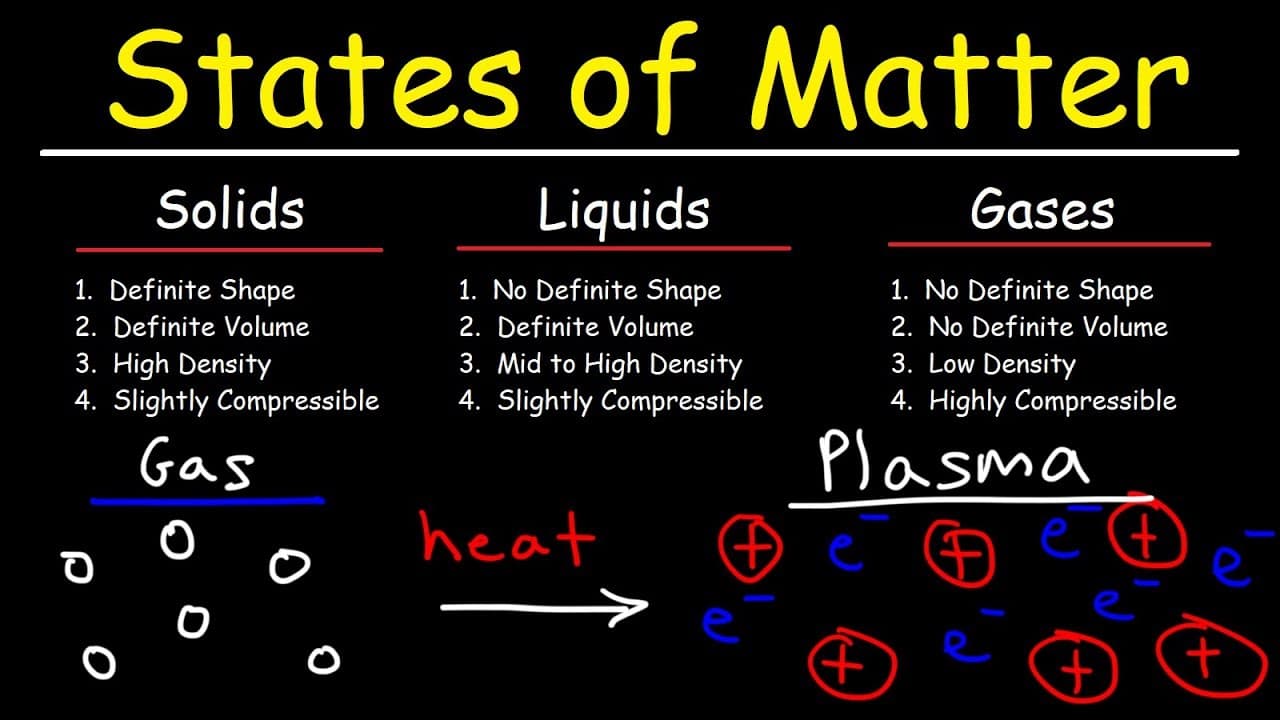
This video explains the three common states of matter - solids, liquids, and gases - as well as the fourth state of matter, plasma.

Transcript

in this video we're going to focus on states of matter at least the most common ones that you typically encounter and so these include solids liquids and gases but first what is matter matter you can think of it as stuff it's basically anything that has mass and takes up space matter is composed of individual tiny particles known as atoms and matte... Read More

Key Insights

  • 🫢 Matter is composed of atoms and can be classified into solids, liquids, and gases.
  • 🔇 Solids have fixed shapes and volumes, while liquids have definite volumes but no fixed shapes.
  • 🫢 Liquids and gases are referred to as fluids because they can flow, while solids cannot.
  • 😘 The density of solids is usually higher than that of liquids, while gases have low density.
  • 🫢 Gases are highly compressible due to their large empty spaces between particles.
  • 🥵 Phase changes involve converting matter from one state to another by adding or removing heat.
  • 🫠 Melting, vaporization, and sublimation are endothermic processes, while freezing, condensation, and deposition are exothermic processes.

Install to Summarize YouTube Videos and Get Transcripts

Explore YouTube Video Summarizer or Get YouTube Transcript Extractor

Questions & Answers

Q: What is the definition of matter and what are its three categories?

Matter refers to anything with mass and takes up space. It is classified into solids, liquids, and gases.

Q: How do the shapes and volumes of solids and liquids differ?

Solids have fixed shapes and volumes, while liquids have no fixed shapes but definite volumes.

Q: Why are liquids and gases referred to as fluids?

Liquids and gases can flow and take the shape of their containers, making them classified as fluids.

Q: Can solids, liquids, and gases be compressed or is it limited to gases only?

Gases have a high compressibility due to their low density, while solids and liquids are only slightly compressible because their atoms are closely packed.

Summary & Key Takeaways

  • Matter refers to anything that has mass and occupies space, consisting of tiny particles called atoms.

  • Solids have a definite shape and volume, while liquids have no definite shape but a definite volume.

  • Gases, like liquids, have no definite shape but also have a low density, and plasma is an ionized gas that conducts electricity.


Read in Other Languages (beta)

English

Share This Summary 📚

Summarize YouTube Videos and Get Video Transcripts with 1-Click

Download browser extensions on:

Try YouTube Summary with ChatGPT & Claude or YouTube Transcript Generator

Explore More Summaries from The Organic Chemistry Tutor 📚
How to Graph Logarithmic Functions with Transformations thumbnail
How to Graph Logarithmic Functions with Transformations
The Organic Chemistry Tutor
How to Tell if a Car Is Speeding Up or Slowing Down thumbnail
How to Tell if a Car Is Speeding Up or Slowing Down
The Organic Chemistry Tutor
How to Draw Free Body Diagrams for Forces thumbnail
How to Draw Free Body Diagrams for Forces
The Organic Chemistry Tutor
How To Create a Calendar In Excel 2016 - VERY EASY! thumbnail
How To Create a Calendar In Excel 2016 - VERY EASY!
The Organic Chemistry Tutor
How to Solve Parallel Plate Capacitor Problems thumbnail
How to Solve Parallel Plate Capacitor Problems
The Organic Chemistry Tutor
Autosum, Average, Max, Min, Count & Autofill Functions | Excel thumbnail
Autosum, Average, Max, Min, Count & Autofill Functions | Excel
The Organic Chemistry Tutor

Summarize YouTube Videos and Get Video Transcripts with 1-Click

Download browser extensions on:

Try YouTube Summary with ChatGPT & Claude or YouTube Transcript Generator

Apps & Extensions

  • Chrome Extension
  • Safari Extension
  • Edge Add-ons
  • Firefox Add-ons
  • iOS App
  • Android App

Key Features

  • YouTube Video Summarizer
  • Web & PDF Summarizer
  • Web & PDF Highlighter
  • Chat with PDF
  • Ask AI Clone
  • Audio Transcriber
  • Glasp Reader
  • Kindle Highlight Export
  • Idea Hatch

Integrations

  • Obsidian Plugin
  • Notion Integration
  • Pocket Integration
  • Instapaper Integration
  • Medium Integration
  • Readwise Integration
  • Snipd Integration
  • Hypothesis Integration

More Features

  • APIs
  • MCP Connector
  • Blog & Post
  • Embed Links
  • Image Highlight
  • Personality Test
  • Quote Shots
  • Open Graph Checker

Company

  • About us
  • Our Story
  • Blog
  • Community
  • FAQs
  • Job Board
  • Newsletter
  • Pricing
Terms

•

Privacy

•

Guidelines

© 2026 Glasp Inc. All rights reserved.