Human ear - structure & working | Sound | Physics | Khan Academy
TL;DR
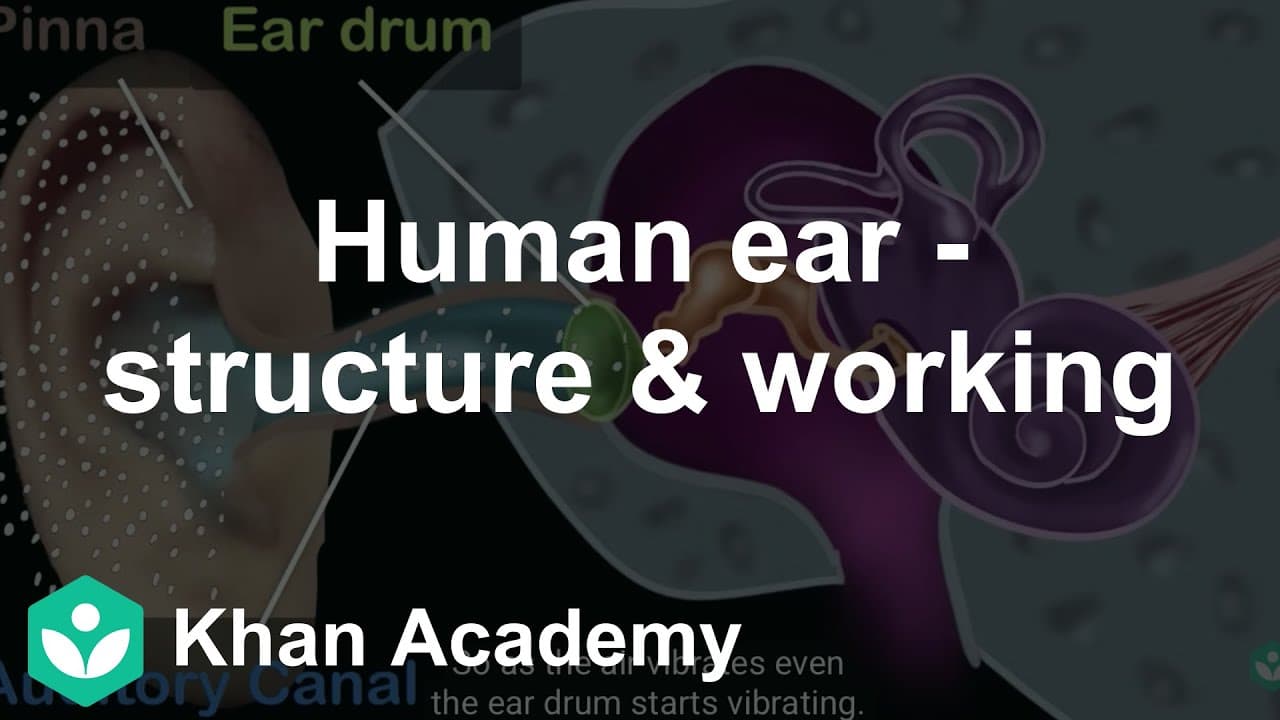
Our ears convert vibrating air particles into electrical signals that our brain interprets as sound.
Transcript
(classical music) - [Narrator] How are you listening to this music right now? (classical music) Well you might know that your speakers are creating sound and your ears are listening to it. But there is a lot more going on here. You see all your speakers are doing right now is vibrating the particles of the air close to it. Then they vibrate the air... Read More
Key Insights
- 😮 The process of hearing involves the vibrations of air particles, which are converted into sound waves and eventually perceived by our ears as sound.
- 👂 The ear is divided into three parts: the outer ear, middle ear, and inner ear, each playing a specific role in the process of hearing.
- 🔊 The outer ear collects sound waves through the pinna and directs them into the auditory canal, where they reach the eardrum.
- 🦴 The middle ear consists of three tiny bones called ossicles, which amplify the vibrations of the eardrum and transfer them to the inner ear.
- 💧 The inner ear is composed of the cochlea, a snail-like structure filled with liquid. When the vibrations reach the cochlea, the liquid starts vibrating.
- ⚡ Specialized cells in the cochlea convert these vibrations into electrical signals, which are then sent through the auditory nerves to the brain for interpretation as sound.
- 👍 The cells in the cochlea are highly sensitive to sound intensity, frequency, and pitch, allowing our brain to differentiate between different sounds.
- 🎶 The entire process of converting the movement of air particles into the complex experience of sound is truly remarkable and cannot be fully described in words.
Install to Summarize YouTube Videos and Get Transcripts
Explore YouTube Video Summarizer or Get YouTube Transcript Extractor
Questions & Answers
Q: How do our ears collect and transmit sound waves?
The pinna of the outer ear collects sound waves and directs them into the auditory canal, where they reach the sensitive ear drum. The ear drum starts vibrating when it encounters air vibrations, and these vibrations are then transferred to the ossicles in the middle ear.
Q: What is the purpose of the ossicles in the middle ear?
The ossicles, consisting of the malleus, incus, and stapes, amplify the pressure of the sound wave as it reaches the inner ear. This is necessary because the inner ear contains liquid instead of air, and higher pressure is needed to vibrate the liquid particles.
Q: How does the cochlea convert vibrations into electrical signals?
When the stapes, the third bone of the ossicles, strikes the cochlea, the liquid within it starts vibrating. This vibration is detected by specialized cells in the cochlea, which then convert them into electrical signals. These signals are transmitted through the auditory nerves to the brain for interpretation.
Q: How sensitive are the cells in the cochlea to sound?
The cells in the cochlea are incredibly sensitive to sound, as they can detect differences in volume (loudness) and frequency (pitch). This enables our brain to differentiate between different sounds, recognize words, and appreciate the nuances of music.
Q: Why is the conversion of air vibrations into sound considered unfathomable?
The transformation of simple back and forth movement of air particles into the complex experience of sound is truly remarkable. Our ears and the intricate structures within them allow us to perceive and interpret the world of sound around us, which is a phenomenon that is difficult to fully comprehend or put into words.
Summary & Key Takeaways
-
The outer ear collects sound waves and directs them to the ear drum, which starts vibrating when it encounters air vibrations.
-
The middle ear contains three tiny bones called ossicles that amplify the sound wave's pressure before transferring it to the inner ear.
-
The inner ear consists of the cochlea, which converts vibrations into electrical signals that are sent to the brain for interpretation.
Read in Other Languages (beta)
Share This Summary 📚
Summarize YouTube Videos and Get Video Transcripts with 1-Click
Try YouTube Summary with ChatGPT & Claude or YouTube Transcript Generator
Explore More Summaries from Khan Academy India - English 📚


Summarize YouTube Videos and Get Video Transcripts with 1-Click
Try YouTube Summary with ChatGPT & Claude or YouTube Transcript Generator