Office Hours: Water
TL;DR
Hank Green answers questions about water's properties and life chemistry.
Transcript
Hello, I'm Hank Green and this is Crash Course Office Hours where I take some of the questions and concerns that you had with the last episode of Crash Course Biology and answer them or address them. We have an excellent question from MsLebbel: "What is meant by polar?" Now, when we were talking about this in the last episode, we're talking about c... Read More
Key Insights
- Chemical polarity occurs when a molecule has distinct positive and negative charges, making it act like a magnet.
- Life as we know it is based on water and carbon, but the possibility of other life forms cannot be entirely dismissed.
- Commonly perceived steam is actually tiny water droplets; true steam is gaseous water and extremely hot.
- Icebergs sinking due to higher density would not raise sea levels since they already displace their mass when floating.
- Hank Green acknowledges the collaborative effort behind Crash Course, highlighting the contributions of his team.
- The concept of polarity is crucial to understanding molecular interactions and chemical reactions.
- The distinction between liquid droplets and gaseous steam is important for scientific accuracy and safety.
- Community feedback plays a significant role in correcting and refining educational content presented in Crash Course.
Install to Summarize YouTube Videos and Get Transcripts
Explore YouTube Video Summarizer or Get YouTube Transcript Extractor
Questions & Answers
Q: What is meant by chemical polarity?
Chemical polarity refers to a condition in molecules where there is a distinct separation of electric charge, leading to the molecule having a positive end and a negative end. This occurs because electrons tend to spend more time around one part of the molecule than another, essentially turning the molecule into a magnet. This characteristic greatly influences molecular interactions and chemical behavior.
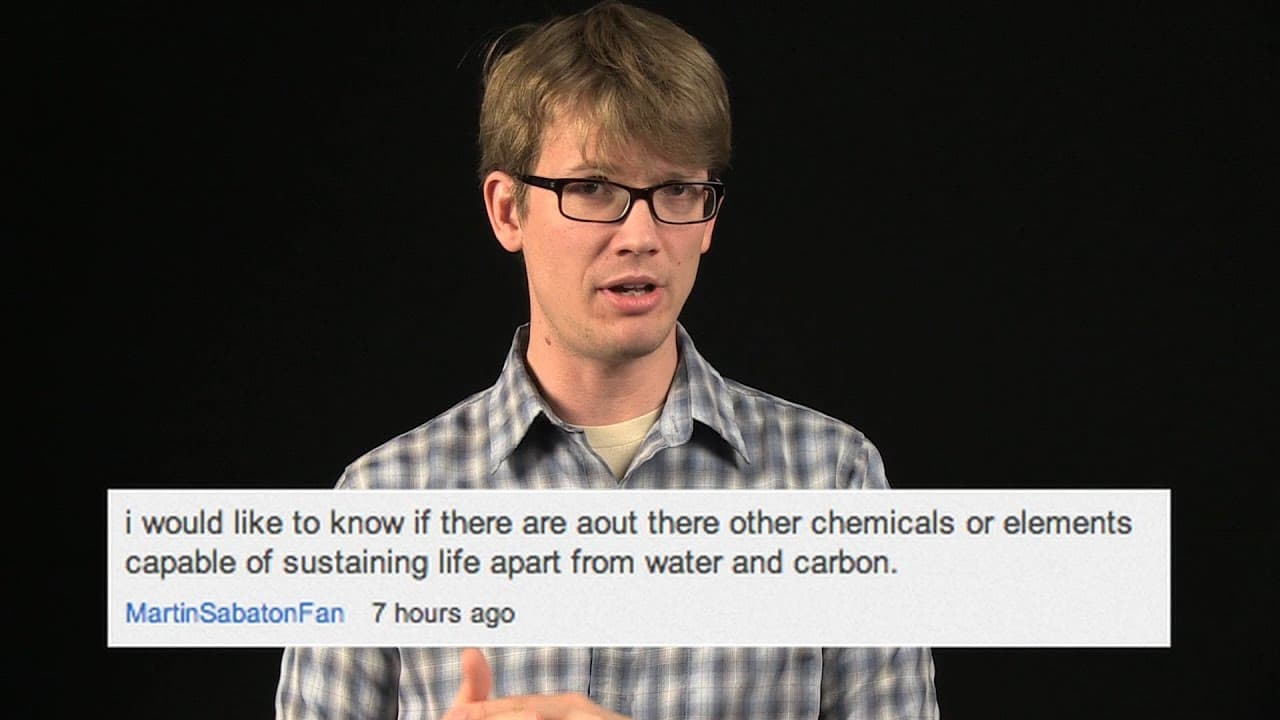
Q: Are there other elements besides water and carbon that life could be based on?
While all known life is based on water and carbon, the possibility of life based on other elements cannot be entirely ruled out. The idea is speculative, as our understanding of life is constrained by the examples we have observed on Earth. However, given the vastness of the universe, it is conceivable that alternative life forms could exist, though we have yet to discover them.
Q: Is steam a gas or a liquid?
Scientifically, steam is gaseous water, not a liquid. The term 'steam' in everyday language often refers to the visible mist of tiny water droplets, which is technically not steam. True steam is an invisible gas that is hotter than boiling water. If you were exposed to a room filled with steam, it would be extremely dangerous due to its high temperature.
Q: Would icebergs sinking increase sea levels?
No, icebergs sinking due to being denser than water would not increase sea levels. Icebergs already displace their mass in water when floating. If they were denser and sank, they would take up less space than when floating, as they would have a smaller volume underwater. This correction highlights the importance of understanding buoyancy and displacement principles.
Q: Who helps Hank Green with Crash Course?
Hank Green is supported by a dedicated team in producing Crash Course. This includes Jenkins, who works behind the camera, Nick, who edits the videos, and Blake and Jesslyn, who assist with writing. Additionally, Amber and Pete contribute to creating the graphics. This collaborative effort ensures the high quality and educational value of the content.
Q: Why is understanding polarity important?
Understanding polarity is crucial because it affects how molecules interact with each other. Polarity determines the solubility of substances, their boiling and melting points, and their reactivity. In biological systems, polarity influences how molecules like proteins and DNA fold and function. It is a fundamental concept in chemistry that underpins many natural and industrial processes.
Q: How does community feedback impact Crash Course?
Community feedback is vital for Crash Course as it helps identify errors and areas for clarification, ensuring the accuracy and relevance of the content. Viewer questions and corrections enable the creators to refine their explanations and address misconceptions, fostering a more interactive and responsive educational experience. This engagement enhances the learning process for all participants.
Q: What is the significance of distinguishing between steam and mist?
Distinguishing between steam and mist is important for both scientific accuracy and safety. Mist, visible as a cloud of tiny water droplets, is not steam, which is an invisible gas. Understanding this difference is crucial, especially in industrial settings where steam's high temperature can pose significant hazards. Accurate terminology helps prevent misunderstandings and promotes effective communication in scientific contexts.
Summary & Key Takeaways
-
Hank Green addresses viewer questions about water's properties, emphasizing the importance of understanding chemical polarity and steam. He clarifies misconceptions, such as the nature of steam and the impact of ice density on sea levels, while acknowledging the collaborative efforts behind Crash Course.
-
In response to questions, Hank explains that life is fundamentally based on water and carbon, though the potential for alternative life forms remains an open question. He also corrects a previous statement about icebergs and sea levels, highlighting the importance of community feedback.
-
Hank Green's Office Hours segment demonstrates the interactive nature of Crash Course, where viewer inquiries drive content clarification and expansion. The episode underscores the significance of scientific accuracy and the collective effort of the Crash Course team in producing educational material.
Read in Other Languages (beta)
Share This Summary 📚
Summarize YouTube Videos and Get Video Transcripts with 1-Click
Try YouTube Summary with ChatGPT & Claude or YouTube Transcript Generator
Explore More Summaries from CrashCourse 📚

Summarize YouTube Videos and Get Video Transcripts with 1-Click
Try YouTube Summary with ChatGPT & Claude or YouTube Transcript Generator