Engines Nomenclatures or Terminology - Introduction of Internal Combustion Engines
TL;DR
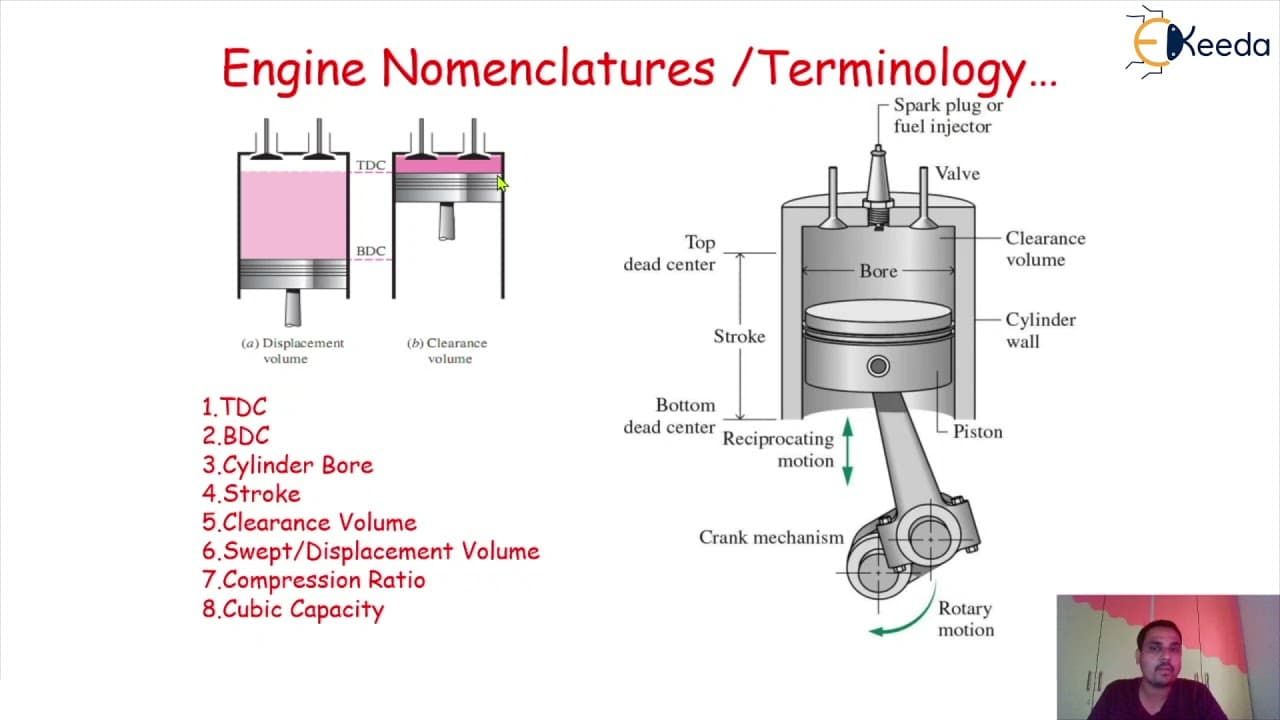
This content provides an explanation of engine nomenclatures and terminology, including concepts such as bore, stroke, clearance volume, and compression ratio.
Transcript
dear friends today we are going to discuss engine nomenclatures or its terminology in the last lecture we already started to discuss about the engine so very important definition of the engine which we had in the last lecture itself that is nothing but engine is a device which is used to convert the chemical energy which present in the fuel into th... Read More
Key Insights
- 🥵 Engines convert chemical energy in fuel into heat energy, which is then used for mechanical work.
- 🚒 Understanding engine nomenclatures and terminology is crucial for gaining a comprehensive understanding of engines.
- 🥳 Important nomenclatures include bore, stroke, clearance volume, and compression ratio.
- 💀 Bore refers to the inner diameter of the engine cylinder, while stroke is the distance traveled by the piston between two dead centers.
- 🤕 Clearance volume ensures there is a gap between the piston and cylinder head to prevent contact.
- 🔇 The displacement volume is the volume swept by the piston during its reciprocating motion.
- ✊ The cubic capacity of an engine indicates its power output and is calculated by multiplying the displacement volume by the number of cylinders.
Install to Summarize YouTube Videos and Get Transcripts
Explore YouTube Video Summarizer or Get YouTube Transcript Extractor
Questions & Answers
Q: What is the definition of an engine?
An engine is a device that converts the chemical energy in fuel into heat energy, which is then utilized for mechanical work.
Q: Why is it important to understand engine nomenclatures and terminology?
Understanding engine nomenclatures is essential for gaining a thorough knowledge of engines and their components.
Q: What is bore in engine nomenclature?
Bore refers to the inner diameter of the engine cylinder, where the piston reciprocates.
Q: How is stroke defined in engine terminology?
Stroke is the distance traveled by the piston between two dead centers (top dead center and bottom dead center).
Q: What is clearance volume in engine nomenclature?
Clearance volume refers to the gap between the topmost position of the piston and the cylinder head. It ensures that the piston does not strike the cylinder head.
Q: Define compression ratio in engine terminology.
Compression ratio is the ratio of the total cylinder volume (when the piston is at bottom dead center) to the clearance volume. It indicates the compression pressure achieved in the cylinder.
Q: What is displacement volume in engine nomenclature?
Displacement volume refers to the volume swept by the piston when it travels from one dead center to another (top dead center to bottom dead center or vice versa).
Q: How is the cubic capacity of an engine calculated?
The cubic capacity of an engine is calculated by multiplying the displacement volume of a cylinder by the number of cylinders in the engine.
Summary & Key Takeaways
-
Engines are devices that convert chemical energy in fuel into heat energy, which is then used for mechanical work.
-
Understanding engine nomenclatures and terminology is crucial for gaining thorough knowledge of engines.
-
Key nomenclatures include bore (inner diameter of the engine cylinder), stroke (distance traveled by the piston between two dead centers), clearance volume (gap between the piston and cylinder head), and compression ratio (ratio of total cylinder volume to clearance volume).
Read in Other Languages (beta)
Share This Summary 📚
Summarize YouTube Videos and Get Video Transcripts with 1-Click
Try YouTube Summary with ChatGPT & Claude or YouTube Transcript Generator
Explore More Summaries from Ekeeda 📚






Summarize YouTube Videos and Get Video Transcripts with 1-Click
Try YouTube Summary with ChatGPT & Claude or YouTube Transcript Generator