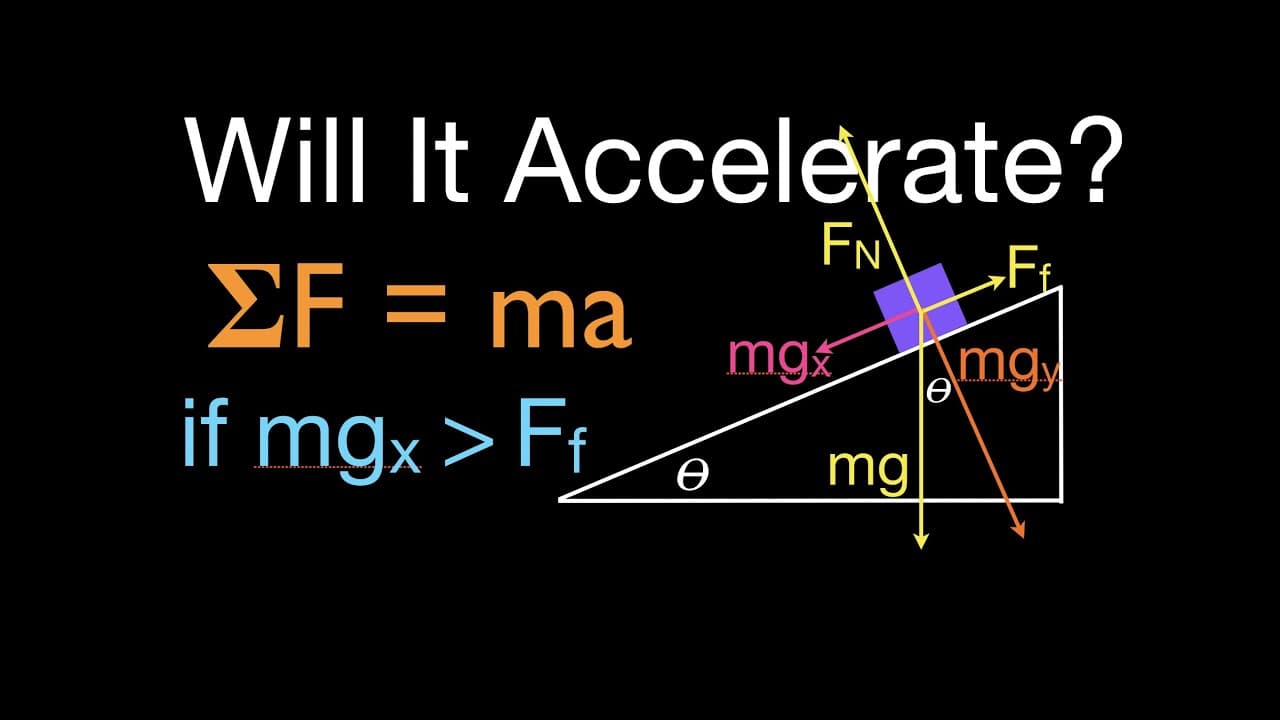
Newton's 2nd Law (18 of 21) Will it Accelerate? Inclined Plane and One Mass
TL;DR
In this video, the concept of object acceleration on inclined planes is explained using Newton's laws of motion.
Transcript
okay in today's video we're going to play one of my favorite physics games and that is will it accelerate and this is the situation we have we have an object on an inc this is the object on an inclined plane there's no friction between the object and the incline plane and we want to know is the object going to accelerate now in two previous videos ... Read More
Key Insights
- ☺️ Objects on inclined planes without friction accelerate due to the unbalanced force of the x-component of the weight.
- ✈️ Friction opposes motion and can affect the acceleration of an object on an inclined plane.
- ❓ The maximum friction force is determined by the coefficient of static friction.
- ☺️ The x-component of the weight must be greater than the friction force for an object to accelerate down an inclined plane.
- ❓ The coefficient of static friction is usually greater than the coefficient of kinetic friction.
- ❓ The maximum friction force is the force required to overcome static friction and start the object's motion.
- ☺️ If the x-component of the weight is less than the maximum friction force, the object will not accelerate.
Install to Summarize YouTube Videos and Get Transcripts
Explore YouTube Video Summarizer or Get YouTube Transcript Extractor
Questions & Answers
Q: Why does an object accelerate down an inclined plane without friction?
An object accelerates down an inclined plane without friction because of the unbalanced force of the x-component of the weight.
Q: What causes an object to accelerate down an inclined plane with friction?
In the presence of friction, an object will still accelerate down the inclined plane if the x-component of the weight is greater than the friction force.
Q: How is the maximum friction force determined?
The maximum friction force is determined by the coefficient of static friction, which is multiplied by the normal force.
Q: Will an object accelerate if the x-component of the weight is less than the maximum friction force?
No, if the x-component of the weight is less than the maximum friction force, the object will not accelerate down the inclined plane.
Summary & Key Takeaways
-
Without friction, an object on an inclined plane will accelerate down the slope due to the unbalanced force of the x-component of the weight.
-
When friction is present, the object will still accelerate down the inclined plane if the x-component of the weight is greater than the friction force.
-
The maximum friction force is determined by the coefficient of static friction, and the object will not accelerate if the x-component of the weight is less than the maximum friction force.
Read in Other Languages (beta)
Share This Summary 📚
Summarize YouTube Videos and Get Video Transcripts with 1-Click
Try YouTube Summary with ChatGPT & Claude or YouTube Transcript Generator
Explore More Summaries from Step by Step Science 📚


Summarize YouTube Videos and Get Video Transcripts with 1-Click
Try YouTube Summary with ChatGPT & Claude or YouTube Transcript Generator