How Do Velocity and Angular Velocity Affect Radius?
TL;DR
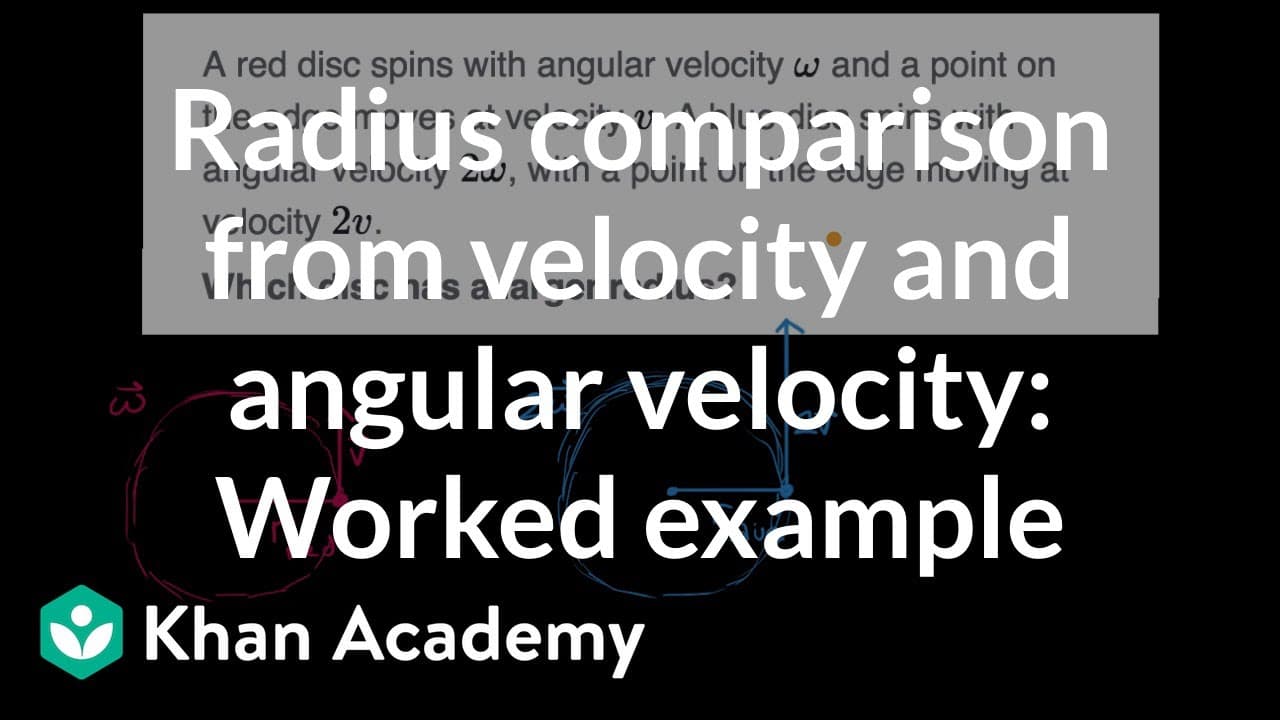
The red and blue discs have identical radii because their ratio of linear velocity to angular velocity is the same. Despite different angular velocities, the cancelled factors show both discs maintain a consistent relationship, leading to equal size.
Transcript
- [Instructor] We are told a red disc spins with angular velocity omega, and a point on the edge moves at velocity V. So they're giving us angular velocity and also you could view this as linear velocity, and they are both vectors, that's why they are bolded. A blue disc spins with angular velocity two omega, so that's twice the angular velocity, s... Read More
Key Insights
- 📐 Angular velocity and linear velocity are related by the equation R = V/omega, where R is the radius, V is the linear velocity, and omega is the angular velocity.
- 🥳 The ratio of linear velocity to angular velocity determines the radius of a spinning object.
- 📐 Increasing the angular velocity will result in an increase in linear velocity if the radius remains constant.
- 😪 The red and blue discs in the video have the same radius because their ratio of linear velocity to angular velocity is the same.
Install to Summarize YouTube Videos and Get Transcripts
Explore YouTube Video Summarizer or Get YouTube Transcript Extractor
Questions & Answers
Q: How are angular velocity and linear velocity related for spinning discs?
The magnitude of angular velocity multiplied by the radius is equal to the magnitude of linear velocity. This means that as angular velocity increases, linear velocity also increases.
Q: How do the velocities and radii of the red and blue discs compare?
The red disc has angular velocity omega and linear velocity V, while the blue disc has angular velocity 2 omega and linear velocity 2V. However, the ratio of linear velocity to angular velocity is the same for both discs, meaning they have the same radius.
Q: What does the equation R = V/omega represent?
The equation represents the relationship between radius, linear velocity, and angular velocity. It shows that the radius is equal to the linear velocity divided by the angular velocity, or speed divided by angular velocity magnitude.
Q: How did the video determine that the red and blue discs have the same radius?
By comparing the equations for the red and blue discs (Rred = V/omega and Rblue = V/omega), it can be seen that they are identical. Therefore, the red and blue discs have the same radius.
Summary & Key Takeaways
-
The video discusses the relationship between angular velocity and radius for spinning discs.
-
A red disc spins with angular velocity omega and a point on the edge moves at velocity V.
-
A blue disc spins with angular velocity two omega, and the point on the edge moves at velocity 2V.
-
The key insight is that the ratio of linear velocity to angular velocity determines the radius, and in this case, the red and blue discs have the same radius.
Read in Other Languages (beta)
Share This Summary 📚
Summarize YouTube Videos and Get Video Transcripts with 1-Click
Try YouTube Summary with ChatGPT & Claude or YouTube Transcript Generator
Explore More Summaries from Khan Academy 📚






Summarize YouTube Videos and Get Video Transcripts with 1-Click
Try YouTube Summary with ChatGPT & Claude or YouTube Transcript Generator