States of Matter: Solids, Liquids & Gases
TL;DR
This video discusses the properties and differences of solids, liquids, and gases, including their shape, volume, compressibility, and phase changes.
Transcript
that's right in today's video we're going to go over some of the similarities differences and characteristics of the three most common states or phases of matter solids liquids and gases before you get started please don't forget to subscribe to my channel step by step science get all my excellent physics chemistry and math videos give me a thumbs ... Read More
Key Insights
- ❓ Temperature is a measure of the energy and motion of particles in matter.
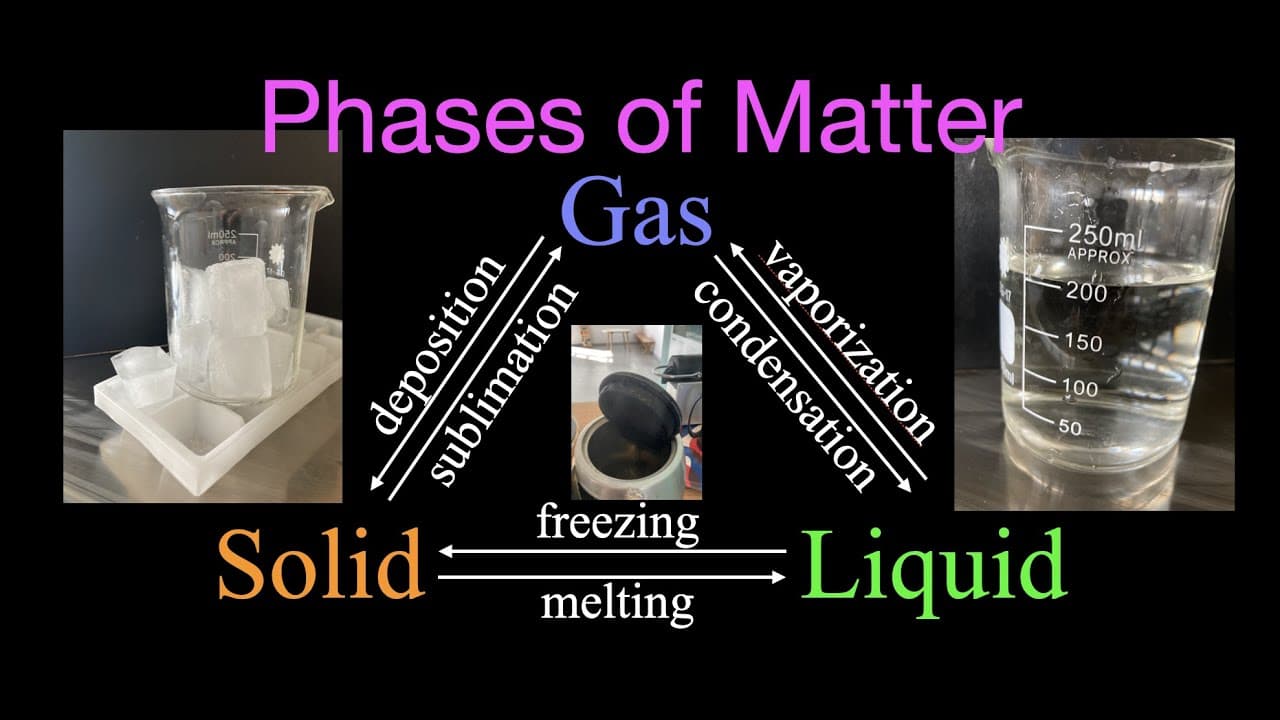
- 💠 Solids have a fixed shape and volume, liquids take the shape of their container, and gases have neither fixed shape nor volume.
- 🫢 Phase changes involve adding or removing energy from particles, leading to transitions between solid, liquid, and gas states.
- 🫠 The six phase changes are melting, vaporization, sublimation, condensation, freezing, and deposition.
- ✋ Plasma, a high-energy phase of matter consisting of ionized particles, exists but is not often discussed in detail.
- 🫢 Solids, liquids, and gases exhibit different particle movement patterns and behaviors.
- ❓ The differences between these three states of matter can be explained by the energy and motion of particles.
Install to Summarize YouTube Videos and Get Transcripts
Explore YouTube Video Summarizer or Get YouTube Transcript Extractor
Questions & Answers
Q: What is the difference between solids, liquids, and gases?
Solids have a fixed shape and volume, liquids take the shape of their container but have a fixed volume, while gases have neither a fixed shape nor volume and are compressible.
Q: Why does the temperature increase as we go from a solid to a liquid to a gas?
The temperature increase corresponds to an increase in the energy of the particles, which affects their motion. Higher energy leads to faster and more vigorous particle movement.
Q: What happens during the phase change from a solid to a liquid?
This phase change is called melting or fusion. The particles of a solid gain energy, which breaks their fixed pattern, allowing them to slide past each other and take the shape of their container.
Q: Can a substance go directly from a solid to a gas without becoming a liquid first?
Yes, this process is called sublimation. Some substances, like dry ice (solid CO2), can go directly from a solid to a gas without passing through the liquid phase.
Summary & Key Takeaways
-
Solids, like ice, maintain a fixed shape and volume and are not compressible, with particles vibrating in a fixed pattern.
-
Liquids, such as water, take the shape of their container and have a fixed volume, with particles sliding past each other.
-
Gases, like steam, do not have a fixed shape or volume, are compressible, and have particles that move easily past each other.
Read in Other Languages (beta)
Share This Summary 📚
Summarize YouTube Videos and Get Video Transcripts with 1-Click
Try YouTube Summary with ChatGPT & Claude or YouTube Transcript Generator
Explore More Summaries from Step by Step Science 📚
Summarize YouTube Videos and Get Video Transcripts with 1-Click
Try YouTube Summary with ChatGPT & Claude or YouTube Transcript Generator