At the Lab Ep. 6: Supermoms to the rescue

TL;DR
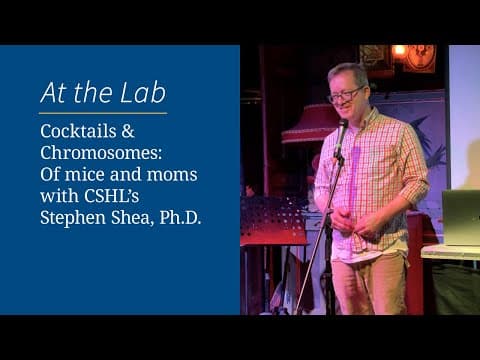
Exploring the neuroscience behind maternal instincts in mice.
Transcript
[music] You’re now At the Lab with Cold Spring Harbor Laboratory. My name is Sue Weil-Kazzaz, and this week At the Lab, “Supermoms to the rescue.” [heroic music] It's a bird! It's a plane! It’s … your mother! Mother's Day is around the corner. So, right about now, you’re probably A) realizing you forgot to buy a gift and B) recalling memories ... Read More
Key Insights
- Professor Stephen Shea investigates maternal behavior in mice to understand social interactions in mammals.
- The study focuses on the brain's reward system, particularly the Ventral Tegmental Area (VTA).
- Dopamine release in the VTA is linked to the rewarding feeling of social contact.
- This research could provide insights into neurodevelopmental disorders.
- Maternal instincts are driven by ancient brain mechanisms shared across species.
- Understanding these mechanisms helps explain how social behaviors are reinforced.
- The study highlights the importance of dopamine in motivation and reward.
- Future research may reveal how these findings apply to other social interactions.
Install to Summarize YouTube Videos and Get Transcripts
Explore YouTube Video Summarizer or Get YouTube Transcript Extractor
Questions & Answers
Q: What is the main focus of Professor Stephen Shea's research?
Professor Stephen Shea's research focuses on understanding the neural mechanisms behind maternal behavior in mice. By studying how the brain processes social interactions, particularly through the release of dopamine in the Ventral Tegmental Area (VTA), Shea aims to uncover the biological basis of maternal instincts and their rewarding nature.
Q: How does dopamine influence maternal behavior in mice?
Dopamine plays a crucial role in reinforcing maternal behavior in mice. When a mother mouse picks up her crying pup, neurons in the Ventral Tegmental Area (VTA) release dopamine, which creates a rewarding sensation. This reward mechanism encourages the mother to continue responding to her pup's distress, reinforcing the behavior.
Q: What potential applications does this research have?
This research has potential applications in understanding neurodevelopmental disorders and providing insights into the broader mechanisms of social behavior in mammals. By exploring how dopamine and the VTA influence social interactions, the study could lead to new approaches in treating disorders that affect social behavior and motivation.
Q: Why is the Ventral Tegmental Area (VTA) significant in this study?
The Ventral Tegmental Area (VTA) is significant because it is a key part of the brain's reward system, involved in releasing dopamine. In this study, the VTA's role in reinforcing maternal behavior through dopamine release provides insights into how social interactions are perceived as rewarding and how these behaviors are motivated and sustained.
Q: How might this research impact our understanding of human social behavior?
This research could impact our understanding of human social behavior by revealing the neural mechanisms that make social interactions rewarding. Since humans share similar brain structures with mice, insights gained from this study may help explain how social behaviors are reinforced and provide a foundation for exploring treatments for social behavior disorders.
Q: What makes maternal instincts a rewarding experience according to the study?
According to the study, maternal instincts are a rewarding experience due to the release of dopamine in the Ventral Tegmental Area (VTA) when a mother interacts with her offspring. This dopamine release creates a sensation of reward, encouraging the mother to continue responding to her offspring's needs, thus reinforcing the behavior.
Q: What is the broader significance of studying maternal behavior in mice?
Studying maternal behavior in mice has broader significance as it provides a model for understanding the neural basis of social interactions in mammals. Insights from this research can be applied to other species, including humans, to explore how similar brain mechanisms influence social behavior and how these processes can be affected in neurodevelopmental disorders.
Q: How does this study relate to Mother's Day?
This study relates to Mother's Day by highlighting the biological basis of maternal instincts, showcasing how mothers are naturally motivated to care for their offspring. It underscores the idea that maternal behaviors are deeply rooted in the brain's reward system, making mothers the unsung heroes who instinctively come to the rescue of their children.
Summary & Key Takeaways
-
Professor Stephen Shea's research at Cold Spring Harbor Laboratory explores the neural mechanisms behind maternal instincts in mice, focusing on the Ventral Tegmental Area (VTA) and dopamine's role in rewarding social interactions.
-
The study suggests that dopamine release in the VTA reinforces maternal behaviors, providing insights into how social interactions are perceived as rewarding and how these behaviors are motivated.
-
Shea's work has potential implications for understanding neurodevelopmental disorders and the broader mechanisms of social behavior in mammals, including humans.
Read in Other Languages (beta)
Share This Summary 📚
Summarize YouTube Videos and Get Video Transcripts with 1-Click
Try YouTube Summary with ChatGPT & Claude or YouTube Transcript Generator
Explore More Summaries from Cold Spring Harbor Laboratory 📚

Summarize YouTube Videos and Get Video Transcripts with 1-Click
Try YouTube Summary with ChatGPT & Claude or YouTube Transcript Generator