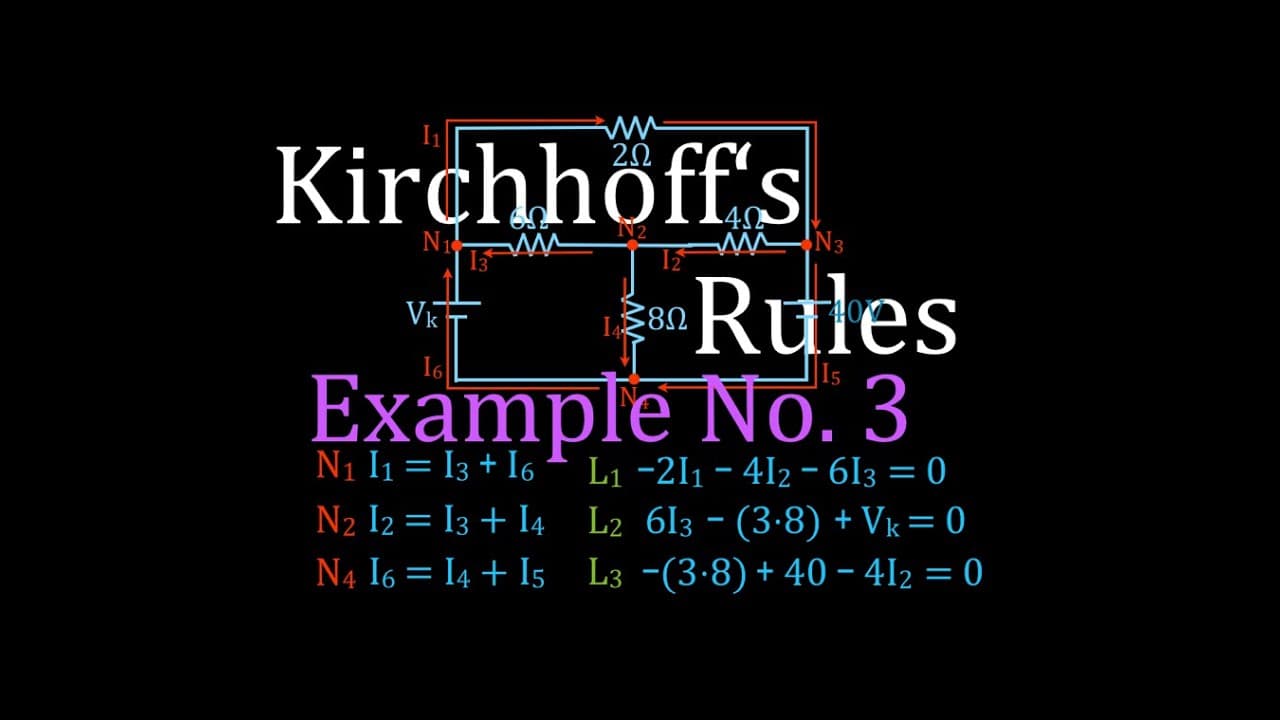
Kirchhoff's Rules (4 of 4) Circuit Analysis, Example No. 3
TL;DR
This video demonstrates how to use Kirchhoff's circuit laws to calculate the voltage and direction of currents in a circuit.
Transcript
okay in today's video we're going to go over another example of using kirkov circuit laws to determine in this case a voltage and then the direction and the magnitud of the currents in the rest of the branches of the circuit in a previous video I kind of made an introduction explanation video of how what kirot rules are and how we apply them and I'... Read More
Key Insights
- 👮 Kirchhoff's circuit laws can be used to determine voltage and current in complex circuits with multiple resistors.
- 🍹 The current rule states that the sum of the currents in and out of a node is zero.
- ⚡ The voltage rule states that the sum of voltage drops and gains in a loop is zero.
- 🤘 Choosing the correct direction for a current can be determined by checking the sign of the calculated value.
- 💦 Ohm's law can be used to calculate voltage drops across resistors in a circuit.
- ⚡ Solving for unknown voltages and currents involves applying the current and voltage rules and solving a system of equations.
- 🤘 Attention to negative and positive signs is crucial in circuit analysis.
Install to Summarize YouTube Videos and Get Transcripts
Explore YouTube Video Summarizer or Get YouTube Transcript Extractor
Questions & Answers
Q: How do you apply Kirchhoff's circuit laws to determine voltage and current?
Kirchhoff's circuit laws can be applied by identifying nodes, assigning currents and their directions to each branch, and following the current and voltage rules for each node and loop.
Q: How do you know if the chosen direction for a current is correct?
If the calculated current value is positive, it means the chosen direction is correct. If the value is negative, the chosen direction is incorrect and the current actually flows in the opposite direction.
Q: How do you apply the voltage rule to determine unknown voltages?
By using Ohm's law for resistors in each loop, the voltage drop can be calculated. The sum of the voltage drops and gains in a loop is set equal to zero, allowing for the determination of unknown voltages.
Q: What are the steps to solve a circuit using Kirchhoff's circuit laws?
The steps include identifying nodes, assigning currents and directions, applying the current rule at each node, applying the voltage rule for each loop, and solving the resulting equations.
Summary & Key Takeaways
-
The video introduces a circuit with four resistors and two voltage sources, one known and one unknown.
-
The circuit is analyzed by identifying nodes, currents, and loops, following Kirchhoff's circuit laws.
-
By applying the current rule and voltage rule, the unknown voltage source and currents in each branch are determined.
Read in Other Languages (beta)
Share This Summary 📚
Summarize YouTube Videos and Get Video Transcripts with 1-Click
Try YouTube Summary with ChatGPT & Claude or YouTube Transcript Generator
Explore More Summaries from Step by Step Science 📚



Summarize YouTube Videos and Get Video Transcripts with 1-Click
Try YouTube Summary with ChatGPT & Claude or YouTube Transcript Generator