How To Evaluate Trigonometric Functions Using Periodic Properties - Trigonometry
TL;DR
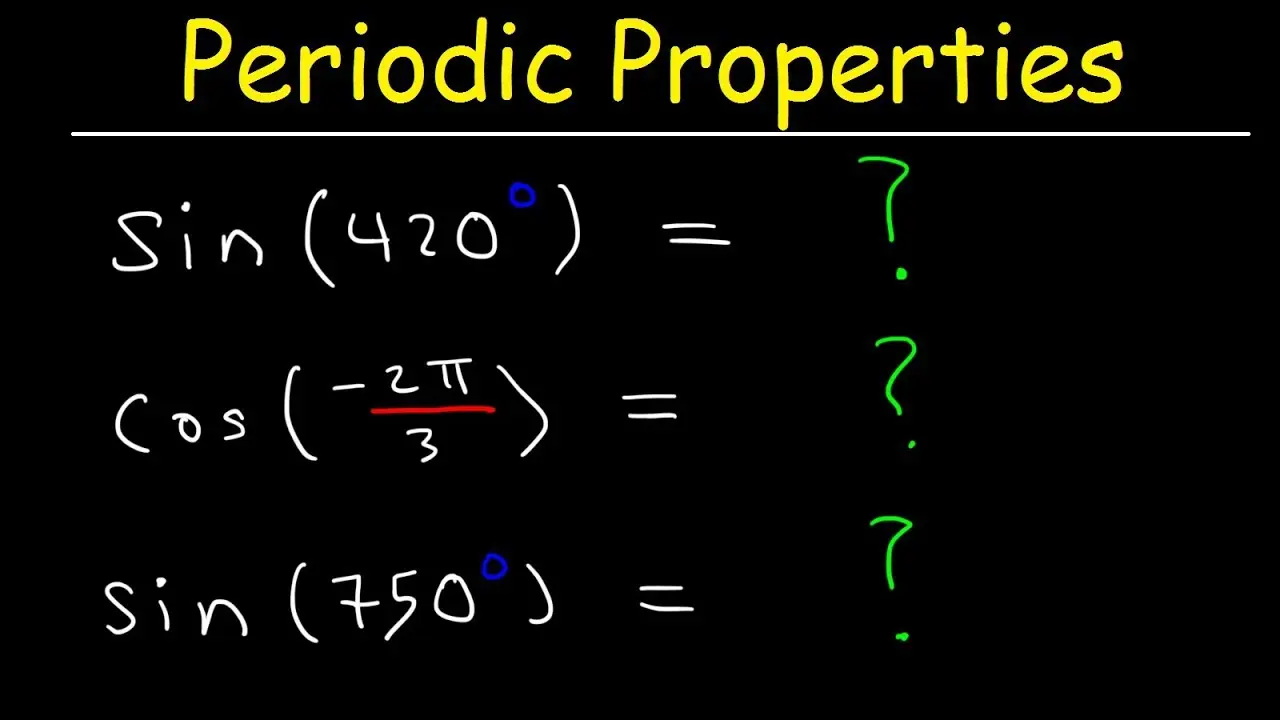
Trigonometric functions have periodic properties, meaning their values repeat when the angle is increased by a multiple of 360 degrees or 2π.
Transcript
now let's talk about the periodic properties of trigonometric functions sine of theta is equal to sine of theta plus 360 degrees or 2 pi so what this means is that if you add 360 to theta the sine will have the same value so whenever you have the sine of an angle and a sign of another coterminal angle they will share the same value if you recall to... Read More
Key Insights
- 👨💼 Trigonometric functions such as sine and cosine exhibit periodicity, meaning their values repeat after every 360 degrees or 2π.
- 🪜 Adding or subtracting 360 degrees or 2π to an angle does not alter the value of the trigonometric function.
- ❓ The periodic properties apply to all trigonometric functions, including tangent, cotangent, and others.
- 🔺 Coterminal angles can be found by adding or subtracting multiples of 360 degrees or 2π to the original angle.
- ❣️ The unit circle can be used to determine trigonometric values, with the x-coordinate representing cosine and the y-coordinate representing sine.
- 📈 The periodic nature of trigonometric functions is evident when graphed, as the functions repeat themselves over and over.
- ⭕ Evaluating trigonometric functions using periodic properties often involves finding coterminal angles and referencing the unit circle.
Install to Summarize YouTube Videos and Get Transcripts
Explore YouTube Video Summarizer or Get YouTube Transcript Extractor
Questions & Answers
Q: What are the periodic properties of trigonometric functions?
The periodic properties of trigonometric functions means that when an angle is increased or decreased by a multiple of 360 degrees or 2π, the value of the trigonometric function remains the same. This holds true for all trigonometric functions.
Q: How can you find coterminal angles?
To find a coterminal angle, you can add or subtract multiples of 360 degrees or 2π to the original angle. By doing so, you will arrive at an angle that has the same value for the trigonometric function.
Q: What does it mean for trigonometric functions to be periodic?
When we say trigonometric functions are periodic, it means that their values repeat in a cyclical manner. Adding or subtracting 360 degrees or 2π to an angle generates an angle that has the same value for the trigonometric function.
Q: How can the unit circle be used to determine trigonometric values?
The unit circle can be used to determine trigonometric values. The x-coordinate of a point on the unit circle corresponds to the cosine value, while the y-coordinate corresponds to the sine value. By identifying the coordinates for a specific angle on the unit circle, we can find the trigonometric value.
Summary & Key Takeaways
-
Trigonometric functions such as sine and cosine have periodic properties, meaning their values repeat after every 360 degrees or 2π.
-
Adding or subtracting 360 degrees to an angle does not change the value of the trigonometric function.
-
The periodic properties hold true for all trigonometric functions such as tangent and cotangent as well.
Read in Other Languages (beta)
Share This Summary 📚
Summarize YouTube Videos and Get Video Transcripts with 1-Click
Try YouTube Summary with ChatGPT & Claude or YouTube Transcript Generator
Explore More Summaries from The Organic Chemistry Tutor 📚

Summarize YouTube Videos and Get Video Transcripts with 1-Click
Try YouTube Summary with ChatGPT & Claude or YouTube Transcript Generator