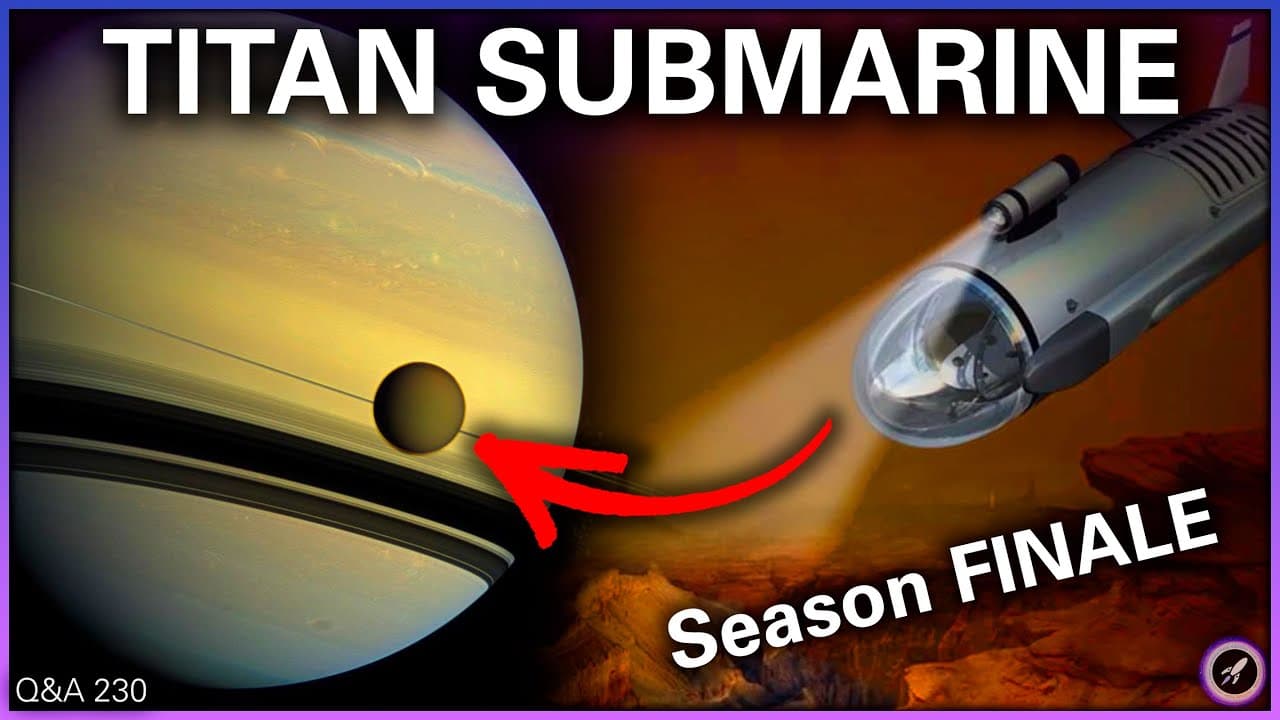
Submarine for Titan, Planets Changing Size, Even Bigger LIGO | Q&A 230
TL;DR
The Question Show explores the possibilities of detecting the Great Attractor using gravitational waves, extending the arms of LIGO, the shrinking of planets over time, and other space-related queries.
Transcript
could we measure the great attractor by gravitational waves could we make ligo but even bigger and is it possible that the planets are shrinking over time all this and more in this week's question show it's time for the question show your questions my answers as always wherever you are of question Pops in your brain just write it down in the YouTub... Read More
Key Insights
- 👋 The Great Attractor is a massive cluster of galaxies located on the far side of the Milky Way, and observing it using gravitational waves requires more sensitive observatories.
- 👋 LIGO, a current gravitational wave detector, can be improved by extending its arms, but future observatories like the Einstein Telescope and Cosmic Explorer will offer even better capabilities.
- 🙂 Planets like Mercury and the Moon are shrinking over time due to cooling, while the Earth maintains its size with a slight loss in mass from its atmosphere.
- 🌍 The Trappist-1 system, with its seven earth-sized planets, is being closely observed with JWST to study their atmospheres and potential habitability.
- 🤩 The detection of population three stars, the emergence of large galaxies early in the universe, and other surprising discoveries are being made using JWST.
Install to Summarize YouTube Videos and Get Transcripts
Explore YouTube Video Summarizer or Get YouTube Transcript Extractor
Questions & Answers
Q: Can we detect the Great Attractor using gravitational waves?
Detecting the Great Attractor using gravitational waves is possible, but current observatories like LIGO need more sensitivity. Future observatories with longer arms will provide better measurements.
Q: Can LIGO's arms be extended to overcome the Earth's curvature?
Yes, LIGO's arms can be extended to detect smaller gravitational wave events. Future observatories like the Einstein Telescope and Cosmic Explorer will have longer arms for more accurate observations.
Q: Do planets shrink over time?
Yes, planets like Mercury and the Moon are shrinking due to cooling. However, the Earth remains the same size with a slight loss in mass due to its atmosphere.
Q: What is the next planet in the Trappist-1 system to be observed?
The observations of the Trappist-1 system are ongoing, and the next planet to be analyzed, potentially in the habitable zone, will be revealed in the coming months.
Summary & Key Takeaways
-
The Great Attractor, a massive cluster of galaxies hidden behind the Milky Way, can potentially be detected using gravitational waves, but more sensitive observatories are needed for accurate measurements.
-
LIGO, a gravitational wave observatory, can have longer arms to detect smaller events, but future telescopes like the Einstein Telescope and Cosmic Explorer are being designed for even more sensitive observations.
-
Planets like Mercury and the Moon are shrinking over time due to cooling and changing temperatures. However, the Earth remains the same size with a slight loss in mass due to its atmosphere.
-
The Trappist-1 system, with its seven Earth-sized planets, is being observed with JWST to analyze their atmospheres and potential habitability.
Read in Other Languages (beta)
Share This Summary 📚
Summarize YouTube Videos and Get Video Transcripts with 1-Click
Try YouTube Summary with ChatGPT & Claude or YouTube Transcript Generator
Explore More Summaries from Fraser Cain 📚




Summarize YouTube Videos and Get Video Transcripts with 1-Click
Try YouTube Summary with ChatGPT & Claude or YouTube Transcript Generator