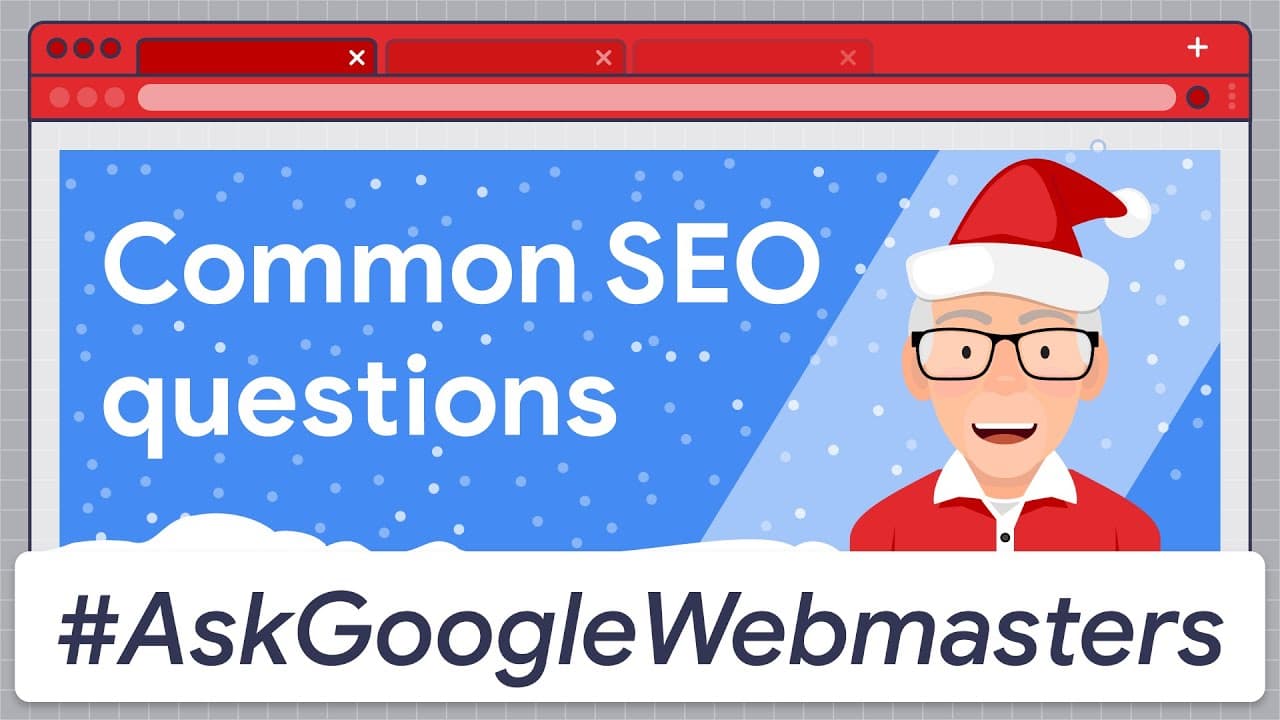
Common SEO Questions Answered by John Mueller, Ask Google Webmasters Holiday Special
TL;DR
John Mueller’s answer to common SEO questions is to use the technically appropriate option without searching for magical ranking advantages. A 301 is permanent, a 302 is temporary, while 404 and 410 responses are processed alike on a normal website. Strong technical foundations, awesome content, and a distinctive result matter more than minor implementation choices, so read on for his specific guidance on each SEO question.
Transcript
[MUSIC PLAYING] JOHN MUELLER: Here today is another round of "Ask Google Webmasters," the series where we answer short questions about Google Search for webmasters everywhere. We usually take questions from the hashtag #AskGoogleWebmasters on Twitter. But since the end of the year is coming soon, I thought we'd do something slightly different. For ... Read More
Key Insights
- Redirect intent determines the code: A 301 tells Google that the move is permanent, so the destination becomes the location it keeps. A 302 communicates a temporary move, causing Google to return to the original location and double-check it later. The distinction concerns expected permanence, even though both codes successfully send users onward.
- Redirects contain no magical dust: Mueller explicitly rejects the idea that choosing between 301 and 302 redirects creates a mysterious SEO advantage. Webmasters should use the right redirect type when they can, based on whether the change is permanent or temporary. His practical reassurance is that both forms work fine for redirecting users.
- Gone pages share one outcome: Both 404 and 410 responses tell Google that a page is now gone. Although a 410 may theoretically be processed a tiny bit faster, Mueller says the difference disappears in normal website practice. Google processes both in the same way, so webmasters should not sweat this distinction.
- Tag length has no fixed rule: Mueller gives no numerical limit for either a page’s description meta tag or its title tag. His criteria concern what the text accomplishes instead. Each tag should be unique, compelling, useful, and capable of providing the information people seek, allowing Google to highlight the page optimally.
- Symbols are allowed with caveats: Webmasters may use symbols in titles, but permission does not ensure that every symbol will appear in search results. Google tries not to show symbols that could mislead people. Mueller also observes that there may not be many people searching for those symbols, connecting their usefulness to actual search behavior.
- URL keywords have little weight: Words appearing in URLs play an insignificant role for web pages, according to Mueller. Their common use partly reflects the fact that most content management systems make them easy to add. If a site already has keyword-based URLs, it can use them, but a site without them need not worry.
- Image filenames are the exception: Mueller distinguishes ordinary web-page URLs from image filenames. Google does use words for image files, making a descriptive filename preferable to an arbitrary numbered label. His concrete comparison is cuterobot.gif versus image-1138.gif, with cuterobot.gif identified as definitely better for the image file.
- Extensions do not decide SEO: Whether a page address ends in .php or .html does not matter in Mueller’s answer, because both endings are fine. He discourages changing between them as an isolated SEO adjustment. Such a change makes sense only when it accompanies bigger changes already being made elsewhere on the website.
- Minor choices should stay minor: Several answers share the same practical theme: do not sweat small technical differences that Google handles similarly or that play an insignificant role. This applies to 404 versus 410 responses, URL keywords, and .php versus .html endings. Mueller uses these examples to move attention toward the website’s bigger picture.
- Technical strength is foundational: When asked for the secret to ranking better, Mueller says there is none. His recommended starting point is a website built on a technically strong foundation and supplied with awesome content. Technique matters, but it works together with content rather than replacing the need to create something genuinely strong.
- The cookie analogy explains quality: Mueller compares a strong website to the best cookie, made from good ingredients by trustworthy bakers using good technique. The finished result should not be merely the same as what people can get elsewhere. The analogy joins content, technical execution, trustworthiness, and differentiation into one standard for quality.
- Word count is not quality: Google’s algorithms do not count the words on a page as the measure of excellence, just as a person would not judge a cookie only by its weight. Mueller’s alternative is demanding: create something awesome, best by far, worth recommending, and worthy of pride over the long run.
Install to Summarize YouTube Videos and Get Transcripts
Explore YouTube Video Summarizer or Get YouTube Transcript Extractor
Questions & Answers
Q: What is the difference between 301 and 302 redirects?
A 301 is a permanent redirect, so its destination is the location Google keeps. A 302 is temporary, so Google returns to the starting location later to double-check it. Both codes send users onward and both work fine. Use the code that matches whether the move is intended to be permanent or temporary, without expecting magical SEO dust from the choice.
Q: What is the difference between 404 and 410 HTTP result codes?
Both 404 and 410 responses tell Google that a page is gone. A 410 can theoretically be processed a tiny bit faster. On a normal website, however, Google processes the two responses in the same way in practice. The practical reason not to sweat the choice is that both communicate the same missing-page outcome.
Q: How long should description meta tags and title tags be?
There is no fixed length for a page’s description meta tag or title tag. Make each one unique, compelling, and useful instead of optimizing for a stated number. The text should provide the information people are looking for. Doing so gives Google material it can use to highlight the page optimally.
Q: Can I use symbols in page titles?
Yes, Mueller says webmasters are welcome to use symbols in titles. Google tries not to display symbols when they are misleading. He also notes that there might not be many people searching for those symbols. Their use is therefore allowed, but their appearance and usefulness depend on whether they communicate honestly and correspond to how people search.
Q: Do keywords in URLs matter for SEO?
Words in URLs play an insignificant role for web pages. Most content management systems make keyword-based URLs easy to use, so keeping them when they already exist is fine. A site without them does not need to worry. Image files are different because Google uses their filename words, which is why cuterobot.gif is definitely better than image-1138.gif.
Q: Do .php or .html page endings affect SEO?
No, both .php and .html endings are fine for pages. Mueller does not identify an SEO advantage for either extension. He recommends against changing from one to the other solely for this concern. A switch is worth considering only if it occurs as part of bigger changes already happening elsewhere on the website.
Q: What is the secret to ranking better on Google?
Mueller says there is no secret to ranking better. A great starting point is a website with a technically strong foundation and awesome content. The site should use good technique while producing something that is not merely the same as what is available elsewhere. Standing out matters because pages seeking recommendation as awesome should actually offer something awesome.
Q: Why does John Mueller compare SEO to baking a cookie?
The cookie comparison shows that quality results from several elements working together. Mueller describes good ingredients, trustworthy bakers, and good technique producing something better than the same offering available elsewhere. He also says a cookie should not be judged only by weight, just as Google’s algorithms do not count a page’s words as the measure of quality. The point is to make something distinctive, best by far, and worthy of long-term pride.
Summary & Key Takeaways
-
Introducing common SEO questions: John Mueller opens this holiday edition of Ask Google Webmasters by changing the usual format. Instead of answering a question submitted through the #AskGoogleWebmasters hashtag on Twitter, he presents short, bite-sized responses to questions the team commonly hears. The first concerns redirects. Both 301 and 302 redirects send users onward, but a 301 is permanent and keeps the destination, while a 302 is temporary and prompts a later return to the starting location for another check.
-
Comparing missing-page responses: Mueller next explains that both 404 and 410 HTTP result codes communicate that a page is gone. A 410 can theoretically be a tiny bit faster, but both codes are processed in the same way on a normal website in practice. He then turns to description meta tags and title tags. Neither has a fixed length. Instead of targeting a particular measurement, webmasters should make them unique, compelling, useful, and informative enough for Google to highlight their pages optimally.
-
Handling titles and URL words: Symbols are permitted in titles, although Google tries not to display misleading symbols and Mueller notes that relatively few people may search for them. Words in web-page URLs play an insignificant role, even though most content management systems make them easy to include. Existing URL keywords can therefore remain, but their absence is not a concern. Image files are the stated exception: Mueller says cuterobot.gif is definitely better than the generic image-1138.gif.
-
Choosing page file endings: Mueller says that .php and .html endings are both fine for pages and do not warrant a change by themselves. He recommends avoiding a switch from one extension to the other unless the website is already undergoing bigger changes elsewhere. This continues the episode’s recurring message not to sweat small differences. With the straightforward technical questions addressed, he redirects attention toward the bigger picture and the question of whether any secret can produce better rankings.
-
Building something genuinely outstanding: Mueller says there is no secret to ranking better. A technically strong foundation and awesome content provide a great start, which he compares to baking the best cookie from good ingredients using trustworthy bakers and good technique. The result should not duplicate what is available elsewhere. Google’s algorithms do not merely count page words, just as a cookie should not be judged only by weight. Pages worthy of recommendation should be awesome, distinctive, durable, and a source of pride.
Read in Other Languages (beta)
Share This Summary 📚
Summarize YouTube Videos and Get Video Transcripts with 1-Click
Try YouTube Summary with ChatGPT & Claude or YouTube Transcript Generator
Explore More Summaries from Google Search Central 📚



Summarize YouTube Videos and Get Video Transcripts with 1-Click
Try YouTube Summary with ChatGPT & Claude or YouTube Transcript Generator