Products
Features
YouTube Video Summarizer
Summarize YouTube videos
Web & PDF Highlighter
Highlight web pages & PDFs
Chat with PDF
Ask any PDF questions with AI
Ask AI Clone
Chat with your highlights & memories
Audio Transcriber
Transcribe audio files to text
Glasp Reader
Read and highlight articles
Kindle Highlight Export
Export your Kindle highlights
Idea Hatch
Hatch ideas from your highlights
Integrations
Obsidian Plugin
Notion Integration
Pocket Integration
Instapaper Integration
Medium Integration
Readwise Integration
Snipd Integration
Hypothesis Integration
Apps & Extensions
Chrome Extension
Safari Extension
Edge Add-ons
Firefox Add-ons
iOS App
Android App
Discover
Discover
Ideas
Discover new ideas and insights
Articles
Curated articles and insights
Books
Book recommendations by great minds
Posts
Essays and notes from readers
Quotes
Inspiring quotes collection
Videos
Curated videos and summaries
Explore Glasp
Glasp Story
How we grew from 0 to 3 million users
Glasp Newsletter
Weekly insights and updates
Glasp Talk
Interview series with great minds
Glasp Blog
Latest news and articles
Glasp Use Cases
Learn how others use Glasp
Build & Support
Glasp API
Access Glasp's API for developers
MCP Connector
Connect Glasp to Claude & ChatGPT
Community
Glasp Reddit Community
Students
Student discount and benefits
FAQs
Frequently Asked Questions
AboutPricing
DashboardLog inSign up

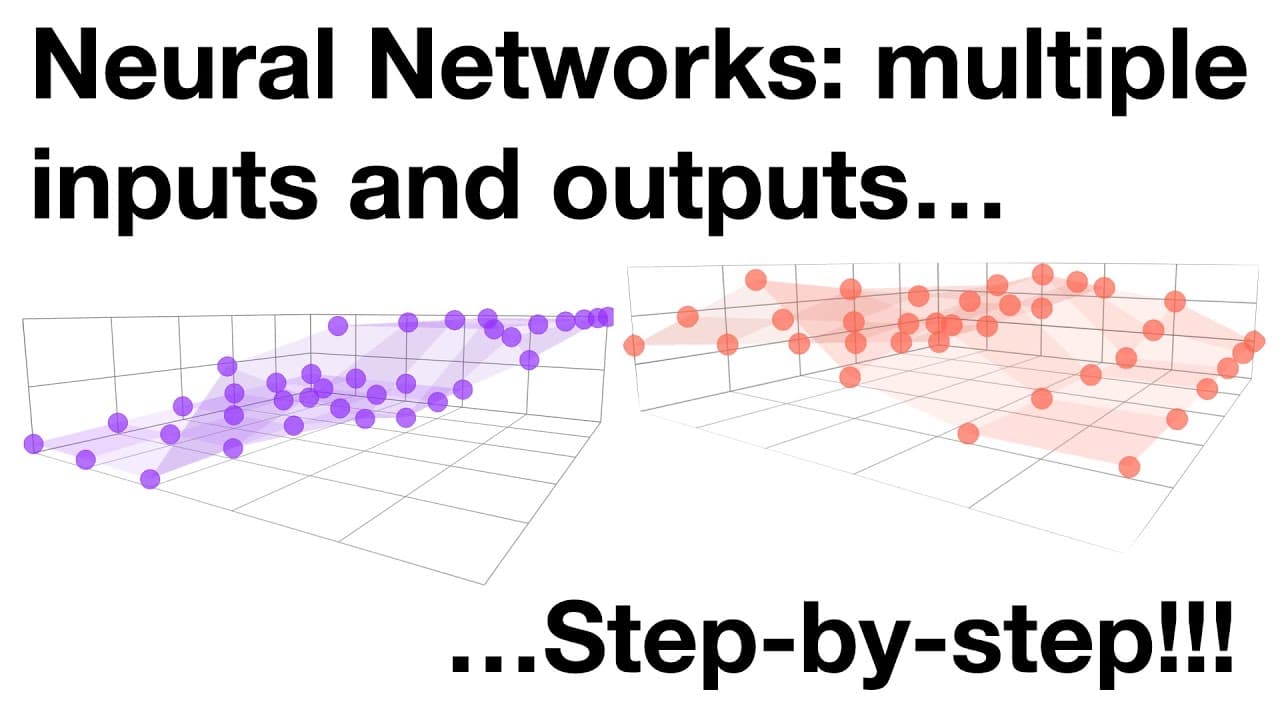
Neural Networks Pt. 4: Multiple Inputs and Outputs
151.1K views
•
January 31, 2021
by
StatQuest with Josh Starmer
YouTube video player
Neural Networks Pt. 4: Multiple Inputs and Outputs

TL;DR

This StatQuest video explains how neural networks with multiple inputs and outputs work.

Transcript

way up north there's an island out in the sea and way out there they've got neural networks and they're cool statquest hello i'm josh starmer and welcome to statquest today we're going to talk about neural networks part 4 multiple inputs and outputs note this stack quest was supported in part by ital also i thought i'd mention that the inspiration ... Read More

Key Insights

  • 🍵 Neural networks with multiple inputs and outputs can handle more complex predictions.
  • 🏋️ Curved surfaces are created using weights, biases, and activation functions.
  • ⚖️ Scaling inputs between 0 and 1 simplifies calculations.

Install to Summarize YouTube Videos and Get Transcripts

Explore YouTube Video Summarizer or Get YouTube Transcript Extractor

Questions & Answers

Q: How does a neural network with multiple inputs and outputs work?

A neural network with multiple inputs and outputs takes in multiple measurements and uses weights, biases, and activation functions to make predictions. It creates curved surfaces that combine to form a crinkled surface, representing the output.

Q: What is the purpose of scaling the inputs in a neural network?

Scaling the inputs between 0 and 1 allows for easier calculations and comparison. It does not reflect the actual measurement values, but rather their relative position in the data set.

Q: How can the crinkled surface in a neural network be used to make predictions?

By examining the y-axis values on the crinkled surface, it is possible to determine the likelihood of a certain prediction. Higher values indicate a higher likelihood, while lower values indicate a lower likelihood.

Q: Why are argmax and softmax used in neural networks with multiple outputs?

argmax and softmax are used to convert the output values into a format that makes it easier to determine the final prediction. They help identify the output node with the highest value or calculate the probabilities of each output.

Summary & Key Takeaways

  • Neural networks can have multiple inputs and outputs, allowing for more complex predictions and analysis.

  • The video demonstrates the use of a neural network to predict the species of an iris flower based on petal and sepal measurements.

  • The process involves creating curved or bent surfaces that combine to form a crinkled surface, which is used to make predictions.


Read in Other Languages (beta)

English

Share This Summary 📚

Summarize YouTube Videos and Get Video Transcripts with 1-Click

Download browser extensions on:

Try YouTube Summary with ChatGPT & Claude or YouTube Transcript Generator

Explore More Summaries from StatQuest with Josh Starmer 📚
Alternative Hypotheses: Main Ideas!!! thumbnail
Alternative Hypotheses: Main Ideas!!!
StatQuest with Josh Starmer
What Is K-Means Clustering and How Does It Work? thumbnail
What Is K-Means Clustering and How Does It Work?
StatQuest with Josh Starmer
What Are ROC Curves and AUC in Classification? thumbnail
What Are ROC Curves and AUC in Classification?
StatQuest with Josh Starmer
How Does Gradient Boosting Work for Regression? thumbnail
How Does Gradient Boosting Work for Regression?
StatQuest with Josh Starmer
CatBoost Part 2: Building and Using Trees thumbnail
CatBoost Part 2: Building and Using Trees
StatQuest with Josh Starmer
The AI Buzz, Episode #3: Constitutional AI, Emergent Abilities and Foundation Models thumbnail
The AI Buzz, Episode #3: Constitutional AI, Emergent Abilities and Foundation Models
The AI Buzz with Luca and Josh

Summarize YouTube Videos and Get Video Transcripts with 1-Click

Download browser extensions on:

Try YouTube Summary with ChatGPT & Claude or YouTube Transcript Generator

Apps & Extensions

  • Chrome Extension
  • Safari Extension
  • Edge Add-ons
  • Firefox Add-ons
  • iOS App
  • Android App

Key Features

  • YouTube Video Summarizer
  • Web & PDF Summarizer
  • Web & PDF Highlighter
  • Chat with PDF
  • Ask AI Clone
  • Audio Transcriber
  • Glasp Reader
  • Kindle Highlight Export
  • Idea Hatch

Integrations

  • Obsidian Plugin
  • Notion Integration
  • Pocket Integration
  • Instapaper Integration
  • Medium Integration
  • Readwise Integration
  • Snipd Integration
  • Hypothesis Integration

More Features

  • APIs
  • MCP Connector
  • Blog & Post
  • Embed Links
  • Image Highlight
  • Personality Test
  • Quote Shots

Company

  • About us
  • Our Story
  • Blog
  • Community
  • FAQs
  • Job Board
  • Newsletter
  • Pricing
Terms

•

Privacy

•

Guidelines

© 2026 Glasp Inc. All rights reserved.