Harvesting Dark Energy, Making Own Telescope, Escaping Gravity Wells | Q&A 199
TL;DR
Fraser Kane answers questions about space and astronomy, including topics like dark energy, star formation, LaGrange points, and more.
Transcript
hi everyone I'm Fraser Kane I'm the publisher of universe today I've been a space and astronomy journalist for over 20 years and this is our question show your questions my answers now wherever you are across my channel the question Pops in your brain just write it down and I will gather a bunch of them up and I will answer them here but we record ... Read More
Key Insights
- 🕶️ Dark energy is a mysterious force accelerating the expansion of the universe, and the possibility of harvesting it remains unknown.
- 🤩 Stars in star clusters like the Eagle Nebula are closer together than stars in the Milky Way, with an average distance of about one light year apart.
- 🤩 Photons undergo a random walk before escaping stars, which can take millions of years.
- 👻 NASA partially fixed the solar panel on the Lucy spacecraft, allowing it to continue its mission.
- 🤩 Matter expands with the universe, but gravitational forces within galaxies and star systems hold objects together.
- 🧑🌾 The Great Attractor is a massive cluster of galaxies that appears to be attracting galaxies on the far side of the Milky Way.
- 💁 Gas clouds collapse under gravity to form stars, with rotating disks and dense cores forming in the process.
Install to Summarize YouTube Videos and Get Transcripts
Explore YouTube Video Summarizer or Get YouTube Transcript Extractor
Questions & Answers
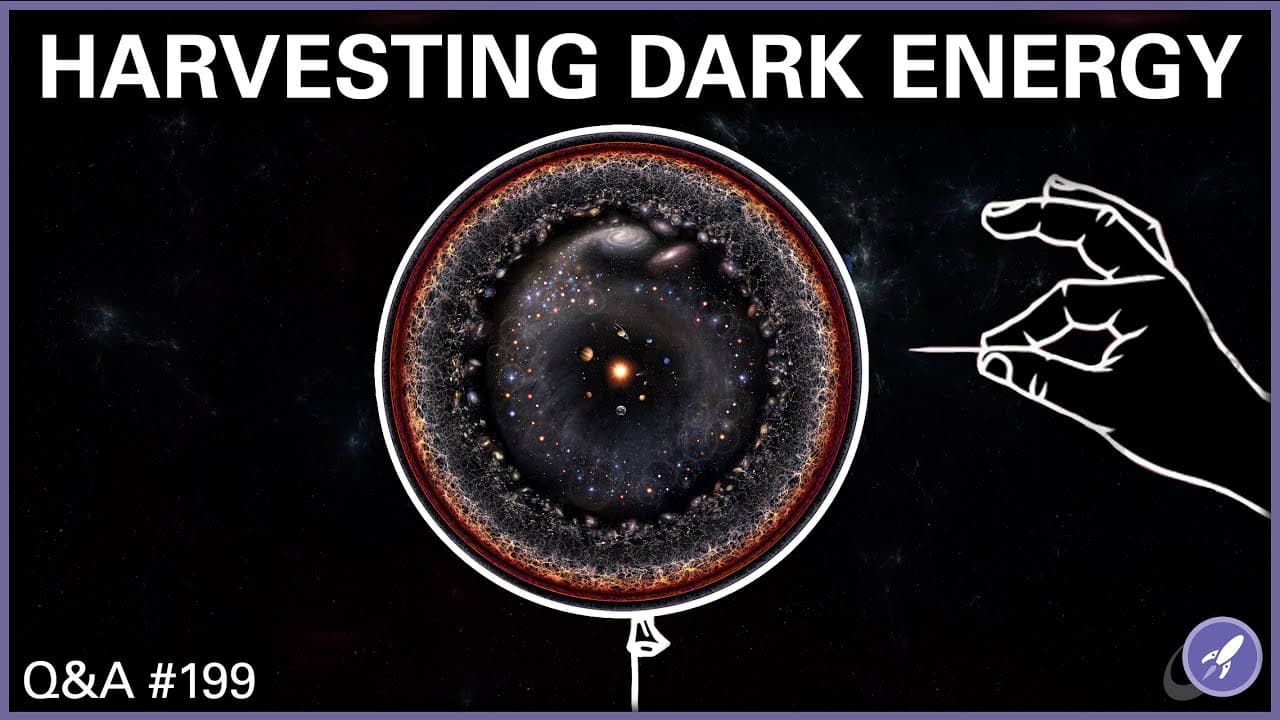
Q: Could we harvest dark energy for energy and extend humanity's shelf life?
Dark energy is a mysterious force that accelerates the expansion of the universe. While it's possible that we could someday harvest dark energy, we still don't know what it is or how to extract it.
Q: Are the stars in The Pillars of Creation closer or farther apart than the stars in our region?
On average, stars in the Milky Way are about five light years apart. However, in star clusters like the Eagle Nebula, stars are closer, at about one light year apart.
Q: Does light from stars in the Eagle Nebula take millions of years to escape due to random walks?
Yes, photons released in the core of stars undergo a random walk, bouncing around the dense core before eventually reaching the convective zone and being carried up to the surface. This process can take anywhere from 100,000 to 10 million years.
Q: Did NASA successfully fix the solar panel on the Lucy spacecraft?
One of Lucy's solar panel arrays failed to latch, but NASA was able to partially roll it out to about 99% open. This provides enough power for Lucy to complete its mission.
Q: Does matter expand and will intelligent life be able to escape a planet's gravity well?
Matter does expand as the universe expands, but the gravitational forces within galaxies, star systems, and planets hold matter together. The escape from a planet's gravity well depends on its mass and the amount of energy available for propulsion.
Q: What is the Great Attractor?
The Great Attractor is a region of space that appears to be causing galaxies on the far side of the Milky Way to be gravitationally attracted towards it. It is a massive cluster of galaxies, part of the Laniakea Supercluster.
Q: How does gas turn into stars?
Gas clouds containing primordial hydrogen and helium collapse under their own gravity. As the cloud collapses, it begins to spin and forms a rotating disk, with a dense core at the center. The core ignites and forms a star, while the surrounding material can form planets.
Q: How does the motion of the Sun and Jupiter affect Jupiter's L1 point?
The motion of the Sun and Jupiter will have an effect on Jupiter's L1 point, as all Lagrange points are not fixed points but rather regions. The gravitational interactions of other celestial bodies also affect the stability and position of Lagrange points.
Summary & Key Takeaways
-
Fraser Kane is a space and astronomy journalist with over 20 years of experience.
-
He hosts a live Q&A show where he answers questions from viewers about space and astronomy.
-
The show covers a range of topics, including dark energy, star formation, the great attractor, LaGrange points, and more.
Read in Other Languages (beta)
Share This Summary 📚
Summarize YouTube Videos and Get Video Transcripts with 1-Click
Try YouTube Summary with ChatGPT & Claude or YouTube Transcript Generator
Explore More Summaries from Fraser Cain / Universe Today Podcast 📚





Summarize YouTube Videos and Get Video Transcripts with 1-Click
Try YouTube Summary with ChatGPT & Claude or YouTube Transcript Generator