What Is Hierarchical Clustering and How Does It Work?
TL;DR
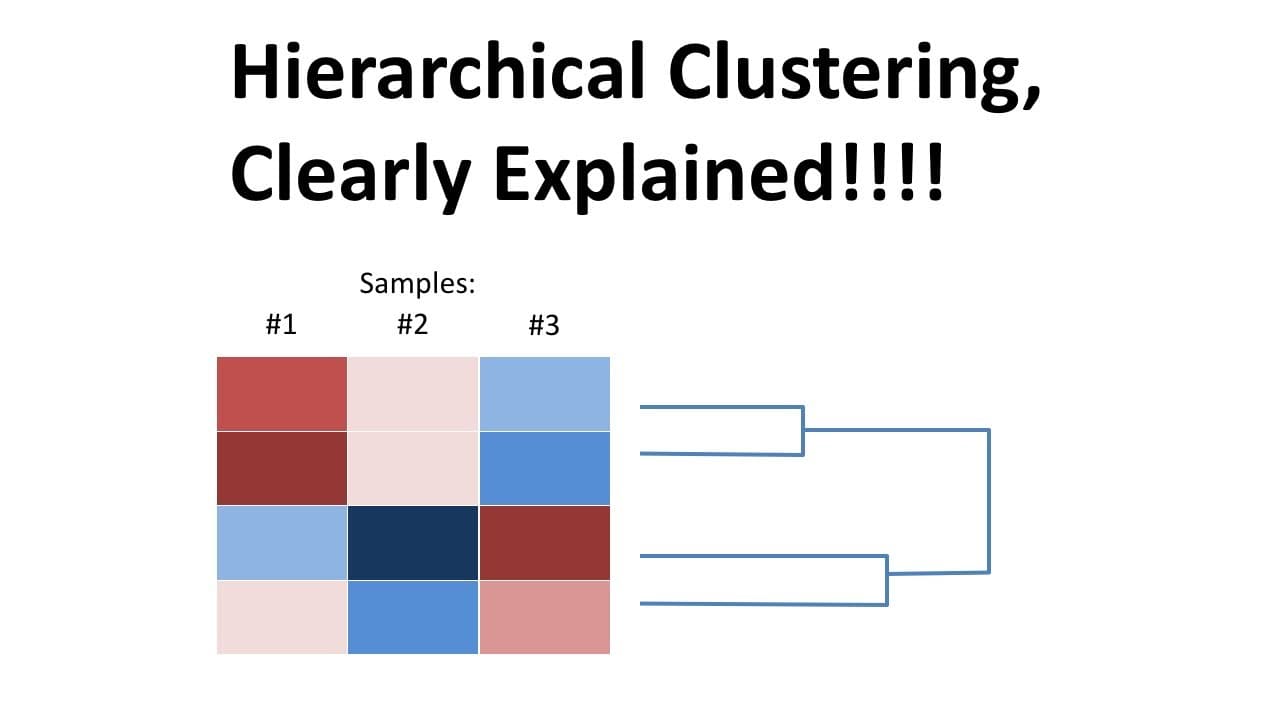
Hierarchical clustering is a method that organizes data by grouping similar items, commonly used with heat maps to visualize gene expression levels. It reveals correlations by ordering rows and columns based on similarity, often accompanied by dendrograms that illustrate the relationship between clusters formed. Different distance metrics and linkage methods affect the clustering results, providing insights into data patterns.
Transcript
going on a quest on a stat Quest stat Quest hello and welcome to stat Quest today we're going to be talking about hierarchical clustering hierarchical clustering is often associated with heat Maps if you're not already familiar with what heat maps are just know that the columns typically represent different samples and that the rows typically repre... Read More
Key Insights
- 🥵 Hierarchical clustering is a useful technique for organizing data in heat maps and identifying correlations.
- 💁 Dendrograms provide information about the similarity and order of clusters formed during hierarchical clustering.
- 📈 Different distance metrics, such as Euclidean or Manhattan distance, can be used to determine similarity between genes in hierarchical clustering.
- 🔂 Different linkage methods, such as average, single, or complete linkage, can be used to compare clusters in hierarchical clustering.
- 📈 The choice of distance metric and linkage method can impact the results and interpretation of hierarchical clustering.
- 😑 Heat maps can provide insights into gene expression patterns and help in understanding relationships between samples or genes.
- 🏑 Hierarchical clustering is a widely used method in various fields, including genetics, biology, and data analysis.
Install to Summarize YouTube Videos and Get Transcripts
Explore YouTube Video Summarizer or Get YouTube Transcript Extractor
Questions & Answers
Q: What is hierarchical clustering and how does it relate to heat maps?
Hierarchical clustering is a method of ordering rows or columns based on similarity, and it is commonly used with heat maps. Heat maps display gene expression levels in different samples using colors.
Q: How does hierarchical clustering help in identifying correlations in data?
By organizing rows or columns based on similarity, hierarchical clustering groups together samples or genes with similar expression profiles. This makes it easier to identify patterns and correlations in the data.
Q: What are dendrograms and why are they included in heat maps?
Dendrograms are graphical representations of the clusters formed during hierarchical clustering. They show the similarity and order in which the clusters were formed, providing additional information about the relationships between samples or genes.
Q: What are the different methods for determining similarity in hierarchical clustering?
The Euclidean distance is a commonly used method for determining similarity between genes. It calculates the square root of the sum of squared differences between expression values. Other methods include the Manhattan distance, which uses absolute differences, and various linkage methods for comparing clusters.
Summary & Key Takeaways
-
Hierarchical clustering is associated with heat maps, which use colors to represent gene expression levels in different samples.
-
Hierarchical clustering orders rows or columns based on similarity, revealing patterns and correlations in the data.
-
Dendrograms are often included in heat maps to show the similarity and order of the clusters formed during hierarchical clustering.
Read in Other Languages (beta)
Share This Summary 📚
Summarize YouTube Videos and Get Video Transcripts with 1-Click
Try YouTube Summary with ChatGPT & Claude or YouTube Transcript Generator
Explore More Summaries from StatQuest with Josh Starmer 📚
Summarize YouTube Videos and Get Video Transcripts with 1-Click
Try YouTube Summary with ChatGPT & Claude or YouTube Transcript Generator