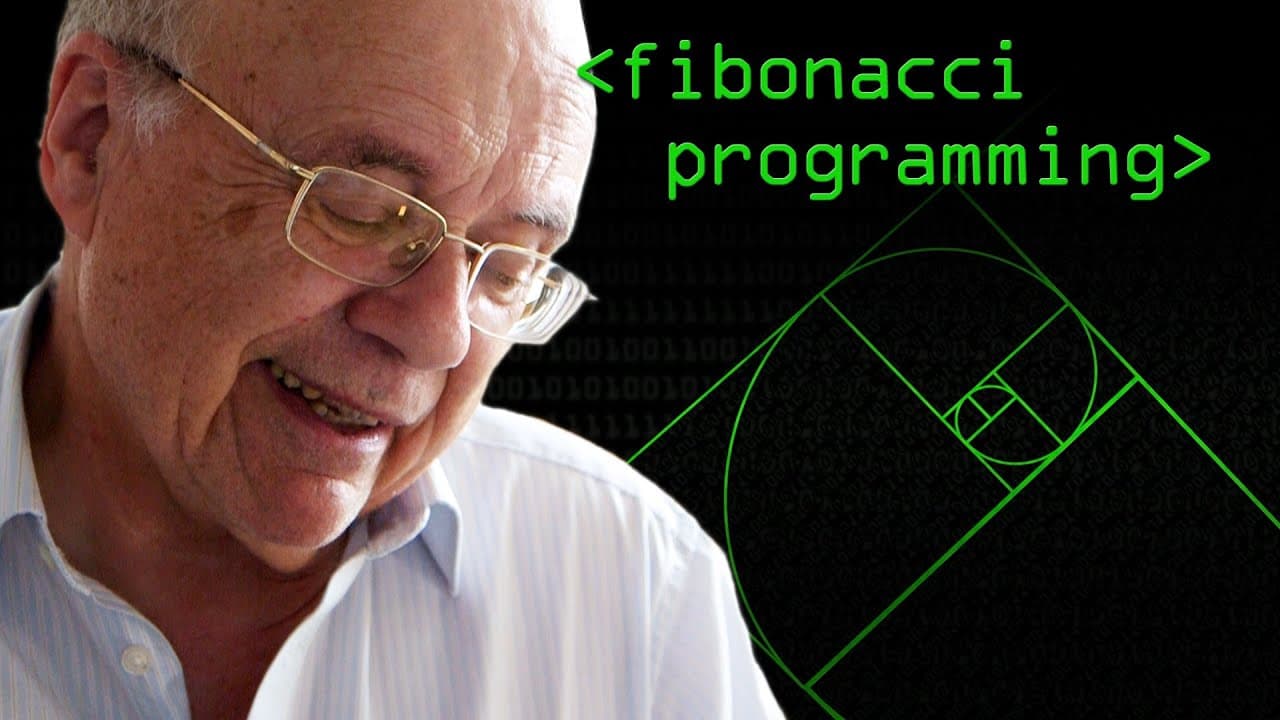
How Does Fibonacci Programming Use Recursion?, Computerphile
TL;DR
Fibonacci programming uses multiply recursive calls to calculate each number as the sum of the two immediately preceding numbers. With F(1) and F(2) both defined as 1, the sequence continues 2, 3, 5, 8, 13, and 21, while fib(10) equals 55. Read on to see how recursion, loops, and PostScript stack frames implement the calculation.
Transcript
Today we're going to carry on the recursion story a little more. Many of you, I hope, have seen my initial effort in this direction which is the Recursion video. It's featured stack frames - how recursion is actually done - and the answer delivered back by 'factorial' will be an integer answer. So, I thought what we'd do today is move on to another... Read More
Key Insights
- 🏑 The Fibonacci sequence is a recursive series of numbers that has practical applications in various fields, including computer science and mathematics.
- ❓ Recursion is a powerful concept in programming and can be used to solve complex problems, such as calculating the Fibonacci sequence.
- 😵💫 The Fibonacci sequence can be used to create visually appealing shapes, such as the Fibonacci spiral, which approximates the logarithmic spiral.
- 🖼️ The concept of stack frames in programming languages, such as PostScript, enables the manipulation of recursive functions like Fibonacci.
Install to Summarize YouTube Videos and Get Transcripts
Explore YouTube Video Summarizer or Get YouTube Transcript Extractor
Questions & Answers
Q: How does Fibonacci programming use recursion?
The Fibonacci function calculates a number by recursively requesting the two numbers immediately before it and adding their results. Because each call creates two recursive strands, Fibonacci is described as multiply recursive rather than singly recursive like factorial.
Q: What is the Fibonacci sequence?
The Fibonacci sequence begins with F(1) = 1 and F(2) = 1. Every later number is the sum of the two immediately preceding numbers, producing 1, 1, 2, 3, 5, 8, 13, and 21.
Q: Why does a recursive Fibonacci function need base cases?
Base cases provide an escape route that stops the function from calling itself indefinitely. Defining the first and second Fibonacci numbers as 1 allows the recursive calls to reach known values and return answers.
Q: How is F(3) calculated recursively?
F(3) is defined as F(2) plus F(1). Both values are 1, so F(3) equals 2.
Q: How does Fibonacci recursion differ from factorial recursion?
Factorial follows one strand of recursion, so it is called singly recursive. Fibonacci adds a second strand because each value depends on two preceding Fibonacci values, making it multiply recursive.
Q: Can Fibonacci recursion be replaced with a loop?
Yes, the Fibonacci function can be de-recursed and implemented with for loops. The transcript identifies functions whose recursion can be removed as primitive recursive.
Q: How does the PostScript Fibonacci program work?
The program uses a for loop ten times, calling the fib function on each pass. Inside fib, the function calls itself recursively, and the program prints Fibonacci numbers through fib(10), which is 55.
Q: How does PostScript handle stack frames for recursive Fibonacci calls?
PostScript makes the programmer construct the equivalent of stack frames. The command “10 dict begin” creates a dictionary with ten spaces that can hold and manipulate values during the recursive calculation.
Summary & Key Takeaways
-
The Fibonacci sequence is a recursive sequence where each number is the sum of the two preceding numbers.
-
The sequence starts with 1 and 1, and each subsequent number is the sum of the previous two numbers.
-
The Fibonacci sequence can be used to create visually appealing shapes, such as the Fibonacci spiral.
Read in Other Languages (beta)
Share This Summary 📚
Summarize YouTube Videos and Get Video Transcripts with 1-Click
Try YouTube Summary with ChatGPT & Claude or YouTube Transcript Generator
Explore More Summaries from Computerphile 📚

Summarize YouTube Videos and Get Video Transcripts with 1-Click
Try YouTube Summary with ChatGPT & Claude or YouTube Transcript Generator