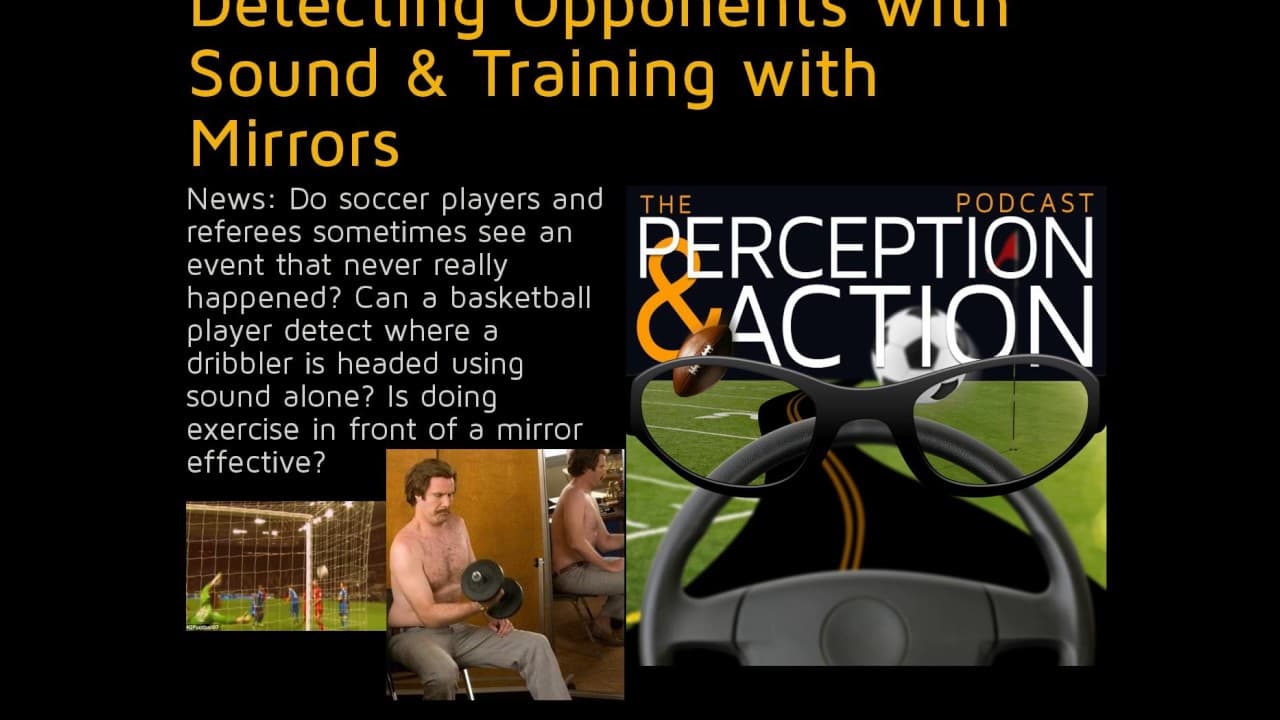
45 – Soccer Illusions, Detecting Opponents with Sound & Training with Mirrors
TL;DR
Exploring how perception affects sports performance and decision-making.
Transcript
today on the perception and Action News can soccer players and referees be tricked into seeing something that didn't actually happen how well can an athlete detect where an opponent is headed based on sound alone is training in front of a mirror effective does it involve an internal or external focus of attention so it's time for a call to action h... Read More
Key Insights
- Soccer players and referees can experience perceptual illusions, leading them to see events that never happened due to filling in gaps in their visual perception.
- The Phantom Goal incident highlights how people fill in visual gaps unconsciously, assuming logical outcomes based on incomplete information.
- Experience in sports does not significantly reduce susceptibility to perceptual illusions, as seen in players and referees who still misperceive events.
- Auditory cues play a crucial role in sports like basketball, where players can detect opponents' movements through sound, enhancing defensive strategies.
- Non-visual senses, such as hearing, contribute significantly to sports performance by providing additional information about player movements.
- Training in front of mirrors may not be the most effective method, as external focus on movement outcomes generally leads to better performance.
- The effectiveness of focus of attention in sports varies; external focus tends to enhance performance more than internal focus, particularly in skill mastery.
- Understanding the differences in perceptual focus can improve training methods, suggesting that more research is needed to optimize athletic performance.
Install to Summarize YouTube Videos and Get Transcripts
Explore YouTube Video Summarizer or Get YouTube Transcript Extractor
Questions & Answers
Q: How do soccer players and referees experience perceptual illusions?
Soccer players and referees experience perceptual illusions through a process known as 'filling in,' where they unconsciously fill visual gaps based on logical assumptions. This occurs when their vision is blocked or unable to follow fast movements, leading them to perceive events that never actually happened, such as in the Phantom Goal incident.
Q: Can auditory cues help basketball players in their defensive strategies?
Yes, auditory cues can significantly aid basketball players in their defensive strategies. Players can use sound to detect where an opponent is headed, allowing them to momentarily take their eyes off the opponent to assess the court. This enhances their ability to anticipate movements and react effectively, even to deceptive plays.
Q: Does experience in sports reduce susceptibility to perceptual illusions?
Experience in sports does not significantly reduce susceptibility to perceptual illusions. Research shows that even experienced players and referees are prone to misperceiving events due to the filling in process. This suggests that perceptual efficiency can sometimes lead to errors, regardless of experience level.
Q: Is training in front of a mirror effective for improving sports performance?
Training in front of a mirror may not be the most effective method for improving sports performance. Research indicates that adopting an external focus of attention, such as concentrating on the outcome of a movement, generally leads to better performance compared to focusing on one's body movements, which mirrors encourage.
Q: What is the difference between internal and external focus of attention in sports?
Internal focus of attention involves concentrating on one's own body movements, while external focus involves concentrating on the effects of those movements on the environment. Research shows that external focus generally enhances performance, particularly once basic skill mastery is achieved, as it allows athletes to execute movements more effectively.
Q: How can non-visual senses contribute to sports performance?
Non-visual senses, such as hearing, contribute to sports performance by providing additional information about the environment and other players' movements. For example, in basketball, auditory cues can help players detect opponents' movements, allowing them to anticipate plays and make more informed defensive decisions, enhancing overall performance.
Q: Why is understanding perceptual processes important in sports?
Understanding perceptual processes is crucial in sports because it helps optimize training methods and improve decision-making on the field. By recognizing how athletes perceive and react to their environment, coaches can develop strategies that enhance performance, reduce errors, and make better use of sensory information beyond visual cues.
Q: What further research is needed to improve athletic performance based on perception?
Further research is needed to explore the integration of non-visual senses in sports, optimize focus of attention strategies, and understand the mechanisms behind perceptual illusions. This research can lead to improved training methods, helping athletes make better use of sensory information and enhancing their ability to perform under various conditions.
Summary & Key Takeaways
-
The podcast explores how perception affects sports, focusing on how players and referees can misperceive events due to visual gaps, as seen in the Phantom Goal incident. It emphasizes the role of auditory cues in basketball, allowing players to detect movements through sound.
-
Research shows that experience in sports does not significantly reduce susceptibility to perceptual illusions, affecting decision-making on the field. Training methods, such as using mirrors, are analyzed for their effectiveness, with external focus proving more beneficial for performance.
-
The discussion highlights the importance of understanding perceptual processes in sports, suggesting that integrating non-visual senses and optimizing focus of attention can enhance athletic performance. More research is needed to explore these phenomena and improve training strategies.
Read in Other Languages (beta)
Share This Summary 📚
Summarize YouTube Videos and Get Video Transcripts with 1-Click
Try YouTube Summary with ChatGPT & Claude or YouTube Transcript Generator
Explore More Summaries from Rob Gray 📚
Summarize YouTube Videos and Get Video Transcripts with 1-Click
Try YouTube Summary with ChatGPT & Claude or YouTube Transcript Generator