What Is Deep Learning and Its Real-World Applications?

TL;DR
Deep learning utilizes neural networks to automatically extract features from raw data, revolutionizing fields from robotics to medicine. This lecture covers foundational concepts, optimization techniques like gradient descent, and the role of adaptive learning rates in effectively training neural networks.
Transcript
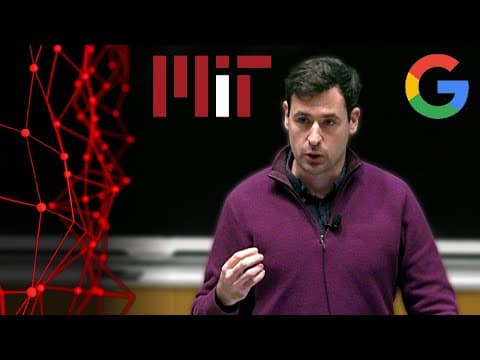
okay good afternoon everyone and thank you all for joining today i'm super excited to welcome you all to mit 6s191 introduction to deep learning my name is alexander amini and i'm going to be your instructor this year along with ava soleimani now 6s191 is a really fun and fast-paced class and for those of you who are not really familiar i'll start ... Read More
Key Insights
- 🎓 Deep learning is a fast-paced class that covers the foundations and practical applications of deep learning using TensorFlow. It is like a one-week boot camp in deep learning, providing hands-on experience and knowledge.
- 💡 Deep learning has the power to generate highly realistic data and simulate virtual worlds using computer vision and neural networks. This allows for applications like training autonomous vehicles in a simulated environment before deploying them in the real world.
- 🚗 MIT has created an open-source data-driven simulator for training autonomous vehicles using deep learning and reinforcement learning. Students in the class have the opportunity to participate in a competition to deploy their models on a full-scale self-driving car.
- 🎉 The class offers the opportunity for students to propose and develop their own deep learning projects. They can work individually or in groups and present their ideas for a chance to win prizes and awards.
- 📚 The course includes technical lectures and software labs, where students can learn and apply deep learning concepts. The lectures cover topics such as neural networks, activation functions, optimization algorithms, and regularization techniques.
- 🔑 One key aspect of training neural networks is selecting an appropriate learning rate. If the learning rate is too low, training can be slow. If it is too high, it may diverge and fail to converge to a good solution. Adaptive learning rates can help stabilize training.
- ⚖️ To prevent overfitting and improve generalization, techniques like dropout and early stopping can be employed. Dropout randomly sets a fraction of neuron activations to zero during training, forcing the network to learn more robust representations. Early stopping helps identify the point where training and testing accuracies diverge, allowing for the selection of the best model.
- 🌟 The class provides a comprehensive introduction to deep learning, covering the foundational concepts, practical applications, and techniques for training neural networks. The course offers hands-on experience through software labs and the opportunity for students to develop their own deep learning projects.
Install to Summarize YouTube Videos and Get Transcripts
Explore YouTube Video Summarizer or Get YouTube Transcript Extractor
Questions & Answers
Q: What is the difference between deep learning and traditional machine learning algorithms?
Deep learning is a subset of machine learning that focuses on neural networks and automatically extracting useful features from raw data, while traditional machine learning algorithms often require hand-engineered features.
Q: How does the process of forward propagation work in a neural network?
In forward propagation, inputs are multiplied by corresponding weights, and the results are summed and passed through an activation function to produce an output. This process is repeated for each neuron in the network, with outputs becoming inputs for subsequent layers.
Q: Explain the concept of backpropagation and its role in training a neural network.
Backpropagation is the process of computing the gradients of the loss function with respect to the weights in a neural network. It involves applying the chain rule to recursively compute gradients from the output layer to the input layer. These gradients are then used to update the weights during training.
Q: Why is regularization important in deep learning, and what techniques can be used for regularization?
Regularization helps prevent overfitting in deep learning models by discouraging complex models. Techniques like dropout randomly set a portion of neuron activations to zero during training, forcing the network to rely on different pathways. Early stopping is another regularization technique that stops training when the model starts to overfit the training data.
Q: How do adaptive learning rates improve the training process in neural networks?
Adaptive learning rates, like those used in some optimization algorithms, adjust the learning rate based on properties of the gradients during training. This allows the network to converge more efficiently and avoid getting stuck in local minima.
Q: What are the benefits of using mini-batches in training a neural network?
Mini-batches, which involve training the network on subsets of the data, provide a compromise between using the entire dataset (which is computationally expensive) and using a single example (which may result in noisy gradients). Mini-batches improve training stability and allow for more parallelizable computation.
Q: Can you explain the concept of early stopping and how it helps prevent overfitting in deep learning models?
Early stopping involves monitoring the performance of the model on a validation set during training. When the performance starts to degrade, signaling overfitting, training is stopped. This helps prevent the model from memorizing the training data and promotes generalization to new data.
Q: What are the advantages of using deep learning in simulating environments and generating realistic data?
Deep learning has the ability to generate high-quality and realistic data, such as videos and simulated environments. This has applications in various fields, including robotics and medicine. Deep learning models can be trained on simulated data and then transferred to the real world, enabling safe and efficient training of AI systems.
Summary & Key Takeaways
-
The lecture begins with an overview of deep learning and its applications, highlighting the power of deep learning to generate realistic data and simulate environments.
-
The building blocks of deep learning, such as neural networks and activation functions, are explained, along with the process of forward propagation and backpropagation.
-
The lecture also covers optimization techniques, including gradient descent and adaptive learning rates, as well as regularization techniques like dropout and early stopping.
Questions:
-
What is the difference between deep learning and traditional machine learning algorithms?
-
How does the process of forward propagation work in a neural network?
-
Explain the concept of backpropagation and its role in training a neural network.
-
Why is regularization important in deep learning, and what techniques can be used for regularization?
-
How do adaptive learning rates improve the training process in neural networks?
-
What are the benefits of using mini-batches in training a neural network?
-
Can you explain the concept of early stopping and how it helps prevent overfitting in deep learning models?
-
What are the advantages of using deep learning in simulating environments and generating realistic data?
Answers:
Q: What is the difference between deep learning and traditional machine learning algorithms?
Deep learning is a subset of machine learning that focuses on neural networks and automatically extracting useful features from raw data, while traditional machine learning algorithms often require hand-engineered features.
Read in Other Languages (beta)
Share This Summary 📚
Summarize YouTube Videos and Get Video Transcripts with 1-Click
Try YouTube Summary with ChatGPT & Claude or YouTube Transcript Generator
Explore More Summaries from Alexander Amini 📚





Summarize YouTube Videos and Get Video Transcripts with 1-Click
Try YouTube Summary with ChatGPT & Claude or YouTube Transcript Generator