Combining All Telescopes On Earth, Cooling Down Venus, Replacing ISS Modules | Q&A 211
TL;DR
This comprehensive analysis discusses various space-related questions such as the mass loss of Earth, stability of Dyson spheres, fixing Venus's atmosphere, the number of atoms in the universe, the future of telescopes, and the possibility of upgrading the International Space Station.
Transcript
how much mass could Earth lose and still remain in orbit can Dyson spheres be stable and what would it take to fix the atmosphere of Venus all this and more in this week's question show welcome to the question show your questions my answers now as always wherever you are across my channel the question Pops in your brain just write it down somewhere... Read More
Key Insights
- 💆 The mass of Earth does not affect its orbit, which is determined by the Sun's gravity.
- 🛰️ Dyson spheres are more stable as a swarm of satellites, rather than a rigid sphere.
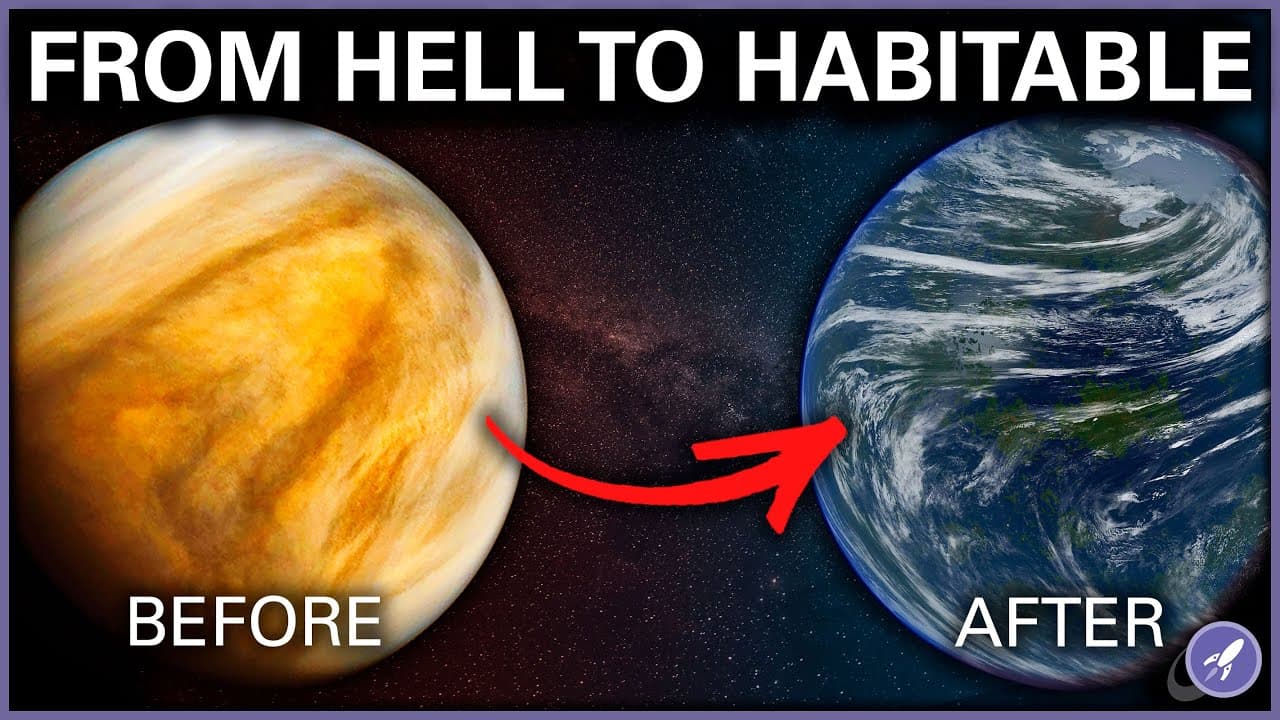
- 🍉 Terraforming Venus requires complex steps and long-term efforts.
- 🫀 The number of atoms in the observable universe is estimated to be between 10^78 and 10^82.
- 🔭 The future of telescopes involves advancements in technology, such as the Louvre telescope.
- 🌱 The International Space Station has no plans for ongoing module upgrades.
- ❓ Blueshift can exist in localized areas where gravity overcomes the expansion of the universe.
Install to Summarize YouTube Videos and Get Transcripts
Explore YouTube Video Summarizer or Get YouTube Transcript Extractor
Questions & Answers
Q: How much mass can Earth lose before losing its orbit?
The mass of Earth does not affect its orbit around the Sun, as it is determined by the gravity of the Sun. Stripping away Earth's mass wouldn't change its orbit.
Q: Can Dyson spheres be stable?
A rigid Dyson sphere would be unstable due to gravitational interactions. The concept of a Dyson swarm, composed of individual satellites, is more stable and feasible.
Q: How can we fix the atmosphere of Venus?
Terraforming Venus involves cooling the planet, sequestering carbon dioxide, replenishing water, and potentially creating an artificial magnetosphere. It would require a massive effort.
Q: How many atoms are there in the universe?
The observable universe contains between 10^78 and 10^82 atoms. The actual number could be higher, considering the possibility of more universe beyond our observability limits.
Q: What is the future of telescopes?
The future of telescopes includes projects such as the Louvre telescope, which aims to study the universe in infrared, visible, and ultraviolet wavelengths. Upgrades and advancements are ongoing.
Q: Why not upgrade modules on the ISS periodically?
Upgrading modules on the International Space Station (ISS) periodically would be costly and logistically challenging. NASA plans to deorbit the ISS in the future, focusing on other projects like the lunar Gateway.
Q: How can blueshift exist if everything is moving away?
Blueshift occurs when something is moving towards us, while redshift indicates movement away. In localized areas, gravity can overcome the expansion of the universe, causing certain galaxies to blueshift.
Summary & Key Takeaways
-
Mass loss of Earth: The mass of Earth does not affect its orbit around the Sun, as the orbit is determined by the gravity of the Sun, not the mass of Earth.
-
Stability of Dyson spheres: The concept of a rigid Dyson sphere orbiting a star is inherently unstable, but the idea of a Dyson swarm, consisting of individual satellites, is more feasible and avoids gravitational instability.
-
Fixing Venus's atmosphere: Terraforming Venus involves cooling the planet, sequestering carbon dioxide, replenishing water, and potentially creating an artificial magnetosphere. It would be a complex and long-term project.
-
Number of atoms in the universe: The observable universe contains between 10^78 and 10^82 atoms. The actual number is likely higher, as there could be more universe beyond our observability limits.
Read in Other Languages (beta)
Share This Summary 📚
Summarize YouTube Videos and Get Video Transcripts with 1-Click
Try YouTube Summary with ChatGPT & Claude or YouTube Transcript Generator
Explore More Summaries from Fraser Cain / Universe Today Podcast 📚
Summarize YouTube Videos and Get Video Transcripts with 1-Click
Try YouTube Summary with ChatGPT & Claude or YouTube Transcript Generator