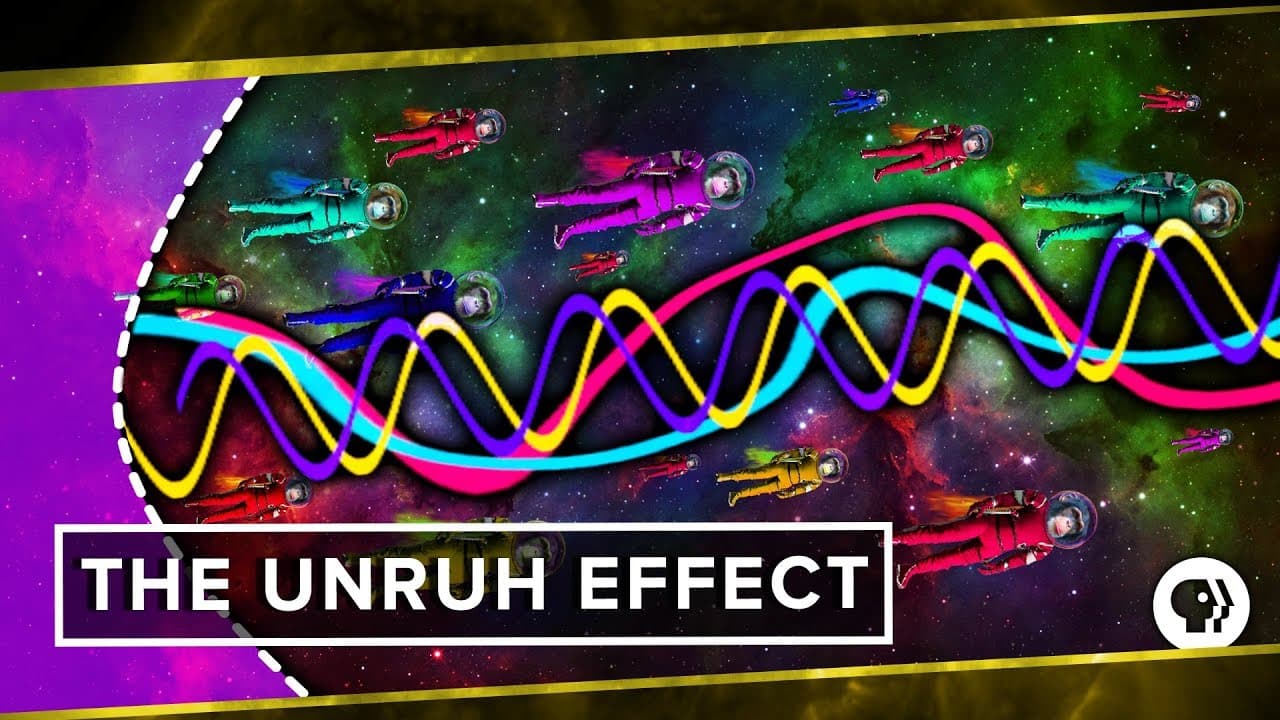
The Unruh Effect
TL;DR
Acceleration creates a horizon and radiation similar to black holes.
Transcript
[GENTLE MUSIC] Are you worried about black holes? Consider this. Every time you accelerate, put your foot on the gas, quicken your step, get out of your chair, you generate an event horizon behind you. The more you accelerate away from it, the closer it gets. Don't worry. It can never catch up to you, but the Unruh radiation it generates sure can. ... Read More
Key Insights
- The Unruh effect suggests that acceleration creates an event horizon, similar to black holes, generating radiation.
- Stephen Fulling, Paul Davies, and William Unruh independently discovered that acceleration affects quantum fields, leading to the Unruh effect.
- Acceleration creates a Rindler horizon, cutting off causal access to parts of the universe, similar to a black hole's event horizon.
- Rindler observers perceive a warm bath of particles due to acceleration, experiencing Unruh radiation with a thermal spectrum.
- The Unruh effect is observer-dependent; accelerating observers see radiation, while inertial observers see empty space.
- Unruh radiation is difficult to observe directly, requiring extremely high acceleration to increase temperature by one degree Kelvin.
- The equivalence principle suggests that gravity and acceleration are similar, implying everyone experiences tiny amounts of Unruh radiation.
- Close to a black hole's event horizon, gravitational acceleration can create significant Unruh radiation, linking it to Hawking radiation.
Install to Summarize YouTube Videos and Get Transcripts
Explore YouTube Video Summarizer or Get YouTube Transcript Extractor
Questions & Answers
Q: What is the Unruh effect?
The Unruh effect is a theoretical prediction that an accelerating observer will perceive a warm bath of particles, known as Unruh radiation, due to their acceleration. This phenomenon is similar to the Hawking radiation predicted to be emitted by black holes, where the acceleration effectively creates an event horizon.
Q: How does acceleration create a horizon?
Acceleration creates a horizon by cutting off causal access to a region of the universe for the observer. This is similar to the event horizon of a black hole, where certain areas become inaccessible. The horizon created by acceleration is known as a Rindler horizon, and it leads to the perception of Unruh radiation.
Q: What is a Rindler horizon?
A Rindler horizon is an event horizon that appears for an observer undergoing constant acceleration. It is named after the coordinate system used to describe such observers in special relativity. The Rindler horizon moves at a fixed distance behind the accelerating observer, cutting off parts of the universe from their causal influence.
Q: How does the Unruh effect relate to Hawking radiation?
Both the Unruh effect and Hawking radiation involve the creation of particles due to horizons. While Hawking radiation is emitted by black holes due to their event horizon, the Unruh effect occurs for accelerating observers due to a Rindler horizon. Both phenomena result in a thermal spectrum of particles, although they differ in their observer-dependence.
Q: Why is the Unruh effect difficult to observe?
The Unruh effect is challenging to observe because it requires extremely high acceleration to produce noticeable radiation. Specifically, an acceleration of 10^20 meters per second squared is needed to increase the temperature via a single degree Kelvin, making it impractical to observe directly with current technology.
Q: What is the observer-dependence of the Unruh effect?
The observer-dependence of the Unruh effect means that only accelerating observers perceive Unruh radiation, while inertial observers see an empty vacuum. This discrepancy arises because the existence of particles, according to the Unruh effect, depends on the observer's frame of reference, highlighting the relative nature of particle detection.
Q: How does the equivalence principle relate to the Unruh effect?
Einstein's equivalence principle suggests that remaining stationary in a gravitational field is equivalent to being in acceleration in free space. This implies that even stationary observers in a gravitational field, like on Earth, experience a tiny amount of Unruh radiation, linking gravity and acceleration in their effects on quantum fields.
Q: What happens near a black hole's event horizon regarding the Unruh effect?
Near a black hole's event horizon, the gravitational acceleration can be so intense that it creates significant Unruh radiation. This suggests a relationship between the Unruh particles seen by someone hovering near the event horizon and the Hawking radiation perceived by a distant observer, although the exact nature of this relationship is still an open question.
Summary & Key Takeaways
-
The Unruh effect demonstrates that acceleration can create a type of event horizon, leading to the generation of radiation similar to Hawking radiation from black holes. This effect is named after researchers who studied how acceleration affects quantum fields.
-
An accelerating observer experiences a Rindler horizon, which cuts off causal access to parts of the universe. This horizon leads to a thermal bath of particles, known as Unruh radiation, which is seen only by the accelerating observer.
-
The Unruh effect illustrates the observer-dependence of particle existence, as inertial observers do not perceive the same radiation. The effect is challenging to observe directly due to the immense acceleration required to produce noticeable radiation.
Read in Other Languages (beta)
Share This Summary 📚
Summarize YouTube Videos and Get Video Transcripts with 1-Click
Try YouTube Summary with ChatGPT & Claude or YouTube Transcript Generator
Explore More Summaries from PBS Space Time 📚
Summarize YouTube Videos and Get Video Transcripts with 1-Click
Try YouTube Summary with ChatGPT & Claude or YouTube Transcript Generator