Quasar Dust, Grabby Aliens and Who Needs von Neumann probes | Q&A 181
TL;DR
Fraser Cain answers viewer questions about topics including quasars, the audio-video coverage of NASA's SpaceX Moon landing, the largest comet spotted, Von Neumann probes, the practicality of ball spin habitats on low gravity worlds, the first results expected from the Webb Telescope, the existence of the Oort Cloud, and the aspirations of Musk and Bezos regarding space exploration.
Transcript
Fraser Cain: Hi, everyone. I'm Fraser Cain. I'm the publisher of Universe Today. And I've been in a space and astronomy journalist for like over 20 years, 23 years at the time of this recording, and this is my live question and answer show where you can ask your questions either just anywhere across my YouTube chat or other places. But also you can... Read More
Key Insights
- 📤 Quasars are formed by supermassive black holes actively feeding on surrounding material, emitting X-ray radiation.
- ☄️ UN271, the largest comet spotted, will not come close enough to Earth to be visible without powerful telescopes.
- 🌌 Von Neumann probes are sent out to explore the Milky Way and gather knowledge about its star systems.
- 🌍 Simulating Earth-like gravity on low gravity worlds like the Moon may require exoskeleton suits for external body parts, while artificial gravity solutions are needed for internal fluid redistribution.
- 🔭 The Webb Telescope's first image release is expected to compare a well-known nebula captured by Webb with images from earlier telescopes.
- ☄️ The existence of the Oort Cloud is inferred based on observations of long-period comets.
- 🥺 The success of SpaceX's Starship could lead to a shift in telescope launches to take advantage of its cost-efficiency.
Install to Summarize YouTube Videos and Get Transcripts
Explore YouTube Video Summarizer or Get YouTube Transcript Extractor
Questions & Answers
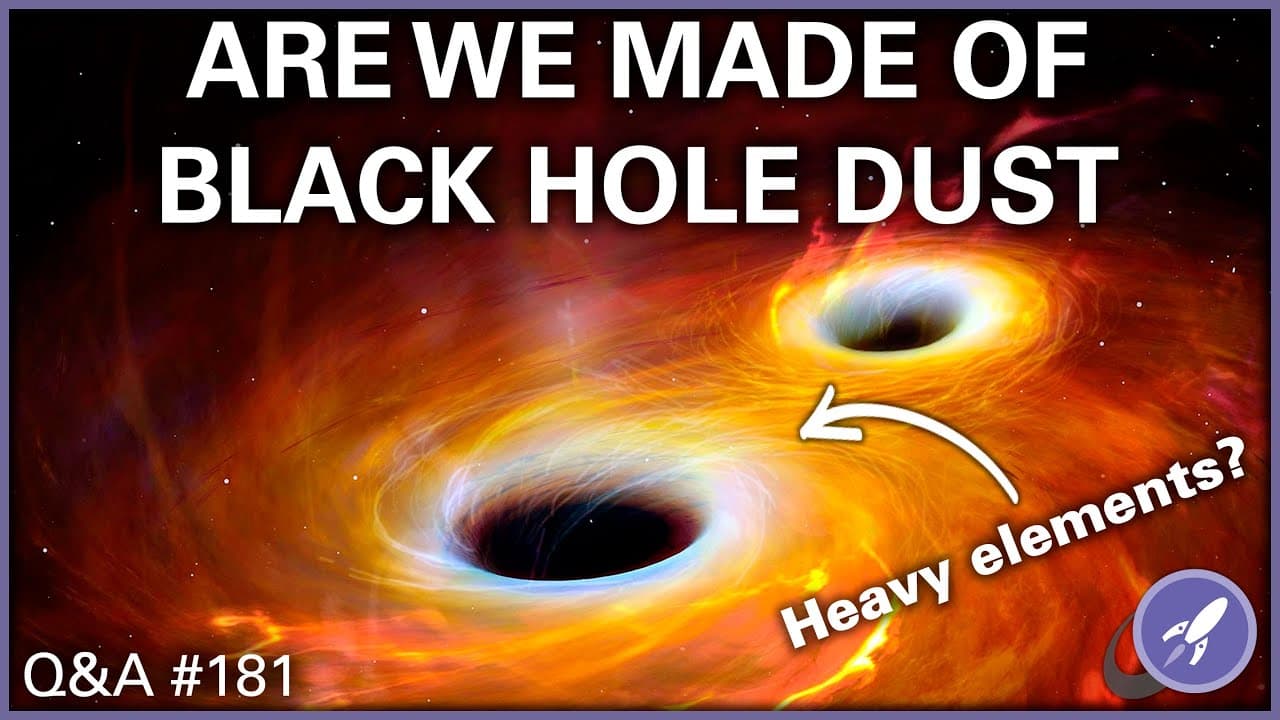
Q: Are any elements being formed in quasars?
Yes, elements are being formed in quasars, with hydrogen turning into helium. While heavier elements like iron may not be formed, there is evidence of the formation of heavier elements that can be ejected into space.
Q: What will the audio-video coverage be like for NASA's SpaceX Moon landing?
While high-resolution images and videos can be expected, the bandwidth limitations between the Moon and Earth may lead to certain constraints. However, efforts will be made to provide the public with visuals of the landing and subsequent activities.
Q: How close will the largest comet, UN271, come to Earth?
The closest point of UN271's orbit will be around the orbit of Saturn, making it unlikely to be visible to the naked eye. However, high-resolution images taken by telescopes like Hubble will provide more detailed observations.
Q: Why would a society send Von Neumann probes everywhere?
The purpose of Von Neumann probes is to gather knowledge about the Milky Way and its star systems, which can be shared with humanity. The quest for knowledge and understanding is reason enough to send out these self-replicating probes.
Q: Could a heavy exoskeleton spacesuit simulate Earth-like gravity on the Moon?
Wearing a weighted exoskeleton suit on the Moon could help simulate Earth-like gravity for the body's external parts. However, it does not address internal fluid redistribution issues, necessitating the need for artificial gravity solutions.
Q: What can be expected as the first result of the Webb Telescope?
The first image released from the Webb Telescope is likely to be a comparison of a well-known nebula captured by Webb and a similar image taken by an earlier telescope. This comparison will showcase the improved capabilities of Webb.
Q: How do we know the Oort Cloud exists?
The existence of the Oort Cloud is inferred based on the observation of long-period comets with calculated orbits originating from a region that fits the predicted location of the Oort Cloud.
Q: Which telescopes are critical to launch into space in the next decade?
With the potential success of SpaceX's Starship, many planned telescopes could be shifted to its launch platform. The telescopes that fit Starship's larger fairing and take advantage of its cost-efficiency are most likely to be prioritized.
Summary & Key Takeaways
-
Fraser Cain, an expert in space and astronomy journalism, answers viewer questions in a live Q&A show.
-
Topics covered include quasars, the formation of elements in quasars, the audio-video coverage of future Moon landings by NASA's SpaceX, the size and visibility of the largest comet spotted, Von Neumann probes and their purpose of exploring the Milky Way, the potential use of exoskeleton suits to simulate Earth-like gravity on the Moon, the critical telescopes to be launched into space in the coming years, the existence of the Oort Cloud, and the motivations behind Musk and Bezos' space ventures.
Read in Other Languages (beta)
Share This Summary 📚
Summarize YouTube Videos and Get Video Transcripts with 1-Click
Try YouTube Summary with ChatGPT & Claude or YouTube Transcript Generator
Explore More Summaries from Fraser Cain 📚
Summarize YouTube Videos and Get Video Transcripts with 1-Click
Try YouTube Summary with ChatGPT & Claude or YouTube Transcript Generator