Fusion Reactor To Melt Through Europa's Ice [NIAC 2023]
TL;DR
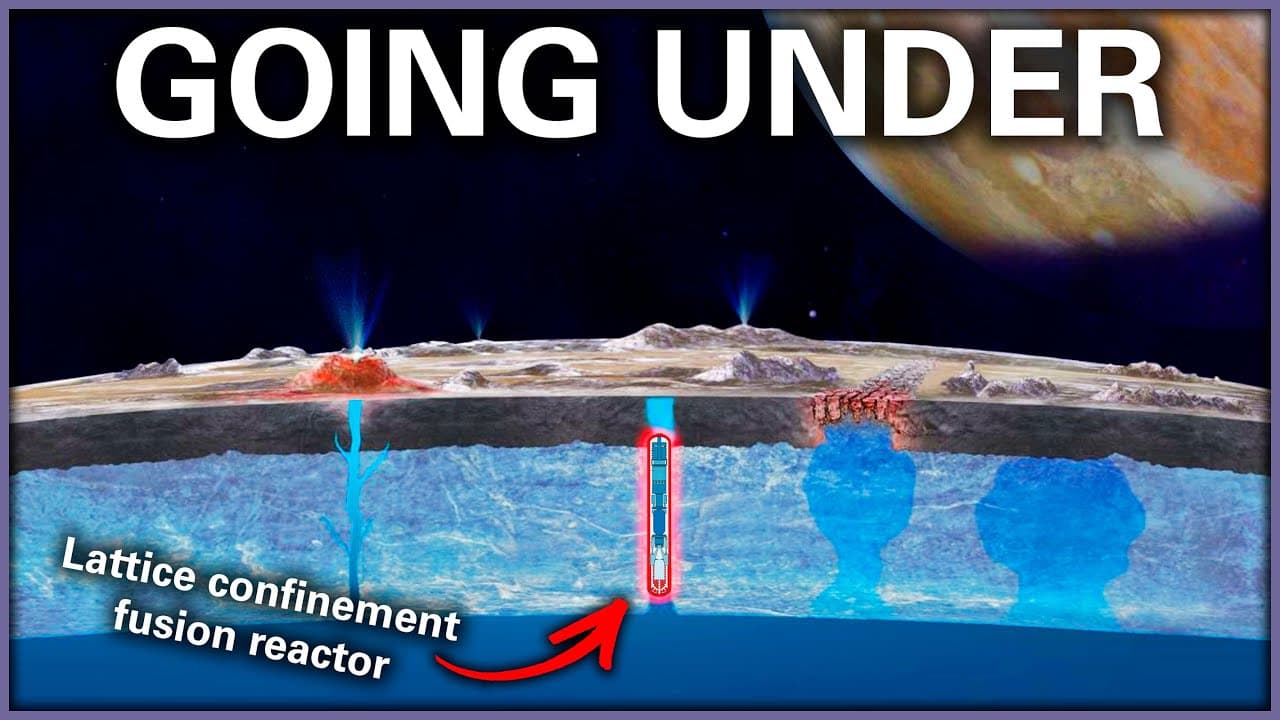
NASA is considering the use of lattice confinement fusion as a power source for future space missions, including melting through ice on moons like Europa and Enceladus. This innovative reactor design combines elements of nuclear fusion and fission to provide ample power for various applications in space.
Transcript
as I mentioned many times before when you're traveling in space your top three priorities are power power and power and when you're far away from the earth say out at Jupiter the amount of solar energy that you can collect is about 1 25th what you can when you're at Earth and so it makes sense to switch to some kind of nuclear version and we've see... Read More
Key Insights
- 👾 Lattice confinement fusion offers a promising solution for providing power in space, especially in scenarios where solar energy is limited.
- 🫠 The reactor's compact size and potential for high power generation make it well-suited for various space applications, including melting through ice on celestial bodies.
- 😒 The use of non-enriched uranium and thorium in lattice confinement fusion eliminates safety concerns associated with traditional fission reactors.
- 👾 Lattice confinement fusion could potentially revolutionize space exploration by providing a reliable and efficient power source for long-duration missions.
- 🧑🌾 The technology has the potential for scalability, with larger reactors enabling even more powerful and far-reaching missions.
- 🥮 Lattice confinement fusion reactors have the advantage of utilizing available resources, such as uranium on the moon or Mars, reducing the need for extensive fuel supplies.
- 🥺 The development of lattice confinement fusion reactors could lead to advancements in both lunar and interstellar space exploration.
Install to Summarize YouTube Videos and Get Transcripts
Explore YouTube Video Summarizer or Get YouTube Transcript Extractor
Questions & Answers
Q: How does lattice confinement fusion differ from traditional nuclear reactors?
Lattice confinement fusion involves trapping deuterium gas in a metal lattice, utilizing the electron screening effect to enable fusion reactions between deuterons. This method does not rely on traditional fusion techniques using magnets or lasers, making it more compact and efficient.
Q: What are the advantages of using lattice confinement fusion for melting through ice on moons like Europa or Enceladus?
Lattice confinement fusion reactors offer a high power density, which is crucial for melting through kilometers of ice. The reactor can provide a continuous source of heat, enabling the slow melting process needed to reach the liquid water beneath the icy crust.
Q: How does lattice confinement fusion compare to other power sources, such as nuclear batteries or fission reactors?
Nuclear batteries, like those used on spacecraft such as Voyager, provide limited electricity. Fission reactors, while more powerful, have safety concerns and require enriched uranium. Lattice confinement fusion combines the best of fusion and fission, providing a safe and efficient power source for space missions.
Q: Besides melting ice on celestial bodies, what other applications does lattice confinement fusion have in space exploration?
Lattice confinement fusion has potential applications in powering lunar bases, providing propulsion systems for deep space missions, and contributing to clean energy initiatives on Earth. Its compact size and efficient power generation make it suitable for various space exploration purposes.
Summary & Key Takeaways
-
NASA is exploring the use of lattice confinement fusion as a power source for space missions, replacing traditional nuclear batteries and fission reactors.
-
Lattice confinement fusion offers advantages over other nuclear reactors in terms of power generation and safety.
-
The primary application of this technology is melting through ice on celestial bodies like Europa and Enceladus to access liquid water beneath the surface.
-
The reactor's compact size and potential for high power generation make it suitable for other space exploration purposes, including lunar bases and propulsion systems.
Read in Other Languages (beta)
Share This Summary 📚
Summarize YouTube Videos and Get Video Transcripts with 1-Click
Try YouTube Summary with ChatGPT & Claude or YouTube Transcript Generator
Explore More Summaries from Fraser Cain / Universe Today Podcast 📚


Summarize YouTube Videos and Get Video Transcripts with 1-Click
Try YouTube Summary with ChatGPT & Claude or YouTube Transcript Generator