Correspondence principle: amplitude as a function of position
TL;DR
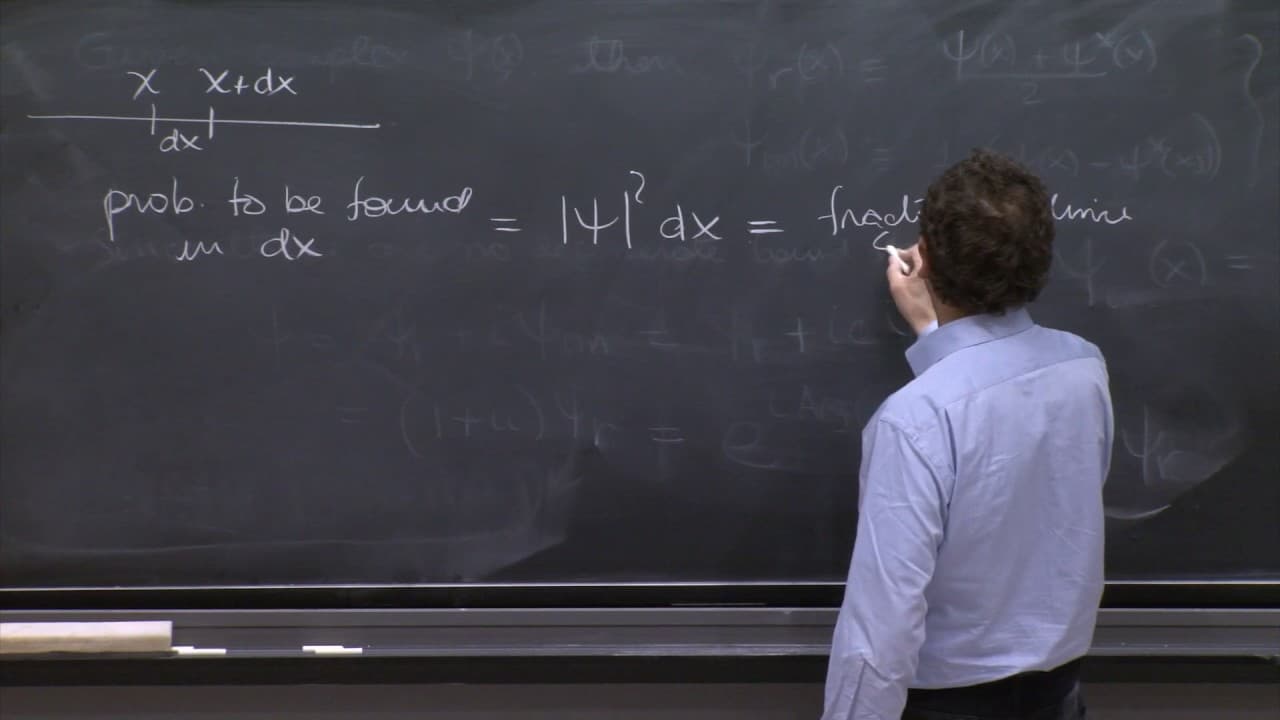
The correspondence principle states that the wave function should be larger in regions where a particle spends more time, and smaller in regions where it spends less time.
Transcript
PROFESSOR: There's one more property of this thing that is important, and it's something called the correspondence principle, which is another classical intuition. And it says that the wave function, and it addresses the question of what happens to the amplitude of the wave function. It says that the wave function should be larger in the regions wh... Read More
Key Insights
- 👋 The correspondence principle helps determine the amplitude of the wave function based on the time spent by the particle in different regions.
- ⌛ The probability of finding a particle in a specific region is related to the fraction of time it spends there.
- 🙃 The magnitude of the wave function is proportional to the square root of the position's de Broglie wavelength.
- 👋 The node theorem states that the number of nodes in a wave function increases with the energy level.
Install to Summarize YouTube Videos and Get Transcripts
Explore YouTube Video Summarizer or Get YouTube Transcript Extractor
Questions & Answers
Q: What is the correspondence principle in quantum physics?
The correspondence principle states that the amplitude of the wave function should be larger in regions where a particle spends more time.
Q: How is the probability of finding a particle in a specific region determined?
The probability is proportional to the fraction of time the particle spends in that region, as stated by the correspondence principle.
Q: What is the relationship between the magnitude of the wave function and the position's de Broglie wavelength?
The magnitude of the wave function is proportional to the square root of the position's de Broglie wavelength, indicating that as the wavelength becomes larger, the particle spends more time in that region.
Q: What is the significance of the node theorem in wave function analysis?
The node theorem states that the number of nodes in a wave function increases with the energy level. For example, the ground state has no nodes, while the first excited state has one node, and so on.
Summary & Key Takeaways
-
The correspondence principle states that the amplitude of the wave function should be larger in regions where a particle spends more time.
-
The probability of finding a particle in a specific region is proportional to the fraction of time spent there.
-
The magnitude of the wave function is proportional to the square root of the position's de Broglie wavelength.
Read in Other Languages (beta)
Share This Summary 📚
Summarize YouTube Videos and Get Video Transcripts with 1-Click
Try YouTube Summary with ChatGPT & Claude or YouTube Transcript Generator
Explore More Summaries from MIT OpenCourseWare 📚
Summarize YouTube Videos and Get Video Transcripts with 1-Click
Try YouTube Summary with ChatGPT & Claude or YouTube Transcript Generator