How to Solve First Order Linear Differential Equations
TL;DR
The formula for solving first order linear differential equations includes a null solution and a particular solution that reflects continuous deposits and growth. This method utilizes integration to account for ongoing changes over time, making it adaptable for various functions such as constants, exponentials, and oscillations.
Transcript
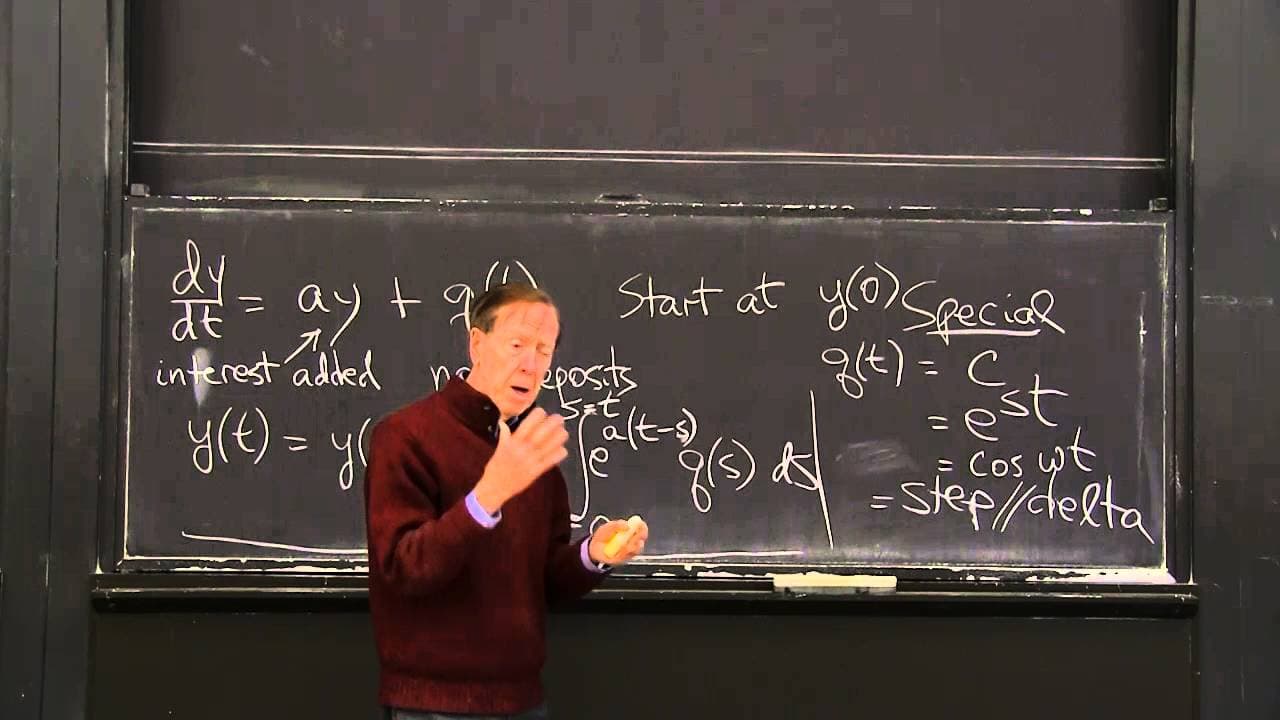
PROFESSOR: OK. Finally, I'm going to solve this first order linear differential equation with a formula that works for any source term. So we've solved it for specific, nice, special source terms I'll remember later. But now we want a formula for the solution to that equation, period. And we want to understand the formula. So now, write the formula... Read More
Key Insights
- 🪈 The formula for solving first order linear differential equations involves a null solution and a particular solution that accounts for continuous deposits and their growth.
- 🪜 Continuous deposits are represented using an integration variable and are added up using integration.
- ❓ The formula can be used to solve specific functions such as constants, exponentials, and oscillations, as well as step functions and delta functions.
- 🧑🏭 Checking the correctness of the formula can be done by verifying that it satisfies the differential equation and by using an integrating factor.
Install to Summarize YouTube Videos and Get Transcripts
Explore YouTube Video Summarizer or Get YouTube Transcript Extractor
Questions & Answers
Q: What is the null solution in the formula for solving first order linear differential equations?
The null solution represents the initial conditions and describes the growth of the balance based on interest rates. It does not take into account any deposits.
Q: How are continuous deposits represented in the formula?
Continuous deposits are represented using an integration variable, with each deposit made at a different time and growing exponentially over the remaining time. The growth factor is given by e to the power of the difference between the current time and the deposit time.
Q: How are continuous deposits incorporated into the formula?
Continuous deposits are added up using integration, which represents continuous time addition. The integral of each deposit's growth factor with respect to the integration variable gives the total contribution of the deposits to the solution.
Q: Can the formula be used for functions other than constants, exponentials, and oscillations?
Yes, the formula can be used for step functions and delta functions as well. Step functions represent deposits that start at a specific time and remain constant, while delta functions represent instantaneous impulses that occur at a particular moment.
Summary & Key Takeaways
-
The formula for solving first order linear differential equations consists of two parts: the null solution that accounts for initial conditions and the particular solution that incorporates continuous deposits and their growth.
-
Continuous deposits are represented using an integration variable and are added up using integration.
-
The formula can be used to solve specific functions such as constants, exponentials, and oscillations, and it can also be used for step functions and delta functions.
Read in Other Languages (beta)
Share This Summary 📚
Summarize YouTube Videos and Get Video Transcripts with 1-Click
Try YouTube Summary with ChatGPT & Claude or YouTube Transcript Generator
Explore More Summaries from MIT OpenCourseWare 📚


Summarize YouTube Videos and Get Video Transcripts with 1-Click
Try YouTube Summary with ChatGPT & Claude or YouTube Transcript Generator