What Is Direct Perception and Why Is It Important?
TL;DR
Direct perception, according to James Gibson, focuses on action-relevant information rather than reconstructing the physical world. This well-posed problem aligns perception with the environment and an organism's goals, emphasizing the significance of affordances — the relationship between environmental properties and an organism's capabilities. This approach shifts away from abstract representations to a more ecological understanding of perception.
Transcript
hi everyone this is rob gray from asu in the perception action podcast back with another article review and today i want to look at the issue of direct perception and the work of james gibson and this is something you know i've covered a lot on the podcast you know i don't think it's something we can cover too much because as i've tried to emphasiz... Read More
Key Insights
- Direct perception, as proposed by James Gibson, focuses on picking up action-relevant information rather than reconstructing the physical properties of the world.
- Traditional views see perception as an ill-posed problem, requiring prior knowledge to interpret ambiguous stimuli, which Gibson challenges.
- Gibson’s ecological approach suggests that perception is well-posed, emphasizing the role of the environment in providing necessary information for action.
- Bill Warren’s paper highlights the importance of ecological psychology and how perception is directly tied to an organism’s environment and goals.
- Affordances, a key concept in Gibson’s theory, refer to the relationship between environmental properties and an organism’s capabilities.
- Information in the environment is specific and relevant to the constraints of the organism’s niche, not general-purpose or abstract.
- Gibson’s approach moves away from the idea of internal models and representations, suggesting perception is grounded in natural laws.
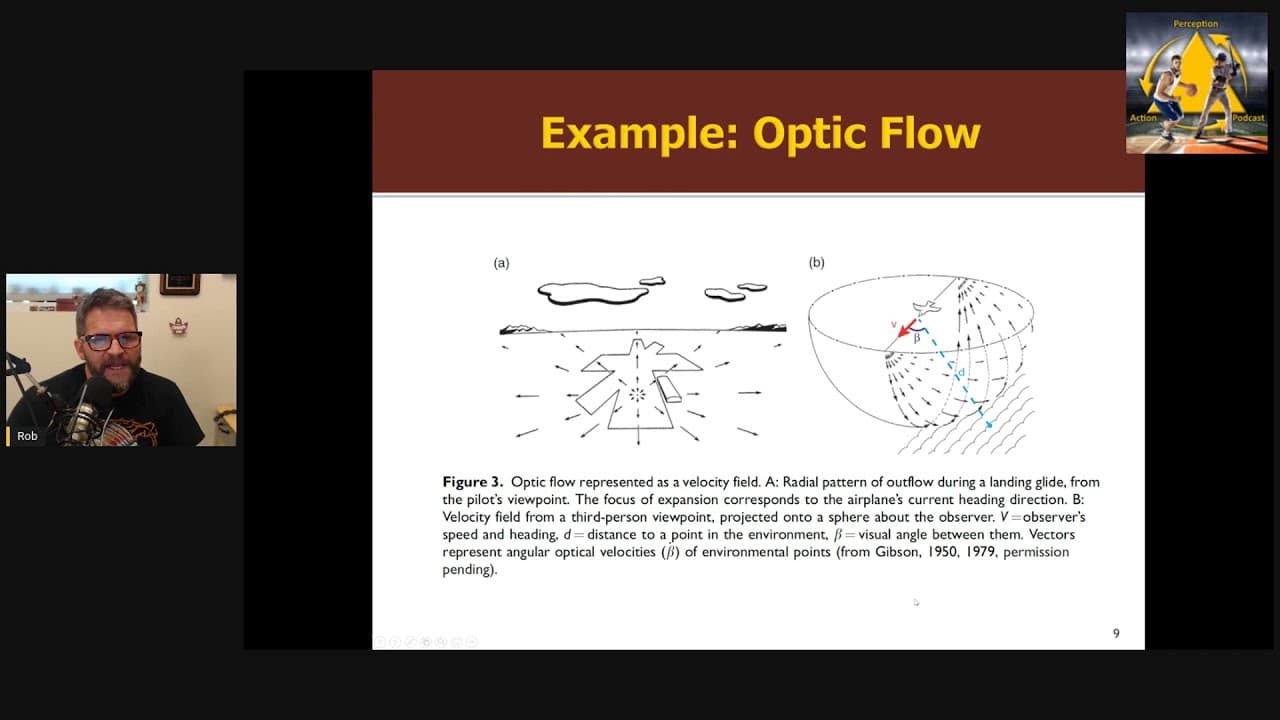
- Warren provides examples, like optic flow and affordances, to illustrate how perception is directly linked to an organism’s ability to interact with its environment.
Install to Summarize YouTube Videos and Get Transcripts
Explore YouTube Video Summarizer or Get YouTube Transcript Extractor
Questions & Answers
Q: What is the main focus of Gibson's theory of direct perception?
Gibson's theory of direct perception focuses on the idea that perception is about picking up action-relevant information from the environment rather than reconstructing the physical properties of the world. This approach emphasizes the ecological relationship between an organism and its environment, suggesting that perception is a well-posed problem directly tied to the organism's goals and capabilities.
Q: How does Gibson's view differ from traditional views of perception?
Traditional views see perception as an ill-posed problem, requiring prior knowledge and internal models to interpret ambiguous stimuli. In contrast, Gibson's view suggests that perception is well-posed and directly tied to the environment. He argues that perception is about picking up information relevant to action, not reconstructing the world, thus eliminating the need for internal representations.
Q: What are affordances in Gibson's theory?
Affordances in Gibson's theory refer to the relationship between environmental properties and an organism’s capabilities. They are higher-order information that specifies how an organism can interact with its environment, based on its own abilities. Affordances are not just about perceiving environmental properties but understanding them in the context of the organism's action capabilities, making perception directly relevant to the organism's goals.
Q: What role does the environment play in Gibson's ecological approach to perception?
In Gibson's ecological approach, the environment plays a crucial role by providing the necessary information for perception. This information is specific to the constraints of the organism’s niche and is directly relevant to its action capabilities. The environment offers patterns and variables that organisms can use to interact effectively, making perception a well-posed problem grounded in natural laws rather than abstract representations.
Q: How does Bill Warren illustrate Gibson's ideas in his paper?
Bill Warren illustrates Gibson's ideas by discussing concepts like optic flow and affordances. He provides examples of how organisms use environmental information to guide actions without reconstructing the world. For instance, optic flow helps birds navigate by providing higher-order information about speed and direction, while affordances show how organisms perceive environmental properties in relation to their own capabilities.
Q: What is the significance of optic flow in Gibson's theory?
Optic flow is significant in Gibson's theory as it exemplifies how organisms use environmental information for navigation and action. It refers to the pattern of movement of objects across the visual field as an organism moves, providing higher-order information about speed and direction. This allows organisms to control actions, like landing a plane, without needing to reconstruct the physical layout of the world, emphasizing direct perception.
Q: Why does Gibson's approach move away from internal models and representations?
Gibson's approach moves away from internal models and representations because it views perception as a well-posed problem directly tied to the environment. By focusing on action-relevant information, Gibson argues that perception does not require reconstructing the world internally. Instead, perception is about interacting with the environment through natural laws, making internal models unnecessary and emphasizing a more parsimonious understanding of perception.
Q: How does Warren's paper contribute to understanding ecological psychology?
Warren's paper contributes to understanding ecological psychology by providing a clear explanation of Gibson's ideas on direct perception and affordances. He emphasizes the role of the environment in providing action-relevant information and illustrates how perception is directly linked to an organism’s goals and capabilities. Warren's examples and explanations help clarify the ecological approach, moving away from traditional views and grounding perception in real-world contexts.
Summary & Key Takeaways
-
James Gibson's theory of direct perception challenges traditional views by focusing on action-relevant information rather than reconstructing the world. This ecological approach suggests perception is a well-posed problem, directly tied to an organism’s environment and goals.
-
Bill Warren's paper emphasizes the role of affordances in Gibson's theory, highlighting the relationship between environmental properties and an organism’s capabilities. Perception is not about creating internal models but about interacting with the environment through natural laws.
-
Warren illustrates Gibson’s ideas with examples like optic flow, showing how perception is specific to an organism’s niche. This ecological perspective moves away from abstract representations, grounding perception in the real-world context and action capabilities.
Read in Other Languages (beta)
Share This Summary 📚
Summarize YouTube Videos and Get Video Transcripts with 1-Click
Try YouTube Summary with ChatGPT & Claude or YouTube Transcript Generator
Explore More Summaries from Rob Gray 📚
Summarize YouTube Videos and Get Video Transcripts with 1-Click
Try YouTube Summary with ChatGPT & Claude or YouTube Transcript Generator