Calculating Power in Physics: Example Problems
TL;DR
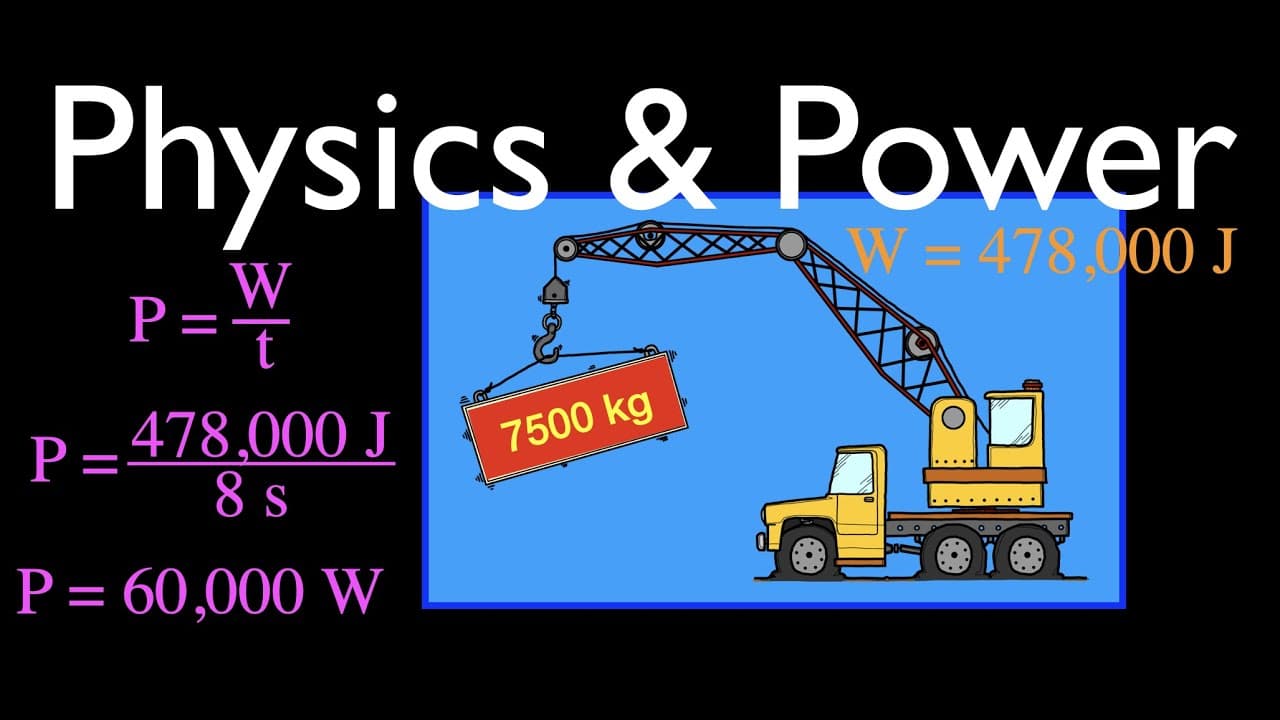
This video provides a brief introduction to power in physics and demonstrates five example problems that involve calculating power, work, time, and force.
Transcript
in today's video we're going to go over a brief introduction to what power is in physics and then most importantly we're going to go over five different example problems where we'll be calculating power work time and fortune all that stuff you need and before we get started please don't forget to subscribe to my channel step by step science get all... Read More
Key Insights
- 💦 Power in physics refers to the rate at which work is done and is calculated by dividing work by time.
- 💦 Power is measured in watts, with one watt representing one joule of work done in one second.
- ✊ Power ratings indicate the maximum power output of devices and systems.
- 💦 Calculating power requires knowledge of work and time, which can be determined from known quantities such as force and distance.
- ✊ Power can vary among devices based on efficiency and design, with higher power ratings indicating the ability to accomplish more work in less time.
- ✊ Understanding power is essential for analyzing the efficiency and capabilities of various systems.
- 💦 Power calculations involve multiple steps, including determining force, work, and time.
Install to Summarize YouTube Videos and Get Transcripts
Explore YouTube Video Summarizer or Get YouTube Transcript Extractor
Questions & Answers
Q: What is power in physics?
Power in physics refers to the rate at which work is done. It represents how fast work is done and is measured in watts.
Q: How is power calculated?
Power is calculated by dividing the work done by the time it takes to do the work. The equation for power is P = W / t, where P is power, W is work, and t is time.
Q: What are the units for power?
The unit for power is the watt, which is equal to one joule of work done in one second. Power is measured in watts (W).
Q: How is power related to power rating?
Power rating represents the maximum power output of a device or system. It indicates how much work can be done in a given amount of time.
Q: Can power be calculated if work and time are known?
Yes, power can be calculated by dividing the work done by the time it takes to do the work. Knowing both values allows for the determination of power.
Q: How does power differ for different devices?
Power output varies among devices based on their efficiency and design. Devices with higher power ratings can accomplish more work in a shorter amount of time.
Q: Why is power important in physics?
Power is an essential concept in physics as it provides insights into the rate at which work is done and the efficiency of various systems and devices.
Q: How is power related to force and distance?
Power involves both force and distance. The force exerted to perform work, multiplied by the distance over which the force is exerted, gives the amount of work done. Power is then determined by dividing this work by time.
Summary & Key Takeaways
-
The video introduces the concept of power in physics and provides three definitions for it.
-
It explains that power is a measure of how fast work is done and is calculated by dividing work by time.
-
The video then presents five example problems involving power, including calculating power ratings for light bulbs, joggers, cranes, and individuals running up stairs.
Read in Other Languages (beta)
Share This Summary 📚
Summarize YouTube Videos and Get Video Transcripts with 1-Click
Try YouTube Summary with ChatGPT & Claude or YouTube Transcript Generator
Explore More Summaries from Step by Step Science 📚
Summarize YouTube Videos and Get Video Transcripts with 1-Click
Try YouTube Summary with ChatGPT & Claude or YouTube Transcript Generator