How to Calculate the Original Price After a Discount
TL;DR
To calculate the original price after a discount, use the formula: original price = new price / (1 - r), where r is the discount rate in decimal form. For example, if a laptop costs $320 after a 20% discount, the original price is $400. This method applies to any item discounted by a percentage.
Transcript
in this video we're going to talk about how to calculate the original price of an item after a discount is received now this discount is typically given in the form of a percentage so let's work on this problem john paid three hundred and twenty dollars for a laptop after receiving a twenty percent discount what was the original price of the item a... Read More
Key Insights
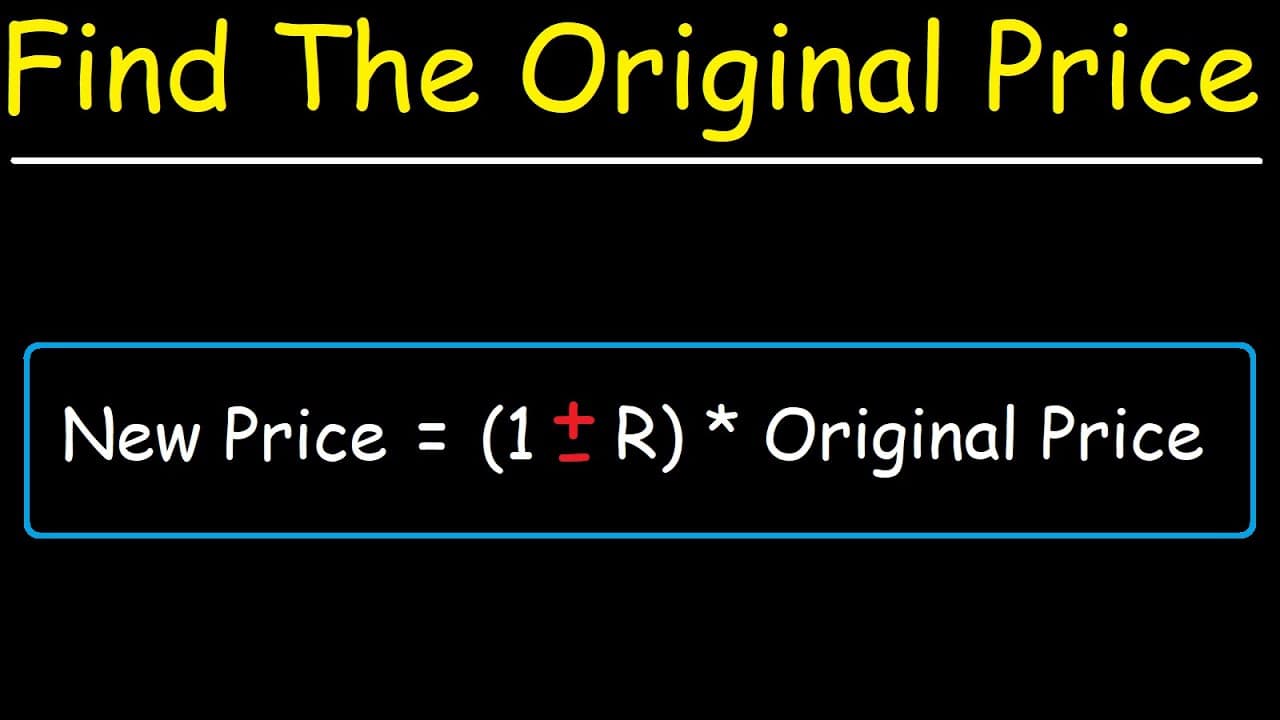
- ☠️ The formula to calculate the original price after a discount is new price = (1 - r) * original price, where r is the discount rate.
- 🤘 A negative sign is used for discounts, while a positive sign is used for an increase in price.
- 🗨️ To convert a percentage into a decimal, divide it by 100 or move the decimal two units to the left.
- ✅ Checking the answer can be done by calculating the discount value and subtracting it from the original price.
- 🈹 The formula can be used to solve various discount-related problems.
- 👶 The original price can be calculated by dividing the new price by (1 - r).
- 🈹 In the provided examples, the original price of a laptop was $400 after a 20% discount, and the original price of a car was $15,000 after a 17% discount.
Install to Summarize YouTube Videos and Get Transcripts
Explore YouTube Video Summarizer or Get YouTube Transcript Extractor
Questions & Answers
Q: What is the formula to calculate the original price after a discount?
The formula is new price = (1 - discount rate) * original price. The discount rate should be converted into a decimal before using it in the formula.
Q: When do we use a positive or negative sign in the formula?
A negative sign is used when dealing with a discount, as it reduces the price. A positive sign would be used for an increase in price, such as sales tax.
Q: How do we convert a percentage into a decimal?
To convert a percentage into a decimal, divide the percentage by 100 (e.g., 20% becomes 0.20) or move the decimal two units to the left (e.g., 20% becomes 0.20).
Q: How can we check our answer when calculating the original price after a discount?
You can check the answer by calculating the discount value (e.g., 20% of the original price) and subtracting it from the original price, which should give you the new price after the discount.
Summary & Key Takeaways
-
The video explains how to calculate the original price of an item after receiving a discount using a formula.
-
The formula is: new price = (1 - r) * original price, where r is the discount rate as a decimal.
-
The video provides two examples to demonstrate the calculation process.
Read in Other Languages (beta)
Share This Summary 📚
Summarize YouTube Videos and Get Video Transcripts with 1-Click
Try YouTube Summary with ChatGPT & Claude or YouTube Transcript Generator
Explore More Summaries from The Organic Chemistry Tutor 📚


Summarize YouTube Videos and Get Video Transcripts with 1-Click
Try YouTube Summary with ChatGPT & Claude or YouTube Transcript Generator